
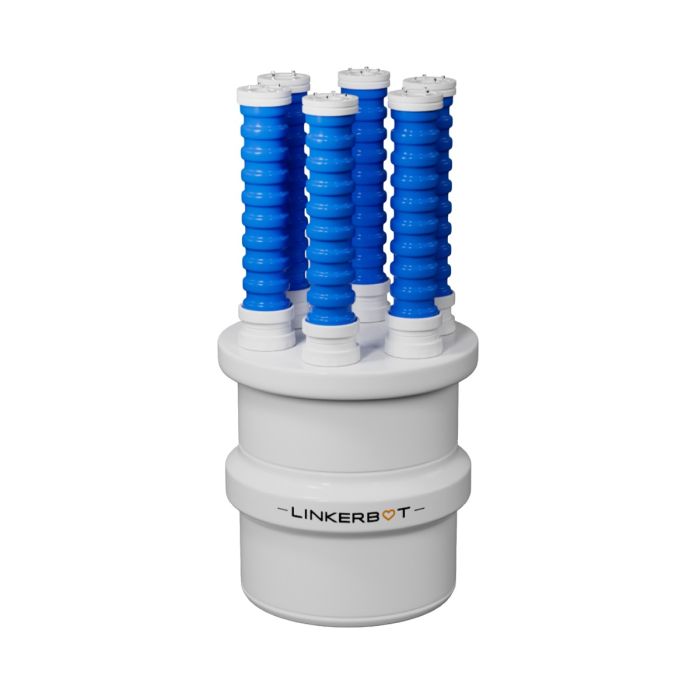
Linkerbot Linker Hand J42 Industrial Grade 6 Finger Claw
In stock
- BRAND:
- LINKERBOT
- PART #:
- Linker Hand J42
- ORIGIN:
- China
- AVAILABILITY:
- SUBJECT TO AVAILABILITY
- SKU:
- Linkerbot-Linker-Hand-J42
Linkerbot Linker Hand J42 Industrial Grade 6 Finger Claw
Most robot grippers come with a single number for their joints. The Linkerbot Linker Hand J42 Industrial Grade 6 Finger Claw comes with a range instead: between 18 and 42 degrees of freedom, with between 9 and 42 active joints, in a six-finger layout driven by ropes rather than by motors packed into every knuckle. That range is the most useful starting point for anyone assessing the hand. It tells you that the J42 is less a fixed product than a platform whose complexity is chosen to suit the work, and that the work in question is the kind where two jaws closing on a part are simply not enough.
Robots Europa, based in Dublin, supplies the Linker Hand J42 to universities, research institutes and industrial development teams across the European Union and the DACH region. Robots Europa prepares each quotation against the configuration you require, coordinates delivery to your site and remains your point of contact for technical questions once the hand is in use.
Background
Linkerbot Technology and the Linker Hand series
The J42 is developed by Linkerbot Technology Co., Ltd., a Chinese manufacturer whose Linker Hand series consists of multi-finger robot hands with a high number of degrees of freedom and high precision, aimed at education, research and industry. Across the series, Linkerbot offers CAN, RS485 and USB communication and support for ROS, the Robot Operating System that much of the academic and industrial robotics community relies upon for middleware, simulation and tooling. Within this family, the J42 stands apart through its six-finger construction and its upper limit of 42 degrees of freedom. Robots Europa also carries other members of the series, which can be browsed in the Robot Hands category.
Positioning: an industrial model built for complex control
The J42 is an industrial multi-finger model, and at the same time it is ideally suited to research and experiments that call for complex multi-finger control. These two roles are not in conflict. Dexterous manipulation is still an area where much of the progress happens in laboratories before it reaches the production line, and a hand that is built to industrial expectations while exposing a very large number of controllable joints serves both stages. The rope drive is central to this approach: routing force through cables allows actuators to sit away from the fingers themselves, which is the conventional route to fitting a large number of joints into a compact, hand-like form.
Technical Specifications
| Specification | Value |
|---|---|
| Model | Linker Hand J42 |
| Manufacturer | Linkerbot Technology Co., Ltd. (China) |
| Positioning | Industrial multi-finger model, six-finger configuration |
| Degrees of freedom | 18–42 |
| Joint configuration | Active 9–42 |
| Drive method | Rope (cable) drive |
| Communication interface | USB |
| Operating voltage | DC24V ±10% |
| Repeat positioning accuracy | ±0.20mm |
| Grip force (four fingers) | 5N |
| Grip force resolution | 0.7N |
Specifications as published by the manufacturer; confirmed against the datasheet at quotation. The manufacturer has not published the weight, the dimensions, the maximum payload, the fingertip force per finger, any tactile sensing, the power consumption and current draw, the finger joint ranges and speeds, the contents of the box, the IP rating, the operating temperature or the mounting interface; all of these are confirmed with you at quotation.
What does a range of 18 to 42 degrees of freedom mean in practice?
A degree of freedom is one independent way in which the hand can move. A human hand is often modelled with a little over twenty, which places the J42 in an unusual position: at the lower end of its range it is comparable to a well-equipped anthropomorphic hand, while at the upper end it offers considerably more independent motion than a hand of five fingers would need. The sixth finger adds a further contact point, which opens up grasps and in-hand manoeuvres that are awkward or impossible with a conventional layout.
The figure for active joints, 9 to 42, matters as much as the headline number. Active joints are those driven directly, whereas the remaining motion is coupled or passive. A configuration with fewer active joints is simpler to control and to calibrate; a configuration towards the top of the range gives a controller far more to work with, and far more to learn. For a research group, that choice shapes everything from the control architecture to the size of the dataset required to train a policy. It is therefore worth settling the configuration with Robots Europa at the outset rather than afterwards.
The remaining figures describe a hand tuned for controlled, repeatable contact rather than raw strength. Repeat positioning accuracy of ±0.20mm supports experiments in which the same pose must be reproduced many times, and a grip force resolution of 0.7N allows force to be stepped in fine increments. The grip force with four fingers is 5N, which positions the J42 for delicate manipulation and for studying grasping behaviour rather than for heavy handling.
How does a rope-driven multi-finger hand differ from a conventional gripper?
A parallel-jaw or vacuum gripper is designed around a known part: it closes, holds and releases, and it does so very reliably when the object and its orientation are predictable. A rope-driven multi-finger hand such as the J42 addresses the opposite situation, in which objects vary in shape, need to be turned within the hand, or must be held with a posture rather than a single pinch. Cable transmission keeps the fingers slim and allows many joints to be driven from actuators housed elsewhere, at the cost of a more involved control problem, since cable tension and routing become part of the system model.
Connection to the host is over USB on the J42, which keeps laboratory set-up straightforward. Across the wider Linker Hand series, Linkerbot also supports CAN and RS485 together with ROS, while the J42 itself is specified with USB; Robots Europa can advise on how the series' tooling fits your set-up. The DC24V ±10% supply is a common industrial voltage, which simplifies integration into cells that already provide a 24V rail.
Who is the Linker Hand J42 for?
The clearest match is the research laboratory working on dexterous manipulation: groups studying grasp synthesis, in-hand reorientation, tactile and visual servoing, or learning-based control, for whom a large and configurable number of joints is the point rather than a complication. University robotics departments that teach advanced manipulation will find in the J42 a platform that exposes students to the full difficulty of multi-finger control.
A second segment is the industrial research and development team exploring whether dexterous hands can take on tasks that currently require human workers, such as handling irregular components or performing assembly steps that involve regrasping. Here the J42 serves as an evaluation and prototyping platform within a wider Industrial Robots programme, before any decision on deployment.
Buyers who do not need six fingers or the upper end of the degree-of-freedom range may prefer to compare other members of the series, such as the Linkerbot Linker Hand L10 Standard Version, the Linkerbot Linker Hand L20 Pro Version or the Linkerbot Linker Hand L30 Cable Driven Version. Robots Europa can set out the differences against your task.
What is the Linker Hand J42 used for?
- Dexterous manipulation research: studying how many independently controlled joints cooperate to grasp and handle objects.
- In-hand reorientation experiments: turning and repositioning objects within the hand without setting them down.
- Learning-based control: collecting demonstration and interaction data to train manipulation policies.
- Grasp planning validation: testing planning algorithms on real hardware after simulation.
- Teaching advanced robotics: giving students hands-on experience of multi-finger kinematics and control.
- Industrial prototyping: evaluating dexterous handling of irregular parts before committing to a production cell.
Pricing and Availability
The Linker Hand J42 is supplied on quotation, because the configuration of degrees of freedom and active joints, together with the interface and integration requirements, determines what is delivered. Delivery, customs and support are arranged with the quotation, so that you receive a single, complete proposal from Robots Europa. To begin, tell us about your intended application and set-up using the quotation request available on this page.
Frequently Asked Questions
How many fingers does the Linker Hand J42 have?
The J42 has a six-finger configuration. The additional finger gives more contact points than a five-fingered hand for complex grasps.
How many degrees of freedom does the J42 offer?
The J42 offers between 18 and 42 degrees of freedom, with between 9 and 42 active joints. The configuration is chosen to suit your application.
How is the J42 driven?
The J42 uses a rope (cable) drive. This allows a large number of joints to be actuated within a compact finger design.
How does the J42 connect to a computer or controller?
The J42 uses USB as its communication interface. The wider Linker Hand series also supports CAN, RS485 and ROS.
What power supply does the J42 require?
The J42 operates at DC24V ±10%, a common industrial supply voltage.
Is the J42 suitable for heavy handling?
The grip force with four fingers is 5N, and the J42 is designed for complex multi-finger control rather than heavy lifting.
Where can I buy the Linkerbot Linker Hand J42 and what does it cost?
Robots Europa supplies the J42 across the EU and the DACH region. The price depends on the configuration and integration requirements and is provided in a written quotation.
Summary
The J42 is defined by a range rather than a single figure: 18 to 42 degrees of freedom, 9 to 42 active joints, six fingers and a rope drive that makes such a count possible in a hand-like form. Combined with repeat positioning accuracy of ±0.20mm and a grip force resolution of 0.7N, that range makes it a platform for controlled, precise and highly articulated manipulation, built to industrial expectations yet most at home where complex multi-finger control is being researched and refined. Choosing the right point within that range is the first decision, and Robots Europa will work through it with you; for a configuration matched to your work, this page is the starting point.


