
Paxini DexH13 Dexterous Robot Hand (DexH13)
In stock
- BRAND:
- PAXINI
- MODEL:
- DEXH13
- PART #:
- DexH13
- ORIGIN:
- China
- AVAILABILITY:
- SUBJECT TO AVAILABILITY
- SKU:
- Paxini-DexH13
Paxini DexH13 Dexterous Robot Hand (DexH13)
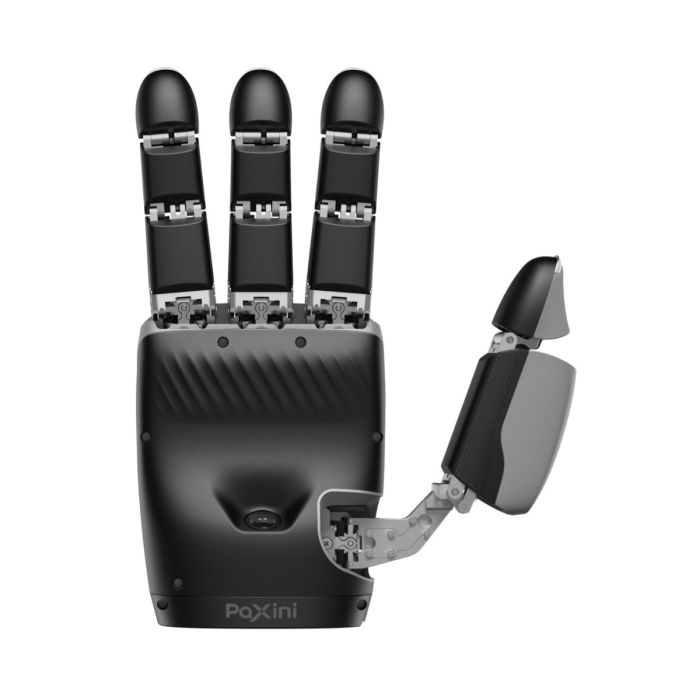
Most robot grippers are effectively blind at the moment that matters most. As the fingers close, the object is hidden from the overhead camera, and the controller must judge the contact from motor feedback alone. The Paxini DexH13 Dexterous Robot Hand (DexH13) is designed to close that gap. It combines 1140 ITPU tactile sensing units with an 8MP RGB HD eye-in-hand camera in a single four-finger hand, so that touch takes over where sight leaves off and the robot can feel what it is holding as well as see it.
Robots Europa, based in Dublin, supplies the DexH13 to universities, research institutes, system integrators and industrial users throughout the European Union and the DACH region. Robots Europa prepares your quotation, arranges delivery to your site and remains your point of contact for technical and commercial questions once the hand is in use. Should you be comparing it with other PAXINI equipment for a larger programme, the same team can advise on the wider range.
Background
PAXINI and the DexH line
PAXINI has built its range around tactile perception. The Paxini catalogue includes dexterous hands alongside wheeled humanoid platforms. Within the DexH line, the DexH13 is the second generation (Gen2), succeeding the first-generation Paxini Dexh5 (DexH5). The two names therefore mark a lineage rather than two variants offered side by side. The DexH13 represents the manufacturer's current thinking on how a sensing-rich hand should be built and controlled.
Generational change matters in this class of equipment. Dexterous hands are rarely bought as finished products to be switched on and left alone. They are integrated into research rigs, humanoid platforms and automation cells, where software, data pipelines and grasp strategies grow up around a particular hand. Choosing the current generation gives a project the longest runway for that work.
Dual-modal sensing: touch plus vision
The DexH13 is the world's first dual-modal robotic end-effector to integrate multi-dimensional tactile sensing with AI vision. Its tactile side consists of 1140 ITPU multi-dimensional tactile sensing units in a single hand, providing up to 15 dimensions of human-like perception. Its visual side is an 8MP RGB HD camera carried on the hand itself, in the eye-in-hand arrangement, so the viewpoint travels with the fingers instead of staying fixed above the workspace.
These two channels are complementary. Vision is strongest before contact, when it locates an object, estimates its pose and plans an approach. Touch is strongest during contact, when it registers pressure, slip and the way a surface yields. A hand that offers both lets a control system hand over from one to the other. Combined with the flexible, compliant motion control and high-precision force control that the DexH13 pairs with its sensing, this is what allows the hand to perform delicate actions in a controlled manner.
Technical Specifications
| Specification | Value |
|---|---|
| Generation | Second generation (Gen2) |
| Product type | Dual-modal robotic end-effector integrating multi-dimensional tactile sensing and AI vision |
| Tactile sensing units | 1140 ITPU multi-dimensional tactile sensing units in a single hand |
| Dimensions of perception | Up to 15 |
| Finger configuration | Four-finger bionic structure |
| Degrees of freedom | 16-DOF (13 active + 3 passive) |
| Thumb | Four independent active DOF |
| Camera | 8MP RGB HD eye-in-hand camera |
| Control | Flexible and compliant motion control; high-precision force control |
| Achievable actions | Grasping, gripping, pinching, pressing, opening/closing fingers |
Specifications are as published by the manufacturer and will be confirmed against the datasheet at quotation.
The manufacturer has not published the weight, the dimensions, the power supply voltage, the IP rating, the mounting interface, the operating temperature, the SDK and software support or the contents of the box; Robots Europa will confirm each of these with your quotation.
Why does a robot hand need both touch and vision?
A camera can tell a robot where an object is, but it struggles to tell the robot how firmly that object is being held. Once the fingers wrap around a component, a cable or a package, much of the scene is hidden from view. At that point the useful information lies in the contact itself: where the pressure sits, whether it is shifting and how the surface responds. With 1140 tactile sensing units spread across the hand and up to 15 dimensions of perception, the DexH13 is designed to capture exactly that information.
The eye-in-hand camera addresses the opposite problem. A fixed camera sees the workspace from a single angle. A camera on the hand can look closely at the object as the hand approaches, which helps with alignment before the first contact. Taken together, the two modalities allow a controller to plan with vision and execute with touch. This combination underpins the hand's ability to move between grasping, gripping, pinching, pressing and opening or closing its fingers without treating every object as a rigid block.
The mechanical design supports the same aim. The DexH13 uses a four-finger, 16-DOF bionic structure, with 13 active and 3 passive degrees of freedom. The thumb has four independent active degrees of freedom. A thumb with that range is central to opposition, the movement that lets a hand pinch small parts or press against a held object. The passive joints add compliance where rigid actuation would offer little benefit.
How does the DexH13 relate to the first-generation DexH5?
The DexH5 is the first generation of the line and the DexH13 is the second. Buyers starting a new project will generally look to the current generation. Laboratories that already run a DexH5 may wish to compare the two before extending a set-up or replacing hardware. Robots Europa is happy to set out the differences for your application as part of the quotation, drawing on the manufacturer's datasheets for both hands. Figures for one generation should never be read across to the other.
Who is the Paxini DexH13 Dexterous Robot Hand (DexH13) for?
The first audience is education and research. University groups and institutes working on embodied intelligence, tactile perception or dexterous manipulation need a hand that produces rich contact data and can execute fine motions. The DexH13's density of tactile sensing, combined with its on-hand camera, makes it a strong platform for studying how touch and vision can be fused in a manipulation policy.
The second audience is industrial manufacturing. Here the interest lies in tasks that parallel grippers handle poorly: parts with irregular shapes, components that must be pressed into place, or items that need a pinch rather than a clamp. Integrators building cells for such tasks can use the DexH13 to explore whether force-controlled, touch-aware handling can replace custom tooling.
Logistics and warehousing form the third group. Picking mixed goods means handling objects that vary in shape, stiffness and surface, often in cluttered bins where a camera's view is partly obstructed. A hand that feels contact as well as seeing it suits this kind of variability.
The fourth group is medical and healthcare. Developers of assistive and service robotics in these settings need careful, compliant handling, which is precisely what the hand's compliant motion control and high-precision force control are intended to deliver.
Teams that have built their work around the first generation, or that wish to compare generations before committing, can review the Paxini Dexh5 (DexH5) alongside the DexH13. Those planning a complete platform rather than an end-effector alone can browse the wider Paxini range.
What is the Paxini DexH13 Dexterous Robot Hand (DexH13) used for?
- Industrial assembly: pressing, inserting and positioning components where contact feedback improves placement.
- Logistics picking: grasping mixed items of varying shape and firmness in warehousing workflows.
- Medical and healthcare robotics: developing assistive and service systems that require gentle, force-controlled handling.
- Embodied intelligence research: studying how tactile and visual data can be combined to drive manipulation policies.
- Tactile data collection: recording rich contact data during grasping, gripping and pinching to train and evaluate learning models.
- Teaching and demonstration: giving students hands-on experience of dexterous manipulation and multi-modal sensing.
Pricing and Availability
Robots Europa supplies the DexH13 on quotation. Pricing depends on the configuration, the quantity and the integration support your project requires. When you request a quotation, please tell us about your application, the robot or platform the hand will be mounted on, and any interface or software requirements. This allows us to confirm the points the manufacturer has not yet published. Delivery, customs and support are all arranged as part of the quotation. To start the process, use the quotation request available on this page.
Frequently Asked Questions
How many tactile sensing units does the DexH13 have?
The DexH13 integrates 1140 ITPU multi-dimensional tactile sensing units in a single hand, providing up to 15 dimensions of human-like perception.
How many degrees of freedom does the hand offer?
It has a four-finger, 16-DOF bionic structure, made up of 13 active and 3 passive degrees of freedom. The thumb alone has four independent active degrees of freedom.
What camera is built into the hand?
The hand carries an 8MP RGB HD eye-in-hand camera, so its viewpoint moves with the fingers.
Which actions can the DexH13 perform?
Thanks to its compliant motion control and high-precision force control, it can grasp, grip, pinch and press, and it can open and close its fingers.
Is the DexH13 a newer generation than the DexH5?
Yes. The DexH13 is the second generation (Gen2) and the DexH5 is the first generation of the line.
What are the weight, interface and software support of the hand?
The manufacturer has not published the weight, mounting interface, power supply voltage or SDK and software support. Robots Europa will confirm these details with your quotation.
Where can I buy the Paxini DexH13 Dexterous Robot Hand (DexH13) and what does it cost?
You can buy it from Robots Europa, which supplies customers across the EU and the DACH region from Dublin. The price is provided on quotation, tailored to your configuration and project.
Summary
The problem the DexH13 addresses is easy to state: a robot loses sight of an object at the very moment it takes hold of it. PAXINI's second-generation hand responds by giving the robot two senses rather than one. Its 1140 ITPU tactile sensing units read the contact, while an 8MP RGB HD eye-in-hand camera guides the approach. A four-finger, 16-DOF structure with a highly articulated thumb supplies the dexterity to act on what those senses report. For research groups, manufacturers, logistics operators and healthcare developers who need a hand that feels as well as sees, and who want Robots Europa to handle the quotation, delivery and support, this page is the starting point.


