
Paxini Dexh5 (DexH5)
In stock
- BRAND:
- PAXINI
- PART #:
- DexH5
- ORIGIN:
- China
- AVAILABILITY:
- SUBJECT TO AVAILABILITY
- SKU:
- Paxini-DexH5
Paxini Dexh5 (DexH5)
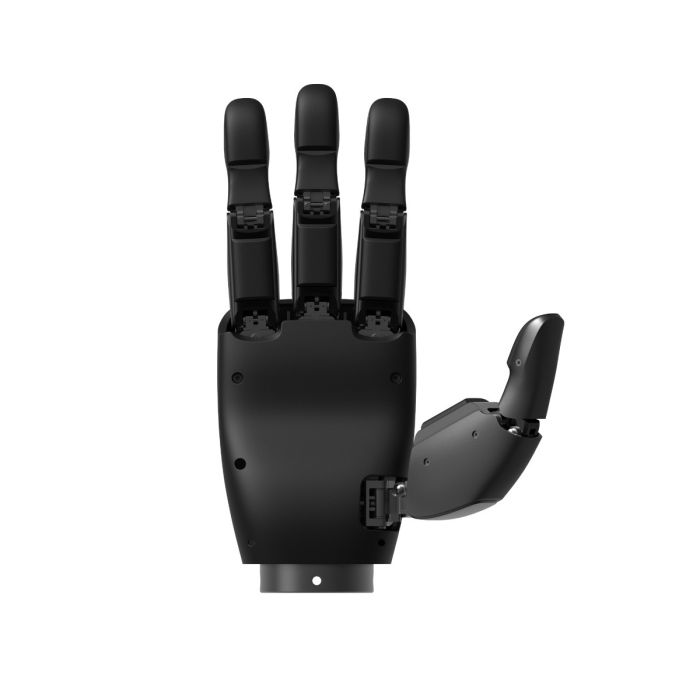
A camera can tell a robot where a cup stands; it cannot tell it whether that cup is beginning to slip. That gap between seeing and feeling is where many manipulation projects stall, and it is precisely the gap the Paxini Dexh5 (DexH5) is designed to close. Rather than adding a sensor to a gripper as an afterthought, PAXINI has made touch the organising principle of this hand. It carries 528 ITPU multidimensional tactile sensing units across a four-finger, coreless-motor-driven design that grips, pinches and presses, and it reports what it encounters to the controller over EtherCAT or Modbus.
Robots Europa, based in Dublin, supplies the Paxini Dexh5 (DexH5) to research institutions, system integrators and industrial users across the European Union and the DACH region. Robots Europa prepares each quotation for the specific configuration, including the choice between the left-hand and right-hand versions, and coordinates delivery, documentation and after-sales support from a single point of contact.
Background
PAXINI and its focus on touch
PAXINI has built its name around multidimensional tactile sensing, and its range extends from dexterous robot hands to complete humanoid platforms. The common thread is the conviction that robots working among people and everyday objects need a sense of contact, not merely a sense of position. The DexH5 sits within that range as a compact, practical hand, and the full PAXINI line-up offered by Robots Europa can be explored in the Paxini category.
Tactile sensing as the core technology
Most end-effectors in industry are built to a simple logic: open, close, and rely on the surrounding cell to make the outcome predictable. A tactile hand reverses that logic. Because the DexH5 distributes its ITPU sensing units across the hand, the control system can register where contact occurs and how it develops, which is the information needed to adjust a grasp while it is happening rather than after it has failed. For embodied AI work, the same signals become training data: a learning system that receives touch alongside vision has a far richer picture of an interaction than one that sees alone.
Technical Specifications
| Specification | Value |
|---|---|
| Versions | DexH5 (Left); DexH5 (Right) |
| Number of fingers | 4 |
| Active degrees of freedom | 5 |
| Total degrees of freedom | 9 |
| Tactile perception | 528 ITPU multidimensional tactile sensing units |
| Payload | 4 kg |
| Maximum grip diameter | 10 cm |
| Minimum opening and closing time | 1 s |
| Driving method | Coreless Motor |
| Achievable movements | Grip, pinch, press and other basic hand movements |
| Communication protocol | EtherCAT / Modbus |
Specifications are as published by the manufacturer and are confirmed against the datasheet at quotation.
The manufacturer has not published the weight, the dimensions, the operating voltage, the power consumption, the fingertip force, the software or SDK support, the contents of the box, the IP rating or the mounting interface details; Robots Europa confirms these at quotation.
What do the active and total degrees of freedom mean on the DexH5?
The DexH5 lists 5 active degrees of freedom and 9 total degrees of freedom. Active degrees of freedom are the joints driven directly by the hand's coreless motors; the total figure counts every joint that can move. The difference between the two indicates joints that follow the driven ones rather than having an actuator of their own, an approach widely used in robot hands to keep the mechanism compact and the control problem manageable while still letting the fingers wrap around an object.
For the buyer, this matters in two ways. First, fewer actuators generally mean fewer axes to command, which simplifies integration into an existing arm and controller. Second, coupled joints allow the fingers to conform to the shape of what they hold, which suits the grip, pinch and press movements the hand is built for. The DexH5 is therefore best understood as a hand engineered for dependable, tactile-informed everyday grasping rather than for the fullest possible imitation of human finger anatomy.
What makes the DexH5 different from a conventional parallel gripper?
A parallel gripper has one task and does it well: two jaws close on an object that has been presented in a known position and orientation. As soon as objects vary in shape, arrive in uncertain positions or must be handled gently, that simplicity becomes a limitation. The DexH5 answers with three things a standard gripper does not offer together.
The first is form. Four fingers and several joints allow the hand to grip, pinch and press, so a single end-effector can cover tasks that would otherwise call for tool changes. The second is sensing: 528 ITPU multidimensional tactile sensing units give the controller direct information about contact, so a grasp can be corrected while it is in progress. The third is connectivity. EtherCAT suits deterministic, real-time control loops in modern robot cells, while Modbus offers a familiar route into industrial automation systems, and the choice between them lets the hand fit both research and production architectures.
The trade-off is honest: a dexterous tactile hand asks more of the integration team than a pneumatic gripper does. In return it gives the robot something a gripper cannot, which is an informed sense of what is happening at the point of contact.
Who is the Paxini Dexh5 (DexH5) for?
Research laboratories working on embodied intelligence and robot learning form the most natural audience. Their experiments depend on rich contact data, and a hand that combines dexterous movement with dense tactile sensing provides it without the need to build a sensing system from scratch.
System integrators building collaborative robot cells are a second group. Where a cell must handle varied or delicate items alongside people, tactile feedback helps the robot apply a measured grasp, and the EtherCAT and Modbus options ease connection to the controller already in use.
Developers of humanoid and mobile manipulation platforms form a third segment. Because the DexH5 is offered as DexH5 (Left) and DexH5 (Right), teams can equip a single arm on the appropriate side or fit a matched pair for two-handed work. Universities and training centres teaching manipulation and sensor-based control will also find the hand a clear, tangible demonstrator.
Buyers who are comparing hands within the PAXINI range may also wish to look at the Paxini DexH13 Dexterous Robot Hand (DexH13) and the Paxini GMH18 Robot Hand; Robots Europa can set out the differences against your task requirements as part of the quotation.
What is the Paxini Dexh5 (DexH5) used for?
- Tactile grasping research: studying how contact information improves the stability and reliability of robotic grasps.
- Embodied AI data collection: recording touch alongside vision to train and evaluate manipulation policies.
- Handling irregular objects: picking and placing items whose shape or position varies from one cycle to the next.
- Pressing and operating controls: using the press movement to actuate buttons, switches and similar interfaces.
- Two-handed manipulation: pairing the left and right versions on dual-arm or humanoid platforms.
- Teaching and demonstration: showing students how dexterous mechanics and tactile sensing work together in practice.
Pricing and Availability
Robots Europa supplies the Paxini Dexh5 (DexH5) on a quotation basis, so that the offer reflects the version you need, the quantity, and the integration support your project requires. Please state whether you require the left-hand version, the right-hand version or a matched pair, together with your preferred communication protocol and the platform the hand will be mounted on. Delivery, customs and support are arranged with the quotation. To begin, simply use the quotation request available on this page.
Frequently Asked Questions
How many fingers does the Paxini Dexh5 (DexH5) have?
The DexH5 has four fingers. It offers 5 active degrees of freedom and 9 total degrees of freedom.
What tactile sensing does the DexH5 provide?
The hand integrates 528 ITPU multidimensional tactile sensing units. These give the control system information about contact during grasping and manipulation.
Which communication protocols does the DexH5 support?
The DexH5 communicates via EtherCAT or Modbus. This allows integration into both real-time robot control systems and established industrial automation networks.
Is there a left-hand and a right-hand version?
Yes, the hand is available as DexH5 (Left) and DexH5 (Right). Both versions can be ordered together for dual-arm or humanoid applications.
What payload and grip size can the DexH5 handle?
The DexH5 has a payload of 4 kg and a maximum grip diameter of 10 cm. Its minimum opening and closing time is 1 s.
Which movements can the DexH5 perform, and how is it driven?
The DexH5 performs grip, pinch, press and other basic hand movements. It is driven by coreless motors.
Where can I buy the Paxini Dexh5 (DexH5) and what does it cost?
You can buy the Paxini Dexh5 (DexH5) from Robots Europa, which supplies customers throughout the EU and the DACH region. The cost depends on the version, the quantity and the support required, and is set out in an individual quotation.
Summary
The question the DexH5 answers is not where an object is, but what happens once the robot touches it. With four fingers, 5 active and 9 total degrees of freedom, 528 ITPU multidimensional tactile sensing units, coreless motor drive and a choice of EtherCAT or Modbus, it gives a robot the means to grip, pinch and press with an informed sense of contact. Offered in left-hand and right-hand versions, it suits research laboratories, integrators and humanoid developers alike, and Robots Europa supports the project from configuration to delivery. For anyone ready to give a robot a sense of touch, this page is the starting point.


