
RobotEra M7 Upper Body Wheeled Humanoid Robot
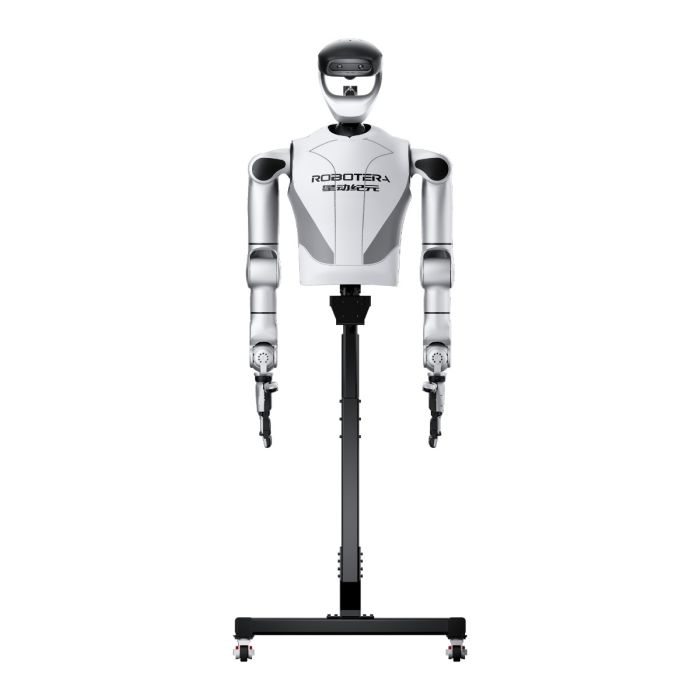
In stock
- BRAND:
- ROBOTERA
- MODEL:
- M7
- ORIGIN:
- China
- Warranty:
- 12 MONTHS
- AVAILABILITY:
- SUBJECT TO AVAILABILITY
- SKU:
- RobotEra-M7
RobotEra M7 Upper Body Wheeled Humanoid Robot
Humanoid robots are usually judged by their legs: the length of the stride, the balance on uneven ground, the recovery from a push. Yet much of the work that laboratories and production engineers actually want to automate happens at bench height, between two hands and the object in front of them. The RobotEra M7 Upper Body Wheeled Humanoid Robot is built around that second view. It concentrates its engineering on a torso, two arms and two dexterous hands. Walking is left to its full-body sibling, and the effort goes where grasping, sorting and assembly succeed or fail.
Robots Europa supplies the RobotEra M7 from Dublin to universities, research institutes and industrial customers throughout the European Union and the DACH region. Our team prepares each quotation, coordinates delivery to your site and remains your point of contact for technical questions once the robot is in service.
Background
A platform within the RobotEra humanoid family
The M7 has a full-body sibling, the L7. The M7 is the upper-body member of that pairing, and it can be easily upgraded to the full-body L7 model. For a research group or an engineering department, this matters more than it might first appear. A team can begin with manipulation work now, building datasets, control policies and teleoperation routines on the upper body, without closing the door to full-body research later. Both members of the family sit within the same RobotEra software world. The M7 is compatible with Robotera embodied AI and VLA models, so work done on the upper body belongs to a wider ecosystem rather than to an isolated machine. You can see the full range of RobotEra machines in our Humanoids category.
Dexterity before locomotion
The M7 integrates 43 degrees of freedom across its body, and 24 of them are in the hands. Its 10 fingers are intended for two-handed work. That distribution is a statement of priorities: more than half of the robot's articulation sits in the hands. Its structure combines aluminium alloy with engineering composites. Actuation pairs electric servo drives with harmonic reducers and precision robotic joints. Harmonic reducers are widely used in robot arms because they are compact and offer precise, repeatable motion at the joint, qualities that fine manipulation depends on. Stereo RGB vision supplies the perception, and Ethernet, USB and WiFi connect the robot to the wider laboratory or factory network.
Technical Specifications
| Specification | Value |
|---|---|
| Product type | Upper body humanoid robot for embodied AI research, teleoperation and dexterous manipulation in laboratory and industrial settings |
| Height | 119 cm |
| Weight | 43 kg |
| Degrees of freedom (total) | 43 |
| Degrees of freedom (hands) | 24 |
| Fingers | 10, for two-handed work |
| Structure | Aluminium alloy and engineering composites |
| Actuation | Electric servo drives with harmonic reducers and precision robotic joints |
| Vision | Stereo RGB |
| Connectivity | Ethernet, USB, WiFi |
| Software environment | Linux and ROS |
| AI model compatibility | Robotera embodied AI and VLA models |
| Upgrade path | Upgradable to the full-body L7 model |
Specifications as published by the manufacturer; they are confirmed against the datasheet at quotation.
The manufacturer has not published the payload, the battery capacity or runtime, the power supply, the IP rating, the arm reach, the arm degrees of freedom, the compute platform, the package contents, the base or stand dimensions, or the details of the mobility base; each of these is confirmed with you at quotation.
How does the RobotEra M7 differ from the full-body L7?
The difference is one of scope rather than generation. The M7 is an upper-body humanoid. The RobotEra L7 is the full-body model. Choosing the M7 means choosing to study and deploy manipulation: the coordination of two arms, the control of 24 degrees of freedom in the hands and the perception needed to guide them. The M7 is best aligned with manipulation-focused workflows such as sorting goods and assembling products. Those are tasks in which the hands, not the legs, decide the outcome.
The two versions are also linked by the upgrade path. Because the M7 can be upgraded to the L7, the decision between them does not have to be final. An organisation that needs results in manipulation research today can start with the upper body. It can then extend towards full-body work when its programme requires it. Each version should be assessed on its own figures, since the figures listed on this page belong to the M7 alone.
Is the RobotEra M7 suitable for VLA and embodied AI research?
The M7 was conceived for exactly this purpose. Its software environment is built on Linux and ROS, the combination most robotics laboratories already use, so existing tools, drivers and research code can be brought across rather than rewritten. Compatibility with Robotera embodied AI and VLA models gives teams a direct route to vision-language-action experiments, in which a model interprets a scene and an instruction and turns them into motion.
Hardware matters as much as software here. Stereo RGB vision gives the perception stack depth cues as well as colour. The density of articulation in the hands lets researchers test policies on grasps and in-hand adjustments that simpler grippers cannot express. Teleoperation completes the picture. Many embodied AI groups collect demonstration data by operating the robot remotely. A two-handed platform with this level of hand articulation is well placed for that kind of data gathering.
Who is the RobotEra M7 for?
The first group is university and institute laboratories working on embodied AI, imitation learning and dexterous manipulation. For them the M7 offers a research platform on familiar Linux and ROS foundations. The second is industrial research and development teams that want to evaluate humanoid manipulation for sorting and assembly before committing to a production deployment. The third is teleoperation specialists who need a two-handed robot with articulated hands to collect demonstrations or carry out remote handling studies.
Where a programme's central question concerns locomotion, whole-body balance or full-body interaction, the full-body RobotEra L7 is the more appropriate starting point. Buyers who want to compare the M7 with other torso-based platforms will find them in our Upper Body Humanoids category.
What is the RobotEra M7 used for?
- Sorting goods: picking, separating and placing items in manipulation-focused handling workflows.
- Assembling products: two-handed assembly tasks that call for coordinated, articulated hands.
- Teleoperation: remote operation of the arms and hands for handling studies and demonstration capture.
- VLA model research: running and evaluating Robotera embodied AI and VLA models on physical hardware.
- Dexterous manipulation studies: exploring grasping and in-hand manipulation with 24 degrees of freedom in the hands.
- ROS development and teaching: building and testing perception and control software in a Linux and ROS environment.
Pricing and Availability
Robots Europa supplies the RobotEra M7 on quotation, prepared for your organisation and its intended application. Tell us about your research or production goals, your site and any integration requirements, and we will prepare the configuration that suits your programme. Delivery, customs and support are arranged with the quotation, so you receive a single, complete offer for your location within the EU or the DACH region. To begin, use the quotation request available on this page.
Frequently Asked Questions
How many degrees of freedom does the RobotEra M7 have?
The M7 integrates 43 degrees of freedom across its body, and 24 of them are in the hands. Its 10 fingers are intended for two-handed work.
Which software environment does the M7 use?
The software environment is built on Linux and ROS. It is compatible with Robotera embodied AI and VLA models.
Can the M7 be upgraded to a full-body humanoid?
Yes. The M7 can be easily upgraded to the full-body L7 model, so manipulation work started on the upper body can later be extended.
What does the M7 use for perception and connectivity?
Perception relies on stereo RGB vision. Connectivity is provided by Ethernet, USB and WiFi.
What is the M7 built from?
Its structure combines aluminium alloy with engineering composites. Actuation pairs electric servo drives with harmonic reducers and precision robotic joints.
Is the M7 suited to industrial settings as well as laboratories?
The M7 is designed for laboratory and industrial settings. In practical deployments it is best aligned with manipulation-focused workflows such as sorting goods and assembling products.
Where can I buy the RobotEra M7 Upper Body Wheeled Humanoid Robot and what does it cost?
You can buy the M7 from Robots Europa, which supplies customers across the EU and the DACH region from Dublin. Pricing is provided by quotation, together with the arrangements for delivery, customs and support.
Summary
If walking is the spectacle of humanoid robotics, manipulation is where the work gets done, and the RobotEra M7 is built for that work. It places 24 of its 43 degrees of freedom in the hands. It runs on Linux and ROS, works with Robotera embodied AI and VLA models, and keeps the full-body L7 within reach through its upgrade path. For a laboratory refining two-handed policies, or an industrial team evaluating humanoid sorting and assembly, it offers a focused platform without a premature commitment to legs. To request a quotation from Robots Europa, this page is the starting point.


