
SIASUN GCR7-910 (GCR7-910)
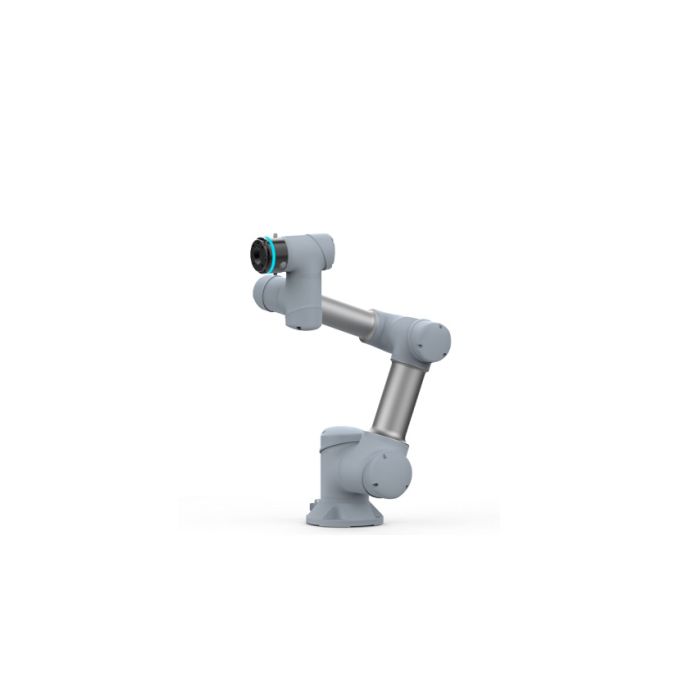
In stock
- BRAND:
- SIASUN
- PART #:
- GCR7-910
- ORIGIN:
- China
- AVAILABILITY:
- SUBJECT TO AVAILABILITY
- SKU:
- SIASUN-GCR7-910
SIASUN GCR7-910 (GCR7-910)
Every collaborative robot has to settle an argument between two demands. It must be gentle enough to share a workbench with an operator, yet quick and precise enough to earn its floor space on a working line. The SIASUN GCR7-910 (GCR7-910) addresses that argument with a six-axis arm that carries 7kg, reaches 917mm and returns to position within ±0.02mm, while 16 TUV-certified safety features govern how it behaves around people. It is a general-purpose machine at the high end of the GCR series. Its appeal lies less in any single figure than in the way vision, force sensing and straightforward teaching are combined in one arm.
Robots Europa, based in Dublin, supplies the GCR7-910 to manufacturers, system integrators and research institutions throughout the European Union and the DACH region. We prepare each quotation around the specific application, arrange delivery to your site and remain your point of contact for technical support once the robot is in service.
Background
SIASUN and the DUCO sub-brand
SIASUN is a Chinese robotics manufacturer whose portfolio extends from industrial arms to mobile robots for logistics and assembly. Its collaborative robots are developed under SIASUN DUCO, a sub-brand dedicated to intelligent robotics. SIASUN DUCO develops all of its core components independently and states that it has broken foreign technology monopolies in multiple fields. For a buyer, the practical significance is that the heart of the arm is engineered by the manufacturer itself rather than sourced from outside suppliers, which simplifies questions of technical responsibility over the life of the installation. The wider range can be explored on our SIASUN page.
Positioning and key technology
The sources name five versions in the GCR series: GCR3-618, GCR5-910, GCR7-910, GCR10-1300 and GCR12-1300. The manufacturer describes the GCR7-910 as a high-end, general-purpose collaborative robot, which places it as a versatile choice rather than a specialist tool. Its defining technology is the integration of 2D/3D vision depth fusion with high-sensitivity force perception and control. In practice, this allows the arm to locate a workpiece and respond to contact rather than simply moving between taught coordinates. That matters wherever parts arrive in varying positions or where a task depends on feel, such as fitting, pressing or surface finishing. The full series is presented in our Cobots category.
Technical Specifications
| Specification | Value |
|---|---|
| Product type | High-end, general-purpose collaborative robot (GCR series) |
| Degrees of freedom | 6 |
| Max payload | 7kg |
| Reach | 917mm |
| Repeatability | ±0.02mm |
| Max TCP speed | 3.6m/s |
| Max straight-line speed | 1.5m/s |
| IP class | IP54/IP65 |
| Safety | 16 TUV-certified safety features for human-machine collaboration |
| Sensing | 2D/3D vision depth fusion; high-sensitivity force perception and control |
| Programming | Drag-and-drop teach programming |
| Software and connectivity | Scenario-specific software packages; multiple external interfaces; cloud-based robot data monitoring; remote OTA upgrades |
Specifications are as published by the manufacturer and are confirmed against the datasheet at quotation.
SIASUN has not published the ambient temperature range, the joint ranges, the noise level, the contents of the control cabinet or the package contents; we confirm each of these at quotation.
What makes the GCR7-910 different from a conventional industrial robot?
A conventional industrial robot is usually installed behind fencing, programmed by a specialist and left to repeat a fixed routine for years. The GCR7-910 is designed around a different premise: that the robot and the operator may occupy the same workspace, and that the task may change more often than the layout of the factory. Its 16 TUV-certified safety features are aimed squarely at human-machine collaboration, so the safety concept forms part of the arm itself rather than being added afterwards with guarding.
Collaboration alone does not make a robot useful, however. The combination of a maximum TCP speed of 3.6m/s, a maximum straight-line speed of 1.5m/s and a repeatability of ±0.02mm gives the arm the pace and precision that productive cells require. Vision depth fusion and force perception then add a layer that many fixed-programme installations lack: the ability to adapt to where a part actually is and how it responds to contact. The result is a robot that can be redeployed between tasks without the re-engineering that a traditional cell would demand. Whether a particular cell can operate without guarding always depends on the risk assessment for the complete application, including the tooling and the workpiece.
How is the GCR7-910 programmed and kept up to date?
Drag-and-drop teach programming lowers the threshold for operation: staff can guide the arm and build sequences without writing code line by line. This is significant for companies that do not employ dedicated robot programmers, and for integrators who wish to hand a cell over to the customer's own team. Scenario-specific software packages offer starting points for typical applications, so that commissioning begins from a structured template rather than a blank screen.
Multiple external interfaces allow the arm to communicate with grippers, sensors and the wider production environment. Beyond commissioning, cloud-based robot data monitoring gives visibility of the robot's operation, and remote OTA upgrades allow its software to be updated without a site visit. For a fleet of robots spread across several sites in Europe, this approach to maintenance can reduce the effort involved in keeping every unit on a consistent software version.
Who is the GCR7-910 for?
The GCR7-910 suits small and medium-sized manufacturers taking their first step into automation, who need a robot their own staff can teach and re-task. It equally serves larger plants that wish to automate individual stations within an existing line without redesigning the whole layout. System integrators will value the combination of vision, force sensing and external interfaces as a flexible platform for customer projects, while universities and research laboratories can use it to study human-robot collaboration and sensor-guided manipulation.
Where the payload of the application is clearly lighter, the GCR5-910 is the natural version to compare. Where the task calls for more payload or reach than the GCR7-910 offers, the GCR10-1300 from the larger end of the series is worth evaluating. Robots Europa sets out the figures of each candidate side by side at quotation, so that the choice rests on the datasheet rather than on the model name.
What is the GCR7-910 used for?
- Machine tending: loading and unloading CNC machines, presses and moulding equipment at a steady rhythm.
- Assembly: fitting and inserting components, where force perception helps the arm respond to contact.
- Vision-guided pick and place: locating parts that arrive in varying positions and placing them accurately.
- Quality inspection: presenting parts to cameras or using integrated vision to check features.
- Surface finishing: grinding, polishing or deburring tasks that rely on controlled contact.
- Research and training: teaching automation and investigating human-robot collaboration in laboratories.
Pricing and Availability
Robots Europa provides the GCR7-910 on a quotation basis, because the right configuration depends on the application, the tooling and the integration required. Delivery, customs clearance and technical support are arranged with the quotation. Please tell us about your task, the parts to be handled and your site, and we will reply with a tailored proposal. To begin, use the quotation request available on this page.
Frequently Asked Questions
What payload and reach does the GCR7-910 offer?
The GCR7-910 has a maximum payload of 7kg and a reach of 917mm. Remember that the weight of the gripper or tool counts towards the payload.
How precise is the GCR7-910?
Its repeatability is ±0.02mm, which suits assembly, inspection and other tasks that require consistent positioning.
Can the GCR7-910 work alongside operators?
The arm has 16 TUV-certified safety features for human-machine collaboration. Whether a specific cell can run without guarding is determined by the risk assessment for the complete application.
Is the GCR7-910 suitable for dusty or wet environments?
The IP class is IP54/IP65. We confirm which rating applies to your chosen configuration when preparing the quotation.
Does the GCR7-910 require specialist programming skills?
No. Drag-and-drop teach programming allows operators to guide the arm and build sequences, and scenario-specific software packages help with common applications.
Can the software be updated remotely?
Yes. The GCR7-910 supports cloud-based robot data monitoring and remote OTA upgrades.
Where can I buy the SIASUN GCR7-910 and what does it cost?
Robots Europa supplies the GCR7-910 across the EU and the DACH region. The cost depends on the configuration and scope of supply, so we provide it in a tailored quotation on request.
Summary
The GCR7-910 resolves the tension at the heart of collaborative automation: it is built to share space with people, yet it brings the speed, repeatability and sensing that productive work demands. A 7kg payload and 917mm reach cover a broad band of everyday tasks, while vision depth fusion, force perception and drag-and-drop teaching make the arm adaptable rather than fixed to a single routine. Remote monitoring and OTA upgrades extend that flexibility into the years of operation that follow. For a manufacturer, integrator or laboratory in Europe weighing up its first or next cobot, this page is the starting point.


