
Tesla Optimus Humanoid Robot
In stock
- BRAND:
- TESLA
- MODEL:
- OPTIMUS
- ORIGIN:
- United States
- AVAILABILITY:
- SUBJECT TO AVAILABILITY
- SKU:
- Tesla-Optimus
Tesla Optimus Humanoid Robot
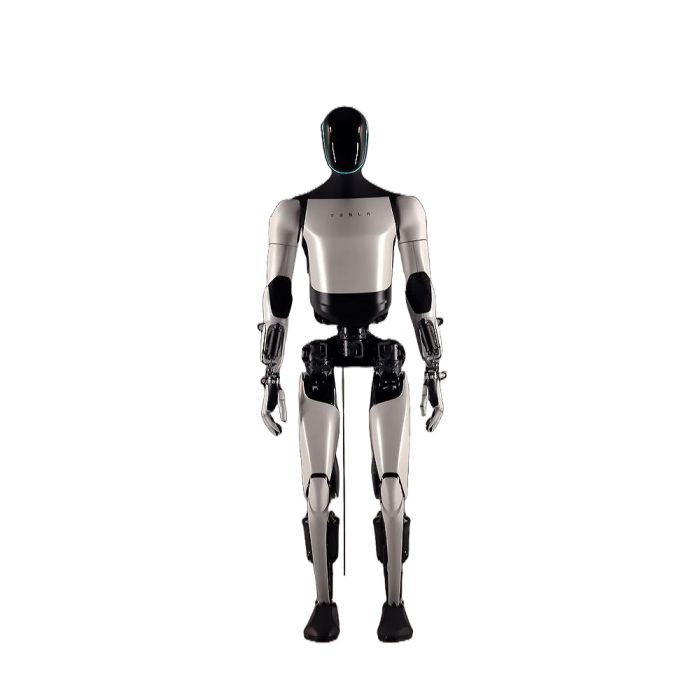
A machine that learnt to read the road is now being taught to walk the factory floor. That is the wager behind the Tesla Optimus Humanoid Robot. Tesla, Inc. is not building a separate mind for its humanoid. It intends to control the robot with the same AI system it is developing for the advanced driver-assistance system in its cars. The result is a general-purpose robotic humanoid, still under development, aimed at work that people would rather hand over: tasks the company describes as dangerous, repetitive and boring.
Robots Europa, based in Dublin, supplies the Tesla Optimus Humanoid Robot to organisations across the European Union and the DACH region. Robots Europa prepares each quotation and coordinates delivery to customers in the EU, Germany, Austria and Switzerland. It also remains the point of contact for documentation and support from the first enquiry onwards. For procurement teams, this means a single European counterpart for a programme that originates in the United States.
Background
Tesla, Inc. and the road to AI Day
Optimus, also known as Tesla Bot, comes from Tesla, Inc., the United States manufacturer best known for its electric vehicles. Tesla announced the project at its Artificial Intelligence (AI) Day event on 19 August 2021. The robot was presented as a general-purpose humanoid rather than a single-task machine. Humanoid robots of this kind are designed around the proportions of the human body so that, in principle, they can work in buildings, workstations and with tools laid out for people. The approach is what distinguishes the bipedal humanoid class from wheeled mobile robots and fixed industrial arms. It has attracted the interest of manufacturers looking for automation that does not require their facilities to be redesigned.
Since that announcement, the programme has moved through successive generations, and the sources refer to Generation 2 and Generation 3. The clearest published evidence of progress between the generations concerns the hands, discussed in detail below.
One AI system, two kinds of machine
The defining technical decision behind Optimus is its control system. According to Tesla, the robot will be controlled by the same AI system that the company is developing for the advanced driver-assistance system used in its cars. Perception, decision-making and motion in the physical world are therefore intended to share a common foundation across Tesla's vehicles and its humanoid.
The mechanical design reflects an equally specific choice. To manage the high force density that dynamic movement requires, the robot's linear actuators use planetary roller screw technology rather than traditional ball screws. This gives higher shock load resistance during walking motions. For a machine that has to absorb the repeated impact of footsteps, this is a deliberate engineering trade-off.
Technical Specifications
| Specification | Value |
|---|---|
| Manufacturer | Tesla, Inc., United States |
| Product type | General-purpose robotic humanoid, under development |
| Also known as | Tesla Bot |
| Announced | AI Day, 19 August 2021 |
| Planned height | 5 ft 8 in (173 cm) |
| Planned weight | 125 lb (57 kg) |
| Carrying capacity (2021 AI Day presentation) | 45 lb (20 kg) |
| Control system | Same AI system Tesla is developing for the advanced driver-assistance system in its cars |
| Linear actuators | Planetary roller screw technology rather than traditional ball screws |
| Hand degrees of freedom: Generation 2 (2023) | 11 |
| Hand degrees of freedom: Generation 3 (2024) | 22 |
| Intended tasks | Tasks that are dangerous, repetitive and boring, such as manufacturing assistance |
Specifications are as published by the manufacturer and are confirmed against the datasheet at quotation.
The manufacturer has not published the battery capacity, battery runtime, walking speed, ingress protection rating, connectivity, charging method, operating temperature range or the contents of the box; these details are confirmed at quotation.
What changed between Generation 2 and Generation 3 Optimus?
The most concrete published difference between the two generations lies in the hands. In 2023, the hands of the Generation 2 Optimus had 11 degrees of freedom. In 2024, the Generation 3 hands had 22. Each generation's figure belongs to that generation alone, so a buyer comparing the two should keep them separate.
Doubling the degrees of freedom in the hands matters because the hands are where a general-purpose humanoid either earns its keep or falls short. A robot that walks well but grips poorly is of limited use on a line where parts must be picked, oriented and placed. More independent joints in the fingers and wrist give a control system more ways to shape a grasp around an object. Whether a given generation suits a particular handling task is a question to settle against the datasheet supplied with the quotation. Robots Europa will state which version a quotation refers to.
The planned height, planned weight and the carrying capacity in the table come from the programme's published plans and the 2021 AI Day presentation. The sources do not attribute them to Generation 2 or Generation 3 specifically. They should therefore be read as programme figures rather than as the measured specification of a particular generation.
Why does Optimus use planetary roller screws instead of ball screws?
A walking robot places unusual demands on its actuators. Every step sends a shock through the legs, and the actuators must deliver high force from a compact package without degrading under that repeated loading. Tesla's answer is to build the linear actuators of Optimus around planetary roller screw technology rather than traditional ball screws. The design provides higher shock load resistance during walking motions.
For an evaluating engineer, the point is less the mechanism itself than what it signals. The design was shaped by the realities of bipedal locomotion rather than borrowed unchanged from stationary automation. Together with a control system shared with Tesla's driver-assistance development, it places Optimus among the humanoids engineered with dynamic movement in mind.
Who is the Tesla Optimus Humanoid Robot for?
The first audience is manufacturing. Tesla names manufacturing assistance as an example of the tasks it proposes for Optimus. Operations managers who already know which jobs on their lines are dangerous, repetitive or simply tedious are the natural evaluators. They can map those jobs against the published capabilities and identify gaps before committing to a pilot.
A second audience is innovation and automation teams within larger industrial groups. Because the programme is still under development, these teams are typically assessing humanoids strategically. They compare form factors and control approaches, and they consider how a human-shaped robot would fit into existing safety and CE marking processes within the EU.
A third audience is research institutions and universities working on humanoid manipulation and locomotion. The published progression in hand dexterity between generations makes Optimus a reference point for groups studying grasping. Its actuator design is of similar interest to those studying impact-tolerant walking.
Buyers still defining their requirements may wish to compare Optimus with other platforms in our Bipedal Humanoids category. The wider Humanoids range also covers designs that are not bipedal. The sources do not currently set out a separate segment for which another Optimus version is better suited. Robots Europa will advise on the version appropriate to your application when preparing a quotation.
What is the Tesla Optimus Humanoid Robot used for?
- Manufacturing assistance: the example Tesla itself gives for the tasks proposed for Optimus.
- Repetitive handling work: jobs that recur all shift long and that the company describes as repetitive and boring.
- Hazardous tasks: work Tesla classes as dangerous, where a robot could stand in for a person.
- Humanoid evaluation programmes: structured assessment of whether a human-shaped robot fits an existing facility.
- Dexterity research: study of grasping and manipulation, informed by the change in hand design between generations.
- Locomotion studies: investigation of dynamic bipedal walking and the actuator loads it produces.
Pricing and Availability
Robots Europa supplies the Tesla Optimus Humanoid Robot on a quotation basis. The programme is under development, so each quotation confirms the version, the applicable datasheet and the current position on supply. Delivery, customs and support are arranged with the quotation. Robots Europa coordinates these for customers throughout the EU and the DACH region. To begin, please use the quotation request available on this page.
Frequently Asked Questions
Who manufactures the Tesla Optimus Humanoid Robot?
The robot is manufactured by Tesla, Inc. of the United States. Robots Europa, based in Dublin, is the seller for customers in the EU and the DACH region.
When was Optimus first announced?
Tesla announced Optimus at its AI Day event on 19 August 2021, where it was also referred to as Tesla Bot.
How tall and heavy is Optimus planned to be?
Optimus is planned to measure 5 ft 8 in (173 cm) tall and to weigh 125 lb (57 kg).
How much can Optimus carry?
The 2021 AI Day presentation gave a carrying capacity of 45 lb (20 kg). The figure applicable to the version you are quoted for is confirmed against the datasheet.
How do the hands differ between generations?
The Generation 2 hands of 2023 had 11 degrees of freedom. The Generation 3 hands of 2024 had 22.
What controls the robot?
Optimus is to be controlled by the same AI system Tesla is developing for the advanced driver-assistance system used in its cars.
Where can I buy the Tesla Optimus Humanoid Robot and what does it cost?
You can buy it through Robots Europa, which serves the EU and the DACH region from Dublin. Pricing is provided individually by quotation, together with delivery, customs and support arrangements.
Summary
The Tesla Optimus Humanoid Robot rests on one idea: intelligence developed for driving can also guide a body that walks and works. That idea is backed by concrete engineering choices. These include actuators built around planetary roller screws for shock load resistance, and hands that moved from 11 degrees of freedom in Generation 2 to 22 in Generation 3. The aim is equally clear: taking on the dangerous, repetitive and boring tasks of manufacturing. Much remains unpublished while the programme is under development, which is why every figure is confirmed at quotation. For organisations in the EU and the DACH region who want to assess Optimus with Robots Europa, this page is the starting point.
Specifications
General
Related Products
Out of stock


