Unitree GD01 Manned Transformable Mecha Robot
In stock
- BRAND:
- UNITREE ROBOTICS
- ORIGIN:
- China
- Warranty:
- 6 MONTHS
- AVAILABILITY:
- SUBJECT TO AVAILABILITY
- SKU:
- Unitree-GD01
Unitree GD01
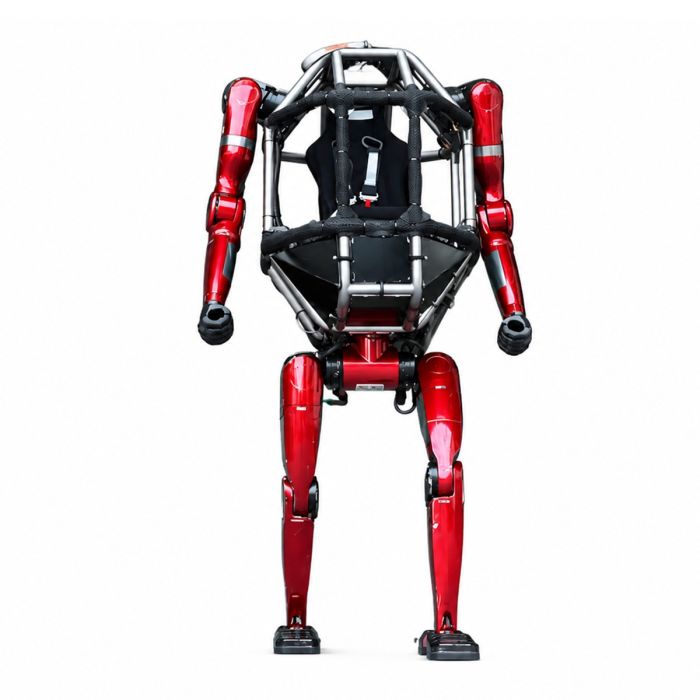
Every so often a machine arrives that refuses its own category. The Unitree GD01 is officially a robot, yet everything about it behaves like the founding of a new vehicle class: it has a cockpit instead of a control tablet, a pilot instead of an operator, a driving position three metres above the pavement, and an off-road mode it reaches by folding itself onto four legs. Revealed on 12 May 2026 — with Unitree's own founder, Wang Xingxing, strapped into the seat as the machine strode across a workshop, flattened brickwork with a swing of its arms, and pitched forward into a quadruped crouch — the GD01 is the first manned transformable mecha ever sold as a production item, and Europe's first opportunity to acquire the category at all. The engineering beneath the spectacle is sober: 36 degrees of freedom driven by integrated electric joints peaking at 700 newton-metres at the hip, a high-strength alloy frame carrying roughly 500 kilograms including its rider, and an NVIDIA Thor computer that splits the piloting workload — the human sets direction, the AI places every footfall, a division proven in launch footage where the machine kept walking while the pilot's hands left the sticks entirely. Unitree's classification is deliberate and repeated: a civilian vehicle for heavy-duty use, with no armament and no military framing.
At Robots Europa, the GD01 sits at the summit of the Unitree range, above the brand's humanoid and quadruped families — supplied across Germany, the DACH region, the United Kingdom and the whole of Europe with customs clearance and after-sales support from Dublin.
Background
Why this machine exists now
For seventy years the piloted mecha stayed fictional for one stubborn reason: nobody could make a multi-tonne biped balance, and nobody could power one electrically. Both problems fell to the same company. Unitree spent a decade shipping legged machines at industrial volume — quadrupeds by the tens of thousands, then the G1 and H-series humanoids — while manufacturing its own low-inertia, internal-rotor permanent-magnet joint motors in-house. The GD01 is that production stack enlarged to carry a person: its four-legged gait runs on lineage from the company's dog robots, its two-legged poise on years of humanoid balance work, and its economics on factories that already exist. That last point is the quiet revolution — a piloted mecha offered not as a one-off laboratory triumph but as a catalogued product with a list price and a delivery pipeline.
A vehicle with two chassis in one
Judge the GD01 as a vehicle and its transformation reads as drivetrain selection. Standing mode is the road gear: upright travel at around three metres of height — reports place it between 2.7 and 3.4 metres, roughly 1.6 human statures — with the pilot enjoying an elevated, frame-protected position. Quadruped mode is the low-range gear: geometry folded, centre of gravity dropped, four limbs grounded for rough surfaces and low clearances, with tracked elements on frame and feet supplying traction where legs would skid. The shift between them takes seconds and involves nobody outside the cockpit — no crane, no support crew — a first among large legged machines. And the demonstrated structural margin is generous: the launch film's wall demolition was performed from a standing posture that never wavered under the recoil.
Technical Specifications
| Feature | Unitree GD01 |
|---|---|
| Category | manned transformable mecha; open-frame seated cockpit; classified by Unitree as a civilian vehicle |
| Revealed | 12 May 2026 |
| Locomotion modes | upright biped and folded quadruped; self-contained transition in seconds |
| Standing height | ~3 m (reported 2.7–3.4 m; ~1.6 adult statures) |
| Mass | ~500 kg with pilot seated |
| Articulation | 36 DOF — 6 per leg, 5 per arm, 2 waist, 2 head/sensor mast |
| Hands | simple grippers |
| Drives | integrated electric joint actuators; low-inertia, high-speed internal-rotor PMSM |
| Peak torque | 700 N·m (hip) / 450 N·m (leg) / 250 N·m (arm) |
| Thermal and feedback | forced-air cooling with heat pipes; dual absolute encoders |
| Compute | NVIDIA Thor primary; 16-core ARM CPU |
| Sensing and comms | monocular camera, four-microphone array, speaker support, Wi-Fi 6, Bluetooth 5.2 |
| Piloting | joystick command with AI-managed gait and foot placement; hands-off walking demonstrated |
| Proven publicly | rider-aboard walking, brick-wall demolition, recoil stability, mode change |
Battery endurance, maximum walking speed and emergency egress procedure remain unpublished; each is confirmed against the engineering datasheet when quoting.
What does one do with a mecha?
Treat the honest novelty of the question as the product's definition: the GD01 is bought for what nothing else can do. Venues buy presence — a piloted, three-metre walking machine is an attraction whose queue is its business case, from ride-along programmes to ticketed encounters at commercial destinations across Europe's theme parks, science centres and exhibition halls. Brands buy the story — a product launch where the presenter arrives inside the product's spiritual successor writes its own coverage. Research buys the platform — nowhere else can a European laboratory study shared human-AI control of a large legged vehicle on production hardware, a standing brief for research institutions in teleoperation, teaming and heavy locomotion. Industry buys the concept early — a protected, elevated pilot position hints at crane-free inspection work and entry into compromised structures alongside the emergency response field, pending the datasheet's endurance figures. And collectors buy the artefact — the first catalogued manned mecha in history, while it is still the only one.
Who is the GD01 for in Europe?
For the continent's venue and experience economy first — the operators for whom spectacle is inventory; for agencies and corporations staging launches and productions where the machine is the headline; for university and institute programmes that have waited for exactly this platform; for industrial and civil-protection bodies evaluating protected-access machines ahead of the field; and for private collectors securing the category's founding piece. Buyers whose brief calls for unmanned Unitree engineering will find the H2 Plus, the G1 line and the full quadruped catalogue beside it — the GD01 alone is the one with a seat.
What is the Unitree GD01 used for?
- Visitor attractions: ride-along and encounter formats whose draw no commercial robot can rival.
- Brand and media production: launches, filming and campaigns built around a piloted mecha as centrepiece.
- Shared-control research: pilot-plus-AI operation of large legged vehicles at research institutions.
- Elevated-access concepts: protected working at height without crane logistics, adjacent to inspection practice.
- Hazard-entry evaluation: protected access to damaged structures within emergency response research.
- Collection and patronage: the first production manned mecha as a historical acquisition.
Pricing and Availability
The Unitree GD01 is available to order across Europe and worldwide through Robots Europa — the flagship of the civilian robotics market, supplied from single acquisitions to venue and programme deployments. It carries an official list price, and because the platform is newly launched with its engineering datasheet still being released, final pricing, configuration, delivery schedule, training and commissioning are confirmed through an individual quotation; delivery, customs clearance and after-sales support across Germany, the DACH region, the United Kingdom, the European Union and beyond are handled by Robots Europa from Dublin. Purchase enquiries, specification updates and availability details for the GD01 are available on this page.
Frequently Asked Questions
What exactly is the Unitree GD01?
The first manned transformable mecha offered as a production item: a rider-operated legged machine from Unitree with an open-frame cockpit, revealed in May 2026, that walks upright on two legs, folds to four in seconds, and is classified by its maker as an intelligent heavy-duty civilian vehicle.
What are its key figures?
Around three metres standing (reported 2.7–3.4 m), roughly 500 kilograms with pilot aboard, 36 degrees of freedom, and peak joint torques of 700, 450 and 250 newton-metres at hip, leg and arm respectively — with wall demolition and recoil-stable walking already shown in public.
How is it piloted?
Through shared control: the rider steers by joystick while the onboard AI — NVIDIA Thor with a 16-core ARM CPU — computes gait and every foot placement; launch footage includes stretches of walking with the pilot's hands entirely off the controls.
Is it in any sense a weapon?
No. Unitree classifies the GD01 strictly as a civilian vehicle for transport, demonstration and heavy-duty work; its published capabilities concern locomotion, transformation and structural strength, with no armament of any kind.
Which specifications are still open?
Battery endurance, top walking speed, the complete sensor inventory and emergency egress procedure have yet to be published; Unitree is releasing documentation ahead of international deliveries, and each figure is confirmed against the official datasheet at quotation.
Where does it sit within the Unitree family?
At the top, and in direct descent: its quadruped gait derives from the company's dog-robot algorithms and its biped stability from the humanoid programme — the same proven architecture, enlarged into a machine with a seat, sold alongside the unmanned Unitree range.
Where can I buy the Unitree GD01 and what does it cost?
Through Robots Europa, with delivery, customs clearance and after-sales support across Germany, the DACH region, the United Kingdom, the European Union and markets worldwide. As a list-priced flagship whose configurations are still being finalised, buyers should request an individual quotation; all purchasing details are on this page.
Summary
Categories are founded rarely, and the Unitree GD01 founds one: the piloted legged vehicle, delivered not as a prototype's promise but as a catalogued product — three metres of high-strength alloy that walks upright, folds to four legs in seconds, shrugs off the recoil of demolished walls, and shares its cockpit between a human's intent and an AI's footwork on NVIDIA Thor. It exists because one manufacturer's decade of mass-produced quadrupeds and humanoids made the manned step an engineering increment, and it is in Europe because Robots Europa delivers it, clears it and supports it from Dublin. For the venue, the laboratory, the brand or the collector ready to own the first of a kind, this page is where the category begins.