
DISCONTINUED - Unitree Go1 Quadruped Robot Dog
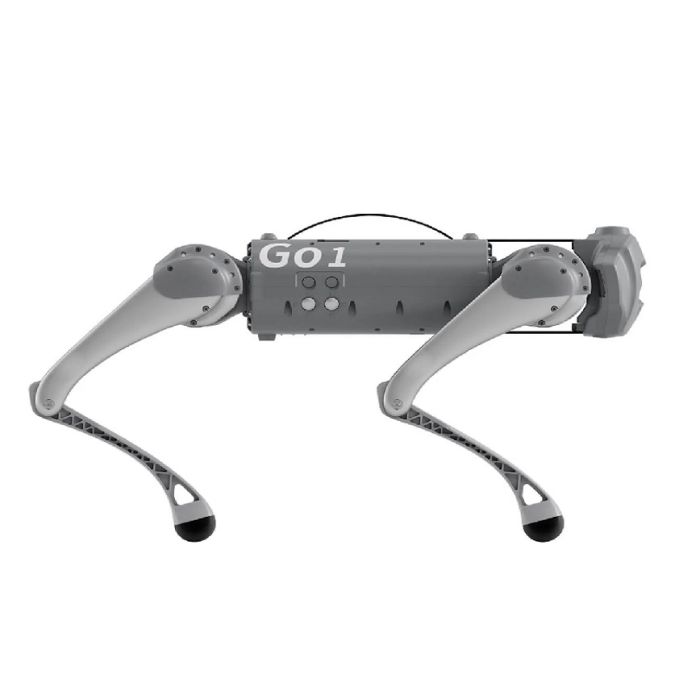
Out of stock
- BRAND:
- UNITREE ROBOTICS
- MODEL:
- GO1
- ORIGIN:
- China
- AVAILABILITY:
- DISCONTINUED
- SKU:
- Unitree-Go1
- Buy 2 for €3,787.68 each and save 3%
- Buy 5 for €3,709.58 each and save 5%
- Buy 10 for €3,592.44 each and save 8%
DISCONTINUED - Unitree Go1 Quadruped Robot Dog
A typical legged robot is driven like a small vehicle: the operator pushes a stick and the machine goes where it is pointed. The DISCONTINUED - Unitree Go1 Quadruped Robot Dog was designed around a different idea, namely that a four-legged machine could keep to its owner's side the way a well-trained dog walks to heel, reading the space around it instead of waiting for every command. Unitree Robotics presented it as the world's first consumer-grade accompanied bionic quadruped, and that description explains why the Go1 still draws attention from laboratories and classrooms: it was sold as a companion, yet built with stereo vision, high-torque joints and a programming interface that serious users value.
Robots Europa, based in Dublin, supplies the Go1 to universities, research groups, system integrators and companies across the European Union and the DACH region. Because the model is now listed as discontinued, Robots Europa sets out in each quotation which Go1 version can be supplied and on what terms, and then handles delivery, onboarding and after-sales support for the order.
Background
Unitree Robotics and its quadruped line
Unitree Robotics is one of the companies that brought legged robots out of specialist research and into a much wider market. Its portfolio has grown from compact robot dogs aimed at developers and enthusiasts to larger platforms such as the Unitree Aliengo Quadruped Robot and industrial machines intended for inspection and field work. The full range is collected in our Quadrupeds category. Within that line, the Go1 marked a deliberate step towards a lighter, more approachable robot that a single person can carry and set up without a dedicated test hall.
Super-sensing and intelligent accompaniment
Two systems define the Go1. The SSS super-perception system relies on fisheye binocular camera sets, each covering a depth sensing angle of ≈ 150 x 170°; the Go1 Air carries one pair, while the Go1 Pro and Go1 Edu carry five pairs. The ISS intelligent accompaniment system provides side-follow behaviour using Unitree's patented wireless vector positioning and control technology, so the robot can stay beside its operator rather than simply being driven. Underneath sit 12 silver alloy precision joint motors, with a patented heat pipe-assisted heat dissipation system built into the vicinity of the knee joint motor. The total onboard compute is a 16-core top CPU + GPU (384Core, 1.5TFLOPS).
Technical Specifications
| Specification | Go1 Air | Go1 Pro | Go1 Edu |
|---|---|---|---|
| Weight | 12 kg | 12 kg | 12 kg |
| Dimensions (L x W x H, folded) | 0.588 x 0.22 x 0.29 m | 0.588 x 0.22 x 0.29 m | 0.588 x 0.22 x 0.29 m |
| Motion speed | 0 ~ 2.5m/s | 0 ~ 3.5m/s | 0 ~ 3.7m/s (limit ~ 5m/s) |
| Load | ≈4kg (limit ~ 10kg) | ≈4kg (limit ~ 10kg) | ≈6kg (limit ~ 10kg) |
| SSS super-sensing system | 1 pair | 5 pair | 5 pair |
| Fisheye binocular depth sensing angle (per set) | ≈ 150 x 170° | ≈ 150 x 170° | ≈ 150 x 170° |
| Silver alloy precision joint motors | 12 piece | 12 piece | 12 piece |
| Body/thigh joint motor | C1-8: 520g 23.70N.m (MAX) | C1-8: 520g 23.70N.m (MAX) | C1-8: 520g 23.70N.m (MAX) |
| Knee joint | C1-8×1.5 ratio 35.55N.m (MAX) | C1-8×1.5 ratio 35.55N.m (MAX) | C1-8×1.5 ratio 35.55N.m (MAX) |
| Charger | 24V,4A | 24V,6A | 24V,6A |
| Python programming interface | No | No | Yes |
| Foot-end physical force sensor | No | No | Yes |
| Radar | No | No | 2D or 3D optional |
Specifications as published by the manufacturer; they are confirmed against the datasheet at quotation.
Unitree has not published the IP rating, the operating temperature range, the Wi-Fi standard, the climbing slope angle, the battery capacity, the exact package contents or the noise level, so Robots Europa confirms these details at quotation.
What do the Go1 Pro and Go1 Edu add over the Go1 Air?
All three versions share the same body: the same 12 joint motors, the same knee torque and the same folded footprint. The differences lie in perception, pace and openness. The Go1 Air works with a single pair of fisheye binocular cameras and a motion speed of 0 ~ 2.5m/s, which suits demonstrations and personal use where the robot mostly follows and performs. The Go1 Pro moves to five camera pairs, raising its awareness of the surroundings considerably, and lifts the motion speed to 0 ~ 3.5m/s, with a stronger 24V,6A charger.
The Go1 Edu is the version built for development. It keeps the five camera pairs, reaches 0 ~ 3.7m/s with a limit of around 5m/s, and carries a higher load of ≈6kg. Above all, it is the only version with a Python programming interface and foot-end physical force sensors, and the only one that can be specified with 2D or 3D radar. For anyone who intends to write their own locomotion, mapping or interaction code, those three features decide the choice on their own.
Is the Go1 still a sensible choice now that it is discontinued?
For many buyers it is, provided the decision is made with open eyes. The Go1 is light at 12 kg, folds to 0.588 x 0.22 x 0.29 m and offers a well-documented architecture that a great deal of teaching material and research has already been built around. The rated life of the robot with no-load static standing and upright running alternately is about 1 -2.5hours, which is ample for lectures, lab sessions and short field trials. The headline maximum speed is ≈4.7m/s (17km/h). The remote control module includes a joystick and mobile phone.
The trade-off is that a discontinued product will not gain new hardware revisions. Teams that need a platform with a longer road ahead may prefer a current model such as the Unitree Go2 PRO Robot Dog DEMO, and Robots Europa is glad to compare both options in a single quotation.
Who is the Unitree Go1 for?
The Go1 Edu is the natural fit for universities, robotics institutes and corporate research teams. Its Python interface, force-sensing feet and optional radar give researchers direct access to the data and control loops they need for work on legged locomotion, perception and human-robot interaction.
The Go1 Pro suits organisations that want a capable, responsive robot for exhibitions, visitor centres, trade fairs and marketing, where fuller camera coverage and a quicker gait matter more than programmability. The Go1 Air serves enthusiasts, schools beginning with robotics, and anyone who mainly wants to experience side-follow behaviour and agile movement in a compact package.
Integrators building prototypes may also find the Go1 useful as a reference platform before committing to larger machines. An overview of the versions within this family is available in our Unitree Go1 category.
What is the Unitree Go1 used for?
- University teaching – a hands-on platform for courses in control engineering, perception and legged robotics.
- Locomotion research – the Edu version's force sensors and Python access support experiments with gaits and balance.
- Human-robot interaction studies – side-follow behaviour offers a ready basis for research into accompaniment and trust.
- Exhibitions and events – an agile, eye-catching robot that draws visitors to stands and showrooms.
- Mapping and navigation trials – the optional 2D or 3D radar on the Edu version supports work on localisation and route planning.
- Prototype development – a compact test bed for software that may later move to larger Unitree platforms.
Pricing and Availability
Robots Europa supplies the Go1 on the basis of an individual quotation, which states the version, the configuration and the condition of the unit offered. Delivery, customs and support are arranged together with the quotation. As the model is discontinued, the quotation also states which versions can still be supplied and outlines current alternatives where useful. To begin, simply send us your intended use and preferred version; the quotation request form is available on this page.
Frequently Asked Questions
Which version of the Go1 can be programmed?
Only the Go1 Edu has a Python programming interface. The Go1 Air and Go1 Pro do not offer this interface.
How fast can the Go1 move?
The motion speed is 0 ~ 2.5m/s for the Go1 Air, 0 ~ 3.5m/s for the Go1 Pro and 0 ~ 3.7m/s for the Go1 Edu, with a limit of around 5m/s on the Edu.
How much can the Go1 carry?
The Go1 Air and Go1 Pro carry a load of ≈4kg and the Go1 Edu ≈6kg, each with a limit of around 10kg.
How long does the battery last?
The rated life with no-load static standing and upright running alternately is about 1 -2.5hours.
How is the Go1 controlled?
The remote control module includes a joystick and mobile phone. In addition, the ISS intelligent accompaniment system allows the robot to follow at its operator's side.
Is the Go1 suitable for outdoor use?
Robots Europa discusses your intended environment with you before quotation so that the robot suits it; the note beneath the specification table lists the environmental details still to be settled.
Where can I buy the DISCONTINUED - Unitree Go1 Quadruped Robot Dog and what does it cost?
You can buy it from Robots Europa, which supplies customers across the EU and the DACH region. The cost depends on the version and configuration and is set out in an individual quotation that you can request on this page.
Summary
The Go1 was conceived as a robot that walks beside you rather than one you steer, and that idea remains its most distinctive quality. Behind the companion concept sits a serious machine: 12 precision joint motors, fisheye stereo vision and, in the Edu version, the Python access, force-sensing feet and optional radar that turn it into a research tool. Choosing between Air, Pro and Edu is therefore a question of how far you want to go beyond following and into development. Robots Europa helps you make that choice, advises on what can still be supplied and supports the robot after delivery. Whether you are equipping a laboratory, a classroom or an exhibition stand, this page is the starting point.


