
Unitree B1 Quadruped Robot
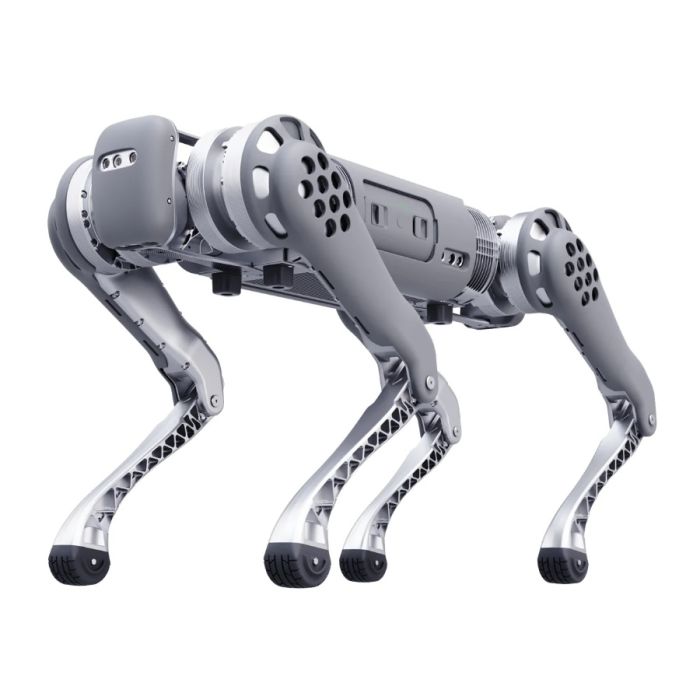
In stock
- BRAND:
- UNITREE ROBOTICS
- MODEL:
- B1
- ORIGIN:
- China
- AVAILABILITY:
- SUBJECT TO AVAILABILITY
- SKU:
- Unitree-B1
Unitree B1 Quadruped Robot
Picture a mobile workstation that happens to walk: a quad-core laptop processor, three edge-AI modules, five depth cameras and a wall of industrial ports, carried on four legs rather than wheeled in on a trolley. That is a more useful way to think about the Unitree B1 Quadruped Robot than the familiar image of a robot dog. Its value lies less in how it moves than in what it can carry, compute and connect while it moves, in places where a fixed sensor or a wheeled platform cannot reach.
Robots Europa, based in Dublin, supplies the Unitree B1 to organisations across the European Union and the DACH region. Robots Europa prepares each quotation against the buyer's intended configuration and arranges delivery to the site, the paperwork for import and the technical support that follows commissioning, so that integrators, operators and research teams deal with one point of contact from enquiry to deployment.
Background
Unitree Robotics and its industrial line
Unitree Robotics is known for bringing legged robots out of the laboratory and into commercial use, with a portfolio that ranges from compact platforms for teaching and research to heavier machines intended for industrial work. The B1 belongs to the industrial end of that range: it is an industrial-grade quadruped robot, positioned for operators who need a legged platform to work in demanding conditions rather than simply to demonstrate locomotion. Buyers comparing the wider family can browse the Unitree B1 category for related listings.
Positioning: a heavy loader with onboard intelligence
Unitree presents the B1 under the headline "IP68 Waterproof, Industrial Level Heavy Loader". Two ideas are combined there. The first is resilience: a robot intended for agriculture, industrial sites and rescue work must tolerate water and dirt. The second is payload: the B1 is designed to carry equipment, and the manufacturer recommends keeping the carried load within 20kg. Behind that physical capability sits a compute and sensing architecture built around an Intel i5-1135G7 main control CPU, three XavierNX modules for perception and five Intel RealSense D430 depth sensors, which together allow the robot to perceive its surroundings and run demanding software on board.
Technical Specifications
| Specification | Value |
|---|---|
| Product type | Industrial-grade quadruped robot |
| Headline protection | IP68 Waterproof, Industrial Level Heavy Loader |
| Recommended carried load | Within 20kg |
| Main control CPU | Intel i5-1135G7 |
| Sensing calculation platform | Multiple brands and models available, XavierNX *3 |
| Sensing sensor | Intel RealSense D430*5 |
| Expansion board | Gigabit Interface*7/RS485*4/USB*5/CAN*4 |
Specifications are as published by the manufacturer and are confirmed against the datasheet at quotation.
Unitree has not published the maximum walking speed, the slope climbing angle, the degrees of freedom, the full IP rating documentation behind the IP68 headline or the contents of the box; Robots Europa confirms these at quotation.
What makes the Unitree B1 different from a consumer robot dog?
Consumer and educational quadrupeds are usually judged on agility and ease of use. The B1 is judged on a different question: can it serve as a reliable carrier for a working payload in an environment that is wet, dusty or unsafe for people? Its answer is built into the specification. The waterproofing headline addresses the environment, the recommended load of up to 20kg addresses the payload, and the computing stack addresses autonomy.
That stack deserves attention. An Intel i5-1135G7 as the main control CPU gives the robot a general-purpose processor of the kind found in business laptops, which makes it straightforward to run standard operating systems, middleware and custom applications. The three XavierNX modules on the sensing calculation platform are dedicated to perception workloads such as processing depth data and running neural networks, so that heavy vision tasks do not compete with motion control for resources. The sensing platform is available in multiple brands and models, so the choice of configuration is settled with Robots Europa during quotation.
Five Intel RealSense D430 sensors provide depth perception around the body. For an operator, multiple viewpoints matter because a legged robot negotiating clutter, steps or uneven ground benefits from seeing its surroundings from several angles rather than from a single forward camera.
How does the expansion board support integration?
For system integrators, the expansion board is often the deciding feature. The B1 offers seven Gigabit interfaces, four RS485 ports, five USB ports and four CAN ports. That mix covers the protocols most commonly used in industrial sensing and control: Gigabit Ethernet for cameras, lidar units and onboard networking; RS485 for field instruments and serial devices; USB for peripherals and storage; and CAN for actuators, battery systems and automotive-style components.
In practice, this means a gas detector, a thermal camera, a radio link and a manipulator controller can be connected without improvised adapters. Fewer adapters mean fewer points of failure in the field, simpler cable routing on the body and a cleaner path to certification of the complete system. Integrators planning a custom payload should share their interface list with Robots Europa during quotation so that port allocation and power arrangements can be planned for the project.
Who is the Unitree B1 Quadruped Robot for?
The B1 suits organisations that need a legged platform to do sustained work rather than to demonstrate mobility. Industrial operators running inspection routes in plants, substations or process facilities are a natural fit, particularly where routes include steps, gratings or wet floors. Security teams responsible for large perimeters can use it as a patrol platform carrying cameras and communications equipment. Agricultural organisations exploring automation in fields, orchards and greenhouses may value a robot that walks over terrain where wheeled vehicles struggle.
Public safety and rescue organisations form another segment: a quadruped can be sent ahead into a damaged or hazardous structure to gather information before people enter. Survey and exploration teams, including those working in tunnels or remote sites, can benefit from the combination of depth sensing and onboard computing. Finally, universities and corporate research groups working on autonomy, perception or field robotics will find the computing headroom and the broad selection of interfaces useful for experimentation. Buyers whose work is primarily teaching or lightweight indoor research are welcome to discuss with Robots Europa whether a smaller platform would serve them better.
What is the Unitree B1 Quadruped Robot used for?
- Industrial inspection: carrying cameras and instruments along routine routes through plants and facilities.
- Security patrols: walking perimeters and sites while streaming video to a control room.
- Agriculture: moving through fields and crop rows with monitoring sensors where wheels lose traction.
- Surveys and exploration: mapping tunnels, construction sites and remote areas with onboard depth sensing.
- Public rescue: scouting damaged or hazardous areas ahead of response teams.
- Research and development: serving as a field-ready base for autonomy, perception and payload integration work.
Pricing and Availability
The Unitree B1 is supplied on quotation, because the final configuration depends on the sensing platform, accessories and integration requirements of each project. Robots Europa reviews the intended application and prepares an offer for the configuration you need. Delivery, customs and support are arranged together with the quotation. To begin, send your requirements through the enquiry form available on this page.
Frequently Asked Questions
What kind of robot is the Unitree B1?
The Unitree B1 is an industrial-grade quadruped robot made by Unitree Robotics, intended for work in agriculture, industry, security patrols, surveys and exploration, and public rescue.
How much can the Unitree B1 carry?
Unitree recommends keeping the carried load within 20kg. Robots Europa can review your planned payload during quotation.
Which processor controls the robot?
The main control CPU is an Intel i5-1135G7, supported by a sensing calculation platform with three XavierNX modules.
What sensors does the B1 use to perceive its surroundings?
The B1 uses five Intel RealSense D430 depth sensors for perception.
Can I connect my own equipment to the B1?
Yes. The expansion board provides seven Gigabit interfaces, four RS485 ports, five USB ports and four CAN ports for integrating payloads and peripherals.
Is the B1 built for wet and outdoor work?
Yes. The B1 carries the headline "IP68 Waterproof, Industrial Level Heavy Loader" and is aimed at agriculture, industrial sites, security patrols and rescue work.
Where can I buy the Unitree B1 Quadruped Robot and what does it cost?
You can buy the Unitree B1 from Robots Europa, which supplies customers across the EU and the DACH region. The cost depends on the configuration and is set out in a tailored quotation requested through this page.
Summary
Seen as a walking workstation rather than a robot dog, the Unitree B1 makes immediate sense. It combines an industrial-grade body, a waterproofing headline and a recommended carried load of up to 20kg with an Intel i5-1135G7 main processor, three XavierNX perception modules, five RealSense D430 depth sensors and an expansion board built for real integration. Those elements together let it take sensors, computing and connectivity into places that are difficult or unsafe for people and wheeled machines. For organisations in the EU and the DACH region that want to plan such a deployment with Robots Europa, this page is the starting point.
Specifications
General
Physical
Performance
Battery + Power
What's included
Related Products
Out of stock


