
Unitree Go2 Edu Plus Mid 360 Quadruped Robot
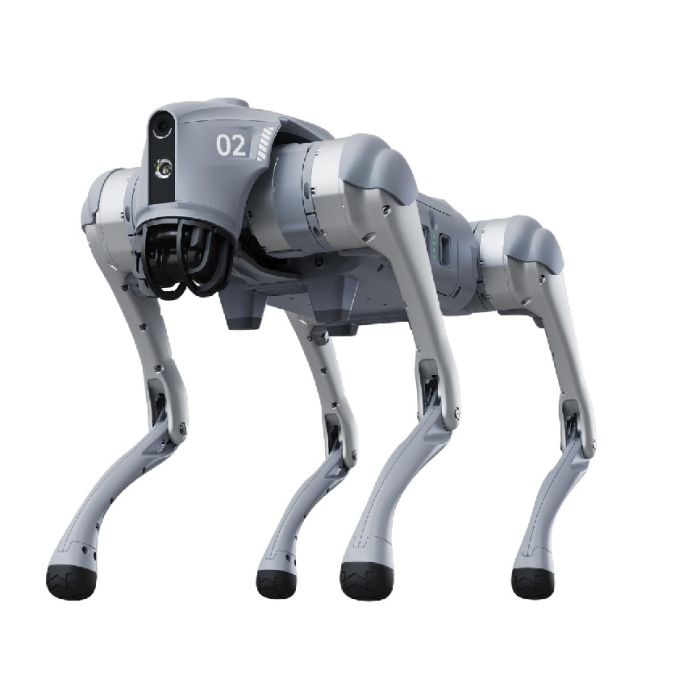
In stock
- BRAND:
- UNITREE ROBOTICS
- MODEL:
- GO2 EDU PLUS MID 360
- ORIGIN:
- China
- Warranty:
- 12 MONTHS
- AVAILABILITY:
- SUBJECT TO AVAILABILITY
- SKU:
- Unitree-Go2-Edu-Plus-Mid-360
Unitree Go2 Edu Plus Mid 360 Quadruped Robot
Most legged-robot demonstrations end the same way: not with a fall, but with a battery warning. The Unitree Go2 Edu Plus Mid 360 Quadruped Robot is built for the opposite situation. Think of the long afternoon of experiments, the survey loop repeated until the data is clean, or the integration test that has to run once more after one last parameter change. It belongs to the EDU line of Unitree's Go2 family, the branch intended for people who write software for robots rather than simply steer them. It combines the long-endurance battery of that line with the higher-compute Edu Plus tier, in the configuration identified by the Mid 360 designation.
Robots Europa, based in Dublin, sells the Unitree Go2 Edu Plus Mid 360 Quadruped Robot and supplies it to universities, research institutes, integrators and industrial teams throughout the European Union and the DACH region. Robots Europa prepares the quotation, arranges delivery to your site and remains your point of contact for technical support after the robot has arrived, so that procurement, import and after-sales questions are handled by a single European partner.
Background
Unitree Robotics and the road to Go2
Unitree Robotics, headquartered in Hangzhou, is one of the companies that brought quadruped robots out of a small circle of well-funded laboratories and into general research and commercial use. Its earlier platforms, among them Laikago, Aliengo, A1 and Go1, showed that a compact, electrically actuated legged robot could be produced in series and supported over time. The Go2 family is the current generation of that compact line. It shares one body and one drive concept across several versions, from consumer-oriented models to research editions, which means that experience gained on one Go2 transfers readily to another.
The EDU line and the Edu Plus tier
Within the Go2 family, Unitree distinguishes the Go2 Air, Go2 Pro and Go2 X from the Go2 EDU, and within the EDU line it separates the Edu Standard, named as the 40 TOPS tier, from the Edu Plus, named as the 100 TOPS tier. The Edu Plus in turn appears in several configurations: the base Edu Plus, the Edu Plus Mid-360 described on this page, and the Edu Plus Hesai XT16. What sets the EDU line apart in Unitree's comparison table is substantive rather than cosmetic: a long-endurance battery in place of the standard pack, foot-end force sensing, and a higher maximum payload and speed. For a research group this is the difference between a platform that can be demonstrated and one that can be worked with day after day.
Technical Specifications
| Specification | Value |
|---|---|
| Dimensions (standing) | 70cm x 31cm x 40cm |
| Dimensions (crouching) | 76cm x 31cm x 20cm |
| Weight (with battery) | About 15kg |
| Payload | ≈8kg (MAX ~12kg) |
| Speed | 0 ~ 3.7m/s (MAX ~5m/s) |
| Max climb angle | 40° |
| Voltage | 28V~33.6V |
| Smart battery | Long endurance (15000mAh) |
| Battery life | About 2-4h |
| Peak joint torque | Approx. 45N·m |
| Foot-end force sensor | Included |
| Wireless module | Wi-Fi6/Bluetooth/4G |
Specifications as published by the manufacturer; they are confirmed against the datasheet at quotation.
The manufacturer has not published the IP rating, the operating temperature range, the package dimensions or the shipping weight of this robot; Robots Europa confirms these with the quotation.
What separates the Go2 Edu Plus Mid 360 from the consumer Go2 models?
From the outside, every Go2 looks much the same. The standing dimensions of 70cm x 31cm x 40cm and a weight of about 15kg with battery describe a robot that fits through an office door, travels in an estate car and can be lifted by two people without special equipment. The differences lie in what the platform is permitted to do once it is working.
The first difference is load. The EDU specification gives a payload of ≈8kg with a maximum of ~12kg, which is the headroom a research team needs to mount computers, sensors, radios or a small manipulator without immediately reaching the platform's limit. The second is pace and terrain: a working speed range of 0 ~ 3.7m/s, a maximum of ~5m/s and a maximum climb angle of 40° allow the robot to keep up with a person on foot and to tackle ramps and slopes found on real sites rather than only on laboratory floors.
The third difference is perception at the feet. The foot-end force sensor is listed for the EDU and not for the consumer models. For locomotion research this matters a great deal: contact forces are the raw material for work on gait control, terrain classification and balance recovery, and having them measured at the foot spares a team from inferring them indirectly. Finally, the Edu Plus tier places this robot at the upper compute level of the EDU line, which is where onboard perception and autonomy workloads belong.
How far does one charge take the Go2 Edu Plus Mid 360?
Endurance is the specification that most often decides whether a legged robot becomes a working tool or remains a showpiece. The Go2 Edu Plus Mid 360 uses the long-endurance smart battery of the EDU line, rated at 15000mAh, and its battery life is about 2-4h, with the system operating across a voltage range of 28V~33.6V.
The spread within that range is itself informative. A robot walking steadily on level ground with a light payload draws far less than one climbing slopes at speed with a full sensor load, so the realistic figure for a given project depends on its duty cycle. In practice, the long-endurance pack means that a typical teaching session, a mapping run through a building or a sequence of control experiments can be completed on one charge, while a second battery allows a team to continue with only a short changeover. Robots Europa can advise on spare batteries and charging arrangements as part of the quotation.
Who is the Unitree Go2 Edu Plus Mid 360 for?
The clearest fit is the university or research-institute laboratory working on legged locomotion, perception or autonomy that wants a platform with force sensing at the feet, higher onboard compute and enough endurance for full experimental sessions. Doctoral groups and multi-disciplinary robotics centres benefit in particular from a robot that several projects can share without reconfiguring the base hardware each time.
Systems integrators and industrial innovation teams form the second segment. For them the Go2 Edu Plus Mid 360 serves as a compact carrier for inspection, monitoring or site-survey pilots, with the payload margin to add customer-specific equipment and wireless connectivity via Wi-Fi6, Bluetooth and 4G for remote operation and data transfer.
Not every buyer needs this exact configuration. Teaching programmes where the 40 TOPS compute level is sufficient may be better served by the Unitree Go2 Edu Standard Quadruped Robot. Teams that plan to fit and integrate their own sensor payload can start from the Unitree Go2 Edu Plus AI Quadruped Robot Dog, while groups that have standardised on Hesai hardware should look at the Unitree Go2 Edu Plus Hesai XT16 Quadruped Robot. Buyers who want a consumer or demonstration robot rather than a development platform will find the Go2 Air, Go2 Pro and Go2 X alongside the whole family in the Unitree Go2 category, and the wider range of laboratory platforms is collected under Research Robots.
What is the Unitree Go2 Edu Plus Mid 360 used for?
- Locomotion research – studying gaits, balance and contact behaviour with force data measured directly at the feet.
- Perception and autonomy development – running onboard algorithms on the higher-compute Edu Plus tier instead of off-board computers.
- Indoor and outdoor mapping trials – carrying sensors through corridors, stairwells and slopes where wheeled platforms struggle.
- Inspection pilots – evaluating legged robots for routine rounds in plants, utility sites and technical buildings before larger deployments.
- University teaching – giving students a real legged platform for courses in control, robotics software and machine learning.
- Payload and integration testing – mounting custom sensors, radios or tools within the published payload to prototype application-specific systems.
Pricing and Availability
Robots Europa supplies the Unitree Go2 Edu Plus Mid 360 Quadruped Robot on the basis of a written quotation tailored to your configuration, accessories and institution. The quotation also sets out the exact contents of the package. Delivery, customs and support are arranged with the quotation, so that your purchasing department receives one complete offer for the EU or the DACH region. To begin, please tell us about your project and intended use; the quotation request is available on this page.
Frequently Asked Questions
How much can the Go2 Edu Plus Mid 360 carry?
The payload is ≈8kg, with a maximum of ~12kg. This leaves room for additional computers, sensors or small tools on top of the robot's own equipment.
How long does the battery last?
The long-endurance smart battery is rated at 15000mAh and gives a battery life of about 2-4h. Actual runtime depends on speed, terrain and the payload carried.
Does the robot have force sensors in its feet?
Yes. The foot-end force sensor is included on the EDU line, to which this configuration belongs, and provides contact-force data for locomotion and terrain research.
How fast can the Go2 Edu Plus Mid 360 move?
Its speed range is 0 ~ 3.7m/s, with a maximum of ~5m/s. It can also climb slopes up to a maximum angle of 40°.
What wireless connectivity does it offer?
The wireless module supports Wi-Fi6, Bluetooth and 4G. This covers local control, accessory pairing and mobile data links for remote operation.
Which other Edu Plus configurations are available?
Besides the Mid-360 configuration described here, the Edu Plus is offered as the base Edu Plus and as the Edu Plus Hesai XT16. Robots Europa can help you choose the configuration that suits your project.
Where can I buy the Unitree Go2 Edu Plus Mid 360 Quadruped Robot and what does it cost?
You can buy it from Robots Europa, which supplies customers across the EU and the DACH region from Dublin. The cost depends on configuration, accessories and delivery, and is set out in a written quotation that you can request on this page.
Summary
A legged robot proves its worth not in the first minute of a demonstration but in the third hour of a working day. The Unitree Go2 Edu Plus Mid 360 Quadruped Robot is designed for that third hour: the long-endurance battery of the EDU line, foot-end force sensing, a payload margin for real equipment, the higher compute tier of the Edu Plus and a compact body that moves through ordinary buildings and up demanding slopes. For laboratories, integrators and inspection teams in the EU and the DACH region, Robots Europa handles the quotation, delivery and support of this configuration, and for every project that needs a quadruped which keeps working after the demonstration has ended, this page is the starting point.


