
Topsky Auxiliary reconnaissance quadruped robot dog
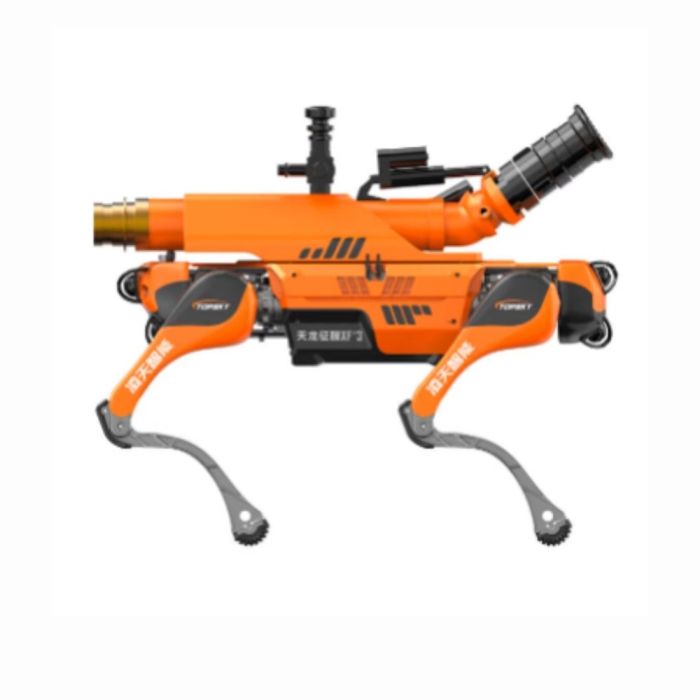
In stock
- BRAND:
- TOPSKY
- PART #:
- Auxiliary reconnaissance quadruped robot dog
- ORIGIN:
- China
- Warranty:
- 12 MONTHS
- AVAILABILITY:
- SUBJECT TO AVAILABILITY
- SKU:
- Topsky-Auxiliary-Reconnaissance-Quadruped-Robot-Dog
Topsky Auxiliary reconnaissance quadruped robot dog
The most dangerous part of a fire-scene search is often the first few metres beyond the door. The smoke is dense, the floor may not hold, and nobody yet knows where the seat of the fire lies or whether anyone is still inside. The Topsky Auxiliary reconnaissance quadruped robot dog is built to walk those metres first. It is a legged rescue machine that pairs bionic locomotion with thermal and visible-light sensing, intended for complex, high-risk fire-fighting scenarios where sending a person ahead would be a gamble. Where a wheeled platform stops at the first staircase, this robot climbs, steps and threads its way through rubble, sending images and temperature data back to an operator who stays at a safe distance.
Robots Europa, based in Dublin, supplies the Topsky Auxiliary reconnaissance quadruped robot dog to fire and rescue services, industrial safety teams and research organisations across the European Union and the DACH region. Robots Europa prepares each quotation, arranges delivery to your site and remains your point of contact for technical support once the robot is in service.
Background
TOPSKY and its range of emergency quadrupeds
TOPSKY builds a family of legged and wheeled robots for emergency and industrial work, and this model is its dedicated scout. The manufacturer describes it as special rescue equipment that integrates bionics with intelligent technology, and the version supplied is the 40kg super-sized dog-assisted reconnaissance quadruped robot dog with a handheld integrated remote control terminal. Its role is not to extinguish or to haul, but to find out: to locate fire sources and trapped people, to read the temperature picture inside a structure and to map the ground before crews commit to it. The wider choice of legged platforms can be explored in our Quadrupeds category.
Legged movement combined with layered sensing
Two ideas define the machine. The first is locomotion modelled on animals, which lets it handle collapsed buildings, stairs, rubble piles and narrow spaces that defeat tracks and wheels. The second is a sensing stack built in layers: front and rear depth cameras work together with a solid-state lidar to secure each foot placement on stairs, while a 360° panoramic camera and a dual-sensor gimbal with visible-light and thermal imaging channels give the operator situational awareness. The same lidar feeds a 3D modelling function that scans a scene and builds a map within 3 minutes, supporting path planning and the avoidance of collapse risks.
Technical Specifications
| Specification | Value |
|---|---|
| Version | 40kg super-sized dog-assisted reconnaissance quadruped robot dog with a handheld integrated remote control terminal |
| Protection rating | IP67 |
| Operating temperature | -20°~55° |
| Chassis standing dimensions | 1083mm×525mm×720mm |
| Overall standing dimensions | 1083mm×525mm×955mm±100mm |
| Overall weight | <95kg (including battery) |
| Power supply type | Lithium battery with a quick-plug structure |
| Charging time | <2h |
| Quick battery replacement | ≤10s |
| Maximum movement speed | 6.5m/s |
| Maximum endurance time | >5.5h (no load) |
| Load endurance time | >4.5h (20kg load) |
| Maximum standing load | >135Kg |
| Continuous walking load | >40Kg |
| Maximum climbing capacity | 45° |
| Maximum step height | 20cm |
| Maximum crossing height | 40cm |
| Sensing system | Front and rear depth cameras combined with solid-state lidar for foot placement on stairs |
| Cameras and gimbal | 360° panoramic camera; dual-sensor gimbal (visible light + thermal imaging) |
| 3D modelling | Scene scanning and 3D map construction within 3 minutes |
| Remote control and audio-video transmission range | 1110m in open areas |
| Handheld remote control terminal | Robot control, water cannon control, video feedback, intercom, gas and other data collection; video recording and screen projection |
| Battery discharge port | DC46V (nominal) |
| Main communication port | Gigabit Ethernet port |
| 24V power supply ports | 3 |
| 12V power supply ports | 3 |
| Gigabit Ethernet ports | 1 in, 4 out |
| Expandability | Diversified mounted modules and expandable interfaces; supports secondary development |
Specifications are as published by the manufacturer and are confirmed against the datasheet at quotation.
The manufacturer has not published the battery capacity, the degrees of freedom, the processor, the wireless standards, the camera resolution, the contents of the box or the noise level; these details are confirmed at quotation.
How does the robot dog find people and fire sources through smoke?
Visible-light cameras lose most of their value once a corridor fills with smoke, which is precisely when information matters most. The dual-sensor gimbal addresses this by pairing a visible-light channel with thermal imaging, so the robot can see through smoke to track heat sources and transmit real-time high-definition images alongside temperature distribution data. For an incident commander, that means the fire source and any trapped person can be located from outside the danger zone, and the decision on where to send crews rests on evidence rather than assumption.
The 360° panoramic camera complements the gimbal by giving the operator a view all around the robot, which helps when it is turning in a confined space or backing out of a dead end. Everything is gathered on the handheld integrated remote control terminal, which combines robot control with video feedback, an intercom, the collection of gas and other data, video recording and screen projection. Projecting the feed to a larger display lets a whole command team watch the same picture, and the recordings can support debriefing after the incident. Control and audio-video transmission reach 1110m in open areas.
How much can it carry, and for how long can it work?
A reconnaissance robot is only useful if it stays in the field long enough to finish the job. Without a load, the maximum endurance time exceeds 5.5h; carrying a 20kg load, it still runs for more than 4.5h. The continuous walking load is more than 40Kg and the maximum standing load more than 135Kg, which leaves room for additional modules on the mounting interfaces. When the battery does run down, the quick-plug lithium pack can be exchanged in 10 seconds or less, and a full charge takes less than 2h, so a pair of packs can keep the robot in rotation through a long operation.
Mobility figures complete the picture: a maximum movement speed of 6.5m/s, a maximum climbing capacity of 45°, steps up to 20cm and obstacles up to 40cm in crossing height. The IP67 rating and an operating temperature of -20°~55° mean that water from hoses, dust and cold winter nights need not keep it in its case.
Who is the Topsky Auxiliary reconnaissance quadruped robot dog for?
The clearest fit is a municipal or regional fire and rescue service that wants a remote scout for building fires, partial collapses and incidents where the structure is in doubt. Industrial fire brigades at chemical plants, refineries and large logistics sites form a second group: their incidents often involve hazardous atmospheres and extensive premises in which a robot that maps, measures and reports back saves time and exposure. Urban search and rescue teams working after collapses will value the ability to move over rubble and through narrow spaces while the thermal channel searches for survivors.
Research institutes and system integrators are a further audience. The Gigabit Ethernet ports, the 24V and 12V power outputs and support for secondary development make the robot a platform on which new sensors and software can be built and trialled.
Where the priority is active suppression rather than reconnaissance, buyers may wish to compare the Topsky Assistive firefighting quadruped robot dog or the Topsky High-speed fan firefighting quadruped robot dog; for moving equipment and supplies, the Topsky Auxiliary transportation quadruped robot dog is the related model in the range. Robots Europa can advise on which combination suits a given fleet.
What is the Topsky Auxiliary reconnaissance quadruped robot dog used for?
- Building fire reconnaissance: entering smoke-filled structures ahead of crews to locate the seat of the fire.
- Search for trapped persons: using thermal imaging to find casualties hidden by smoke or debris.
- Collapse and rubble operations: crossing unstable ground in damaged buildings where people cannot safely walk.
- Tunnels and underground spaces: scouting long, enclosed routes such as tunnels and metro systems from a remote position.
- Incident mapping: producing a 3D map of the scene to support path planning and collapse risk assessment.
- Development and integration: serving as an expandable base for additional modules and custom software.
Pricing and Availability
The Topsky Auxiliary reconnaissance quadruped robot dog is supplied on quotation, so that the configuration, any additional modules and the support arrangements can be matched to your operational requirements. Delivery, customs and after-sales support are arranged together with the quotation from Robots Europa. A tailored offer for organisations in the EU and the DACH region can be requested using the quotation form available on this page.
Frequently Asked Questions
Can the robot climb stairs?
Yes. It handles steps up to 20cm and slopes up to 45°, with front and rear depth cameras and a solid-state lidar working together to place its feet on stairs.
Is it protected against water and dust?
The robot carries an IP67 protection rating and operates between -20°~55°, which suits it to wet fire scenes and outdoor deployment.
How far away can the operator stand?
Remote control and audio-video transmission reach 1110m in open areas, using the handheld integrated remote control terminal.
How long does the battery last?
Endurance exceeds 5.5h without load and 4.5h with a 20kg load. The quick-plug lithium battery can be swapped in 10 seconds or less and recharges in under 2h.
Can it map the scene it is exploring?
Yes. Using lidar and 3D modelling technology, it scans a scene and constructs a 3D map within 3 minutes to assist path planning and the avoidance of collapse risks.
Can additional equipment be mounted on the robot?
It offers diversified mounted modules and expandable interfaces, including Gigabit Ethernet ports and 24V and 12V power outputs, and supports secondary development.
Where can I buy the Topsky Auxiliary reconnaissance quadruped robot dog and what does it cost?
Robots Europa supplies it across the EU and the DACH region. The cost depends on configuration and support requirements, so please request a quotation and Robots Europa will prepare an offer for your organisation.
Summary
Every fire and rescue operation turns on what can be known before people are put at risk. The Topsky Auxiliary reconnaissance quadruped robot dog takes over those first uncertain metres: it walks where wheels cannot, sees through smoke with its thermal channel, maps the scene within minutes and reports everything to a terminal held well outside the danger area. With IP67 protection, quick battery exchange and open interfaces for further development, it is a scout that can stay in service through a long incident and grow with a team's needs. For a quotation from Robots Europa, with delivery and support arranged across the EU and the DACH region, this page is the starting point.


