
Topsky Assistive firefighting quadruped robot dog
In stock
- BRAND:
- TOPSKY
- PART #:
- Assistive firefighting quadruped robot dog
- ORIGIN:
- China
- Warranty:
- 12 MONTHS
- AVAILABILITY:
- SUBJECT TO AVAILABILITY
- SKU:
- Topsky-Firefighting-Quadruped-Robot-Dog
Topsky Assistive firefighting quadruped robot dog
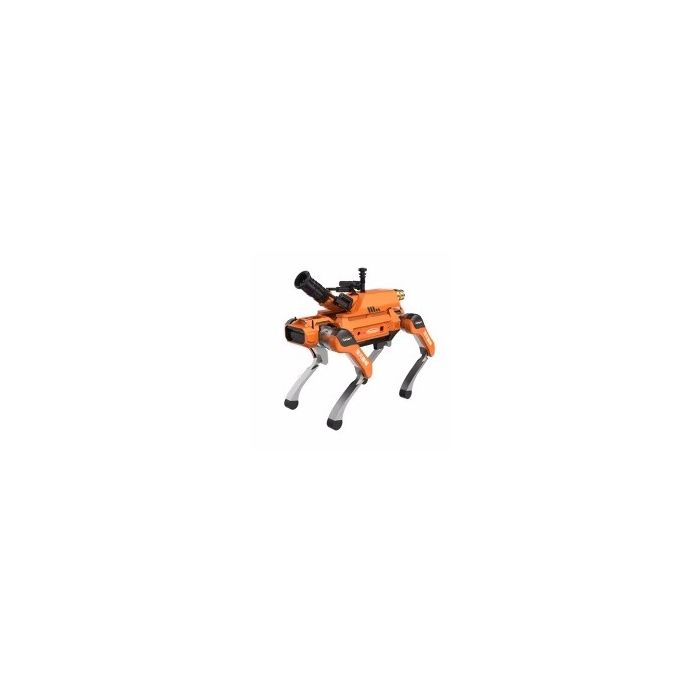
Every fire attack has a stretch of ground that no commander wants to send a person across: the final metres before the seat of the fire, where the smoke is densest, the air may be toxic and the structure overhead may not hold. The Topsky Assistive firefighting quadruped robot dog is built to walk that stretch in place of a crew. It carries a water cannon and a set of detection modules on four legs, climbs stairs and slopes, steps over obstacles and sends video, audio and gas readings back to an operator who remains at a safe distance. The robot takes on the exposure, while the firefighter keeps the judgement and the control.
Robots Europa, based in Dublin, supplies the Topsky Assistive firefighting quadruped robot dog to fire and rescue services, industrial emergency teams, infrastructure operators and research organisations across the European Union and the DACH region. Robots Europa prepares each quotation, arranges delivery to the customer's site and remains the point of contact for technical support once the robot is in service.
Background
Topsky and its family of working quadrupeds
Topsky builds legged robots for public-safety and industrial work, and this model belongs to a family rather than standing alone. The range offered by Robots Europa includes quadrupeds for reconnaissance, for transport and for fan-assisted firefighting alongside this assistive firefighting version. The logic of such a family is practical: an emergency service rarely needs one machine that does everything moderately well, and is usually better served by platforms tailored to a defined task. This version is the one designed to put water on a fire, with sensing and communication built around that job.
Bionics and intelligent technology for high-risk scenes
The robot is rescue equipment that integrates bionics and intelligent technology, designed for complex and high-risk firefighting scenarios. Legged locomotion is the bionic part: instead of rolling over the ground, the robot places each foot individually, which is what allows a machine of this class to deal with stairs, kerbs, debris and uneven floors. The intelligent part is the perception that guides those feet. Front and rear depth cameras work together with a solid-state lidar to ensure correct foot placement on stairs, so the robot can move between levels of a building or an industrial plant rather than being confined to flat ground. Around this core the robot accepts functional modules for toxic and harmful gas detection, environmental detection, two-way intercom, the water cannon and an ad hoc network, and its expandable interfaces support secondary development.
Technical Specifications
| Specification | Value |
|---|---|
| Protection rating | IP67 |
| Operating temperature | -20°~55° |
| Chassis standing dimensions | 1083 mm×525mm×720mm |
| Overall standing dimensions | 1083 mm×525mm×955mm±100mm |
| Overall weight | <75kg (including battery) |
| Power supply | Lithium battery with quick-plug structure |
| Charging time | <2h |
| Quick battery replacement | ≤10s |
| Maximum movement speed | 6.5m/s |
| Maximum endurance time | >5.5h (no load) |
| Load endurance time | >4.5h (20kg load) |
| Maximum standing load | >135Kg |
| Continuous walking load | >40Kg |
| Maximum climbing capacity | 45° |
| Maximum step height | 20cm |
| Maximum crossing height | 40cm |
| Sensing system | Front and rear depth cameras with solid-state lidar |
| Battery discharge port | DC46V (nominal) |
| Main communication port | Gigabit Ethernet port |
| 24V power supply ports | 3 |
| 12V power supply ports | 3 |
| Gigabit Ethernet ports | 1 in, 4 out |
| Spray distance | ≥62m |
| Maximum flow rate | ≥40L/s |
| Adjustable flow rate | 20L/30L/40L |
| Working pressure | ≤1.0MPa |
| Remote control and audio-video transmission range | 1110m in open areas |
| Cloud connectivity | 4G/5G network to robot networked cloud platform |
Specifications as published by the manufacturer; they are confirmed against the datasheet at quotation.
The manufacturer has not published the payload capacity of the mounted modules, the battery capacity, the camera resolution, the thermal imaging specification, the gas sensor detection ranges, the number of degrees of freedom in the legs, the noise level or the contents of the box; Robots Europa confirms these points at quotation.
How does the Topsky Assistive firefighting quadruped robot dog deliver water to a fire?
The water cannon is the reason this version exists, and its figures define how it is deployed. With a spray distance of ≥62m, the robot does not need to stand in the flames: it can take up a position with a line of sight to the fire and attack from there, while the operator stays much further back. The flow rate is adjustable in three steps, 20L, 30L and 40L, up to a maximum of ≥40L/s, at a working pressure of ≤1.0MPa. That lets the operator match the output to the situation, from cooling a tank or a wall to a full attack on a developed fire.
A charged hose is heavy, and dragging it back out is often harder than dragging it in. The water inlet is therefore fitted with a quick hose detachment system: by remote control the operator releases the hose automatically, so the robot returns with a light load once the task is complete. This also explains the load figures in the table. A continuous walking load of >40Kg and a maximum standing load of >135Kg describe a platform built to pull and hold equipment rather than simply to walk.
How long can it operate, and how is it controlled?
Endurance is >5.5h without load and >4.5h with a 20kg load, which covers a long working period at an incident. When a battery runs low, the lithium pack with its quick-plug structure is replaced in ≤10s, and a depleted pack recharges in <2h, so a service holding spare batteries can keep the robot working through an extended operation.
Control is brought together on a handheld integrated remote control terminal. From one device the operator drives the robot, directs the water cannon, watches the video feed, speaks through the voice intercom and collects gas and other sensor data, with video recording and screen projection for the command post. Remote control and audio-video transmission reach 1110m in open areas. Beyond the handheld link, the robot connects to a networked cloud platform over 4G/5G: position, battery level, audio, video and gas detection data can then be viewed in real time on a back-office PC and on mobile terminals, so an incident commander or a remote specialist sees what the operator sees.
Who is the Topsky Assistive firefighting quadruped robot dog for?
The first group is municipal and regional fire and rescue services that want a means of attacking fires and gathering information in places where sending in a crew carries too great a risk: collapsed or unstable structures, dense smoke, toxic or oxygen-deficient atmospheres. The IP67 rating and the -20°~55° operating range suit services that work outdoors throughout the year.
The second group is industrial fire brigades at sites where a fire may coincide with a release of hazardous substances, such as chemical plants, energy installations and large logistics facilities. Here the gas detection module and the stair-capable sensing matter as much as the water cannon. Tunnel and underground transport operators form a third group, since a robot that can carry its own sensing and stream data over an ad hoc network is valuable where people cannot easily enter.
Finally, research institutes and system integrators will appreciate the Gigabit Ethernet ports, the 24V and 12V power outputs and support for secondary development, which allow their own sensors and software to be added. Buyers whose main task is scouting rather than putting water on a fire should also compare the Topsky Auxiliary reconnaissance quadruped robot dog; for carrying equipment the Topsky Auxiliary transportation quadruped robot dog is the related model, and the Topsky High-speed fan firefighting quadruped robot dog is another firefighting option in the range. The complete selection is listed under Quadrupeds.
What is the Topsky Assistive firefighting quadruped robot dog used for?
- Remote fire attack: directing the water cannon onto a fire from a position that would be too dangerous for a crew.
- Hazardous atmosphere detection: measuring toxic and harmful gases before personnel enter an area.
- Reconnaissance in smoke: sending live video and environmental data from inside a building or plant to the command post.
- Contact with trapped persons: using the two-way intercom to speak to people who cannot yet be reached.
- Communications in difficult areas: extending coverage with the ad hoc network module where existing networks are weak.
- Development and integration: serving as a base for additional sensors and software through the expandable interfaces.
Pricing and Availability
Robots Europa supplies the Topsky Assistive firefighting quadruped robot dog on quotation, tailored to the modules and configuration your service requires. Delivery, customs clearance and technical support are arranged with the quotation. To discuss your requirements and receive an offer, the request form is available on this page.
Frequently Asked Questions
Can the robot climb stairs?
Yes. Front and rear depth cameras combined with a solid-state lidar ensure correct foot placement on stairs, and the robot handles a maximum step height of 20cm and slopes of up to 45°.
How far can the water cannon reach?
The spray distance is ≥62m, with a flow rate adjustable between 20L, 30L and 40L and a maximum of ≥40L/s at a working pressure of ≤1.0MPa.
How long does the battery last?
Endurance is >5.5h without load and >4.5h with a 20kg load. The battery is replaced in ≤10s and recharges in <2h.
How far away can the operator be?
Remote control and audio-video transmission reach 1110m in open areas. Status data can additionally be sent to a cloud platform over 4G/5G and viewed on a PC or mobile terminal.
Is it suitable for wet and dusty conditions?
The robot carries an IP67 protection rating and operates between -20° and 55°.
Can our own equipment be integrated?
Yes. The robot offers Gigabit Ethernet ports, three 24V and three 12V power supply ports and supports secondary development, so additional modules can be integrated.
Where can I buy the Topsky Assistive firefighting quadruped robot dog and what does it cost?
Robots Europa supplies the robot across the EU and the DACH region. The price depends on configuration and is set out in an individual quotation, which you can request on this page.
Summary
The most dangerous metres of a fire attack are no longer something a crew must cover in person. The Topsky Assistive firefighting quadruped robot dog brings a water cannon with a reach of ≥62m, stair-capable sensing, gas detection and a 1110m control range to that ground, while its quick-change battery and remote hose release keep it working and let it withdraw cleanly. For fire services, industrial brigades and integrators planning to equip themselves with this robot through Robots Europa, this page is the starting point.


