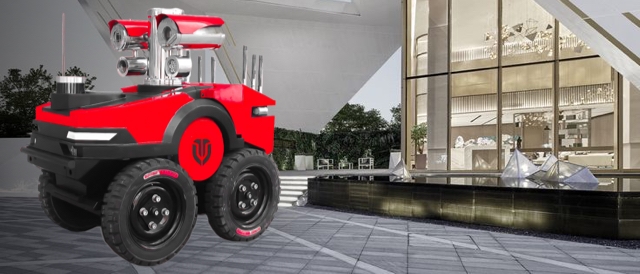
Topsky All-terrain fire fighting robot

In stock
- BRAND:
- TOPSKY
- MODEL:
- RXR-M80LGD
- PART #:
- RXR-M80LGD
- ORIGIN:
- China
- Warranty:
- 12 MONTHS
- AVAILABILITY:
- SUBJECT TO AVAILABILITY
- SKU:
- Topsky-RXR-M80LGD
Topsky All-terrain fire fighting robot
Every fire has a line beyond which a hose team should not go: the heat is too fierce, the air too poor, the ground too broken to trust. The Topsky All-terrain fire fighting robot is built to work on the far side of that line. Model RXR-M80LGD mounts a remotely controlled water monitor on a chassis that combines tracks, four swing arms and full metal tyres. The nozzle can therefore be driven across debris, mud and uneven surfaces into positions that people should not occupy, while the operator directs the attack from a safer distance.
Robots Europa, based in Dublin, supplies the RXR-M80LGD to fire and rescue services, industrial fire brigades and infrastructure operators across the European Union and the DACH region. We prepare each quotation, coordinate delivery to your site and remain your point of contact for technical questions, commissioning and after-sales support once the robot is in service.
Background
TOPSKY and its firefighting robot family
TOPSKY offers a range of firefighting robots, and the RXR-M80LGD is one of several models that Robots Europa supplies from that range. Alongside it sit a portable four-wheel-drive unit, a dry-powder extinguishing robot, smoke-exhaust variants and dedicated reconnaissance machines, each aimed at a different task on the fireground. The complete line-up can be compared in our Firefighting Robots category. Within that family, the All-terrain model is the one whose name puts the ground first: its purpose is to carry a high-flow water monitor over terrain where access, rather than water supply, is the limiting factor.
Firefighting robots of this class have become a recognised tool for incidents where the risk to personnel outweighs the benefit of a close-in attack. Instead of committing a crew to a collapsing structure or a burning process area, the incident commander sends a machine forward, connects it to a supply line and controls the monitor remotely. The approach does not replace firefighters; it changes where they stand.
A hybrid chassis of tracks, swing arms and metal tyres
The RXR-M80LGD uses what TOPSKY describes as a track plus front and rear four-arm plus tyres design. In general terms, tracks spread the weight of a vehicle and maintain traction on loose or soft surfaces, while articulated swing arms allow a tracked robot to raise its front or rear section to mount a step or settle onto an obstacle in a controlled way. The tyres on this model are full metal, intended to cope with high-temperature environments where rubber would be at risk.
Propulsion comes from a DC motor supplied by a large-capacity battery, and the robot follows a modular distributed control design. Distributed control, as an engineering approach, assigns functions to separate modules rather than a single central unit, which generally makes individual subsystems easier to diagnose and service. For an operator, the practical result is an electrically driven machine with no combustion engine to draw air from the fire zone.
Technical Specifications
| Specification | Value |
|---|---|
| Weight | 564kg |
| Size (detail table) | 1520*1340*1265mm |
| Unit size (specification list) | 148 *117 *83cm |
| Structure | Track + front & rear 4 arm + tyres design |
| Tyres | Full metal tyres, adapted to high-temperature environments |
| Drive and control | DC motor with large-capacity battery, modular distributed control design |
| Walking speed | 2m/s |
| Climbing | ≥ 30° |
| Obstacle climbing | 550mm |
| Chassis clearance | 150mm |
| Load capacity | 350kg |
| Control distance (detail table) | 1000m |
| Remote control distance (specification list) | ≥300m |
| Flow rate | 19~80 L/S |
| Working pressure | 1.0-1.4mpa |
| Injection distance | ≥60-110 m |
| Horizontal rotation angle | 360 |
| Pitch angle | Electronic control 30~90 |
| Monitor functions | Spray / jet mode switch, shoot / rod angle switching, swing function |
Specifications as published by the manufacturer; they are confirmed against the datasheet at quotation.
The manufacturer has not published the battery capacity, run time, charging time, ingress protection rating, explosion-proof rating, camera specifications, gas detection sensors, remote controller details or the contents of the box; these are confirmed at quotation.
How does the RXR-M80LGD cope with rubble, kerbs and slopes?
Access is the first question at any large incident, and the chassis figures address it directly. The robot climbs obstacles of 550mm and gradients of ≥ 30°, which covers kerbs, low walls, steps in a loading area and the kind of debris piles left after a partial collapse. A chassis clearance of 150mm keeps the underside clear of scattered material, while the swing arms give the tracks a way to approach an obstacle rather than simply striking it.
At 564kg, the machine is substantial. Mass of this order is generally an advantage for a monitor-carrying robot, because the reaction force of a high-flow jet acts on the vehicle, and a heavier platform is less inclined to shift while the monitor is working. The walking speed of 2m/s allows the robot to cover the approach to a fire quickly once a route is clear, and the load capacity of 350kg indicates a sturdy platform. The metal tyres complete the picture: they are the part of the running gear designed with hot ground in mind.
What can the water monitor do on the fireground?
The monitor is the reason the chassis exists, and its figures are those of a serious suppression tool. It delivers a flow rate of 19~80 L/S at a working pressure of 1.0-1.4mpa, with an injection distance of ≥60-110 m. That reach allows the robot to stand off from radiant heat while still placing water where it is needed.
Aiming is handled remotely. The monitor turns through a horizontal rotation angle of 360, and its pitch is electronically controlled across 30~90. The operator can switch between spray and jet modes, change between shoot and rod angle positions and engage a swing function. In general practice, a straight jet is chosen for reach and penetration into a fire, while a spray pattern is used to cool exposures and create a protective water curtain; a swing function sweeps the stream back and forth across a wider area without continuous input from the operator. Having all of these options on one remotely controlled platform lets the commander adapt tactics as the incident develops, without sending anyone forward to reposition a branch.
Who is the Topsky All-terrain fire fighting robot for?
The first group of buyers is public fire and rescue services that respond to large-scale incidents: warehouse fires, transport hubs, industrial estates and structural collapses where a sustained, high-volume water attack is required from a position crews cannot safely hold. The second is industrial fire brigades at petrochemical plants, energy facilities and heavy manufacturing sites, where fixed protection may need to be supplemented by a mobile monitor that can be driven to the affected area. The third comprises operators of airports, railways and tunnels, whose incident plans often involve long approach routes and confined, smoke-filled spaces.
Some requirements are better served elsewhere in the range. Where operations take place in potentially explosive atmospheres, the absence of a published explosion-proof rating for this model matters, and buyers should also review the Topsky Explosion proof fire extinguishing and smoke exhaust robot. Where the task is scouting rather than suppression, the Topsky Small fire reconnaissance robot is the more natural starting point. Organisations evaluating remote platforms beyond firefighting can browse our wider selection of UGVs.
What is the Topsky All-terrain fire fighting robot used for?
- Stand-off fire attack: placing a high-flow stream on a fire from a position too hot or too unstable for a hose team.
- Cooling exposures: using spray mode to protect tanks, structures or neighbouring buildings from radiant heat.
- Industrial and petrochemical incidents: bringing a mobile monitor into process areas where conditions are unsafe for personnel.
- Transport infrastructure: supporting firefighting at airports, rail sites and large open-area fire scenes.
- Collapsed and debris-strewn buildings: crossing rubble to reach a seat of fire that crews cannot approach directly.
- Tunnels and underground spaces: advancing a water attack through smoke-filled, confined environments under remote control.
Pricing and Availability
Robots Europa supplies the RXR-M80LGD on a quotation basis, as each order depends on the intended application, the site and the operating requirements. When you request a quotation, please describe the incidents you plan to address, the water supply available and any certification your organisation requires, so that our team can confirm the configuration and the datasheet figures that apply. Delivery, customs and support are arranged with the quotation. To begin, use the quotation request available on this page.
Frequently Asked Questions
How far can the RXR-M80LGD project water?
The injection distance is ≥60-110 m. This reach allows the robot to attack a fire while staying clear of the most intense radiant heat.
What flow rate and working pressure does the monitor use?
The monitor delivers 19~80 L/S at a working pressure of 1.0-1.4mpa. It can switch between spray and jet modes and offers a swing function.
What obstacles and gradients can the robot handle?
It climbs obstacles of 550mm and gradients of ≥ 30°, with a chassis clearance of 150mm. The combination of tracks, four swing arms and metal tyres is designed for broken and uneven ground.
What is the control range?
The manufacturer's detail table lists a control distance of 1000m, and its specification list gives a remote control distance of ≥300m. Robots Europa states the figure that applies to your configuration in the quotation.
How is the robot powered?
The RXR-M80LGD uses a DC motor supplied by a large-capacity battery, with a modular distributed control design. Robots Europa provides the battery figures together with the quotation.
Can it operate on hot ground?
The robot runs on full metal tyres, which are designed to adapt to high-temperature environments. This is one of the reasons the chassis suits fire scenes where rubber running gear would be vulnerable.
Where can I buy the Topsky All-terrain fire fighting robot and what does it cost?
Robots Europa supplies the Topsky All-terrain fire fighting robot across the EU and the DACH region. The cost depends on configuration and delivery, so we provide it in a tailored quotation, which you can request on this page.
Summary
The value of the RXR-M80LGD lies in moving the line at which a fire can be fought. Its hybrid chassis of tracks, swing arms and full metal tyres brings a monitor across rubble, slopes and hot ground; the monitor itself, with its high flow, long reach and remote aiming, does the work that would otherwise demand a crew in harm's way. For fire services, industrial brigades and infrastructure operators who need to fight from beyond that line, Robots Europa supplies, delivers and supports the robot, and this page is the starting point.