
Topsky Small Fire Reconnaissance Robot
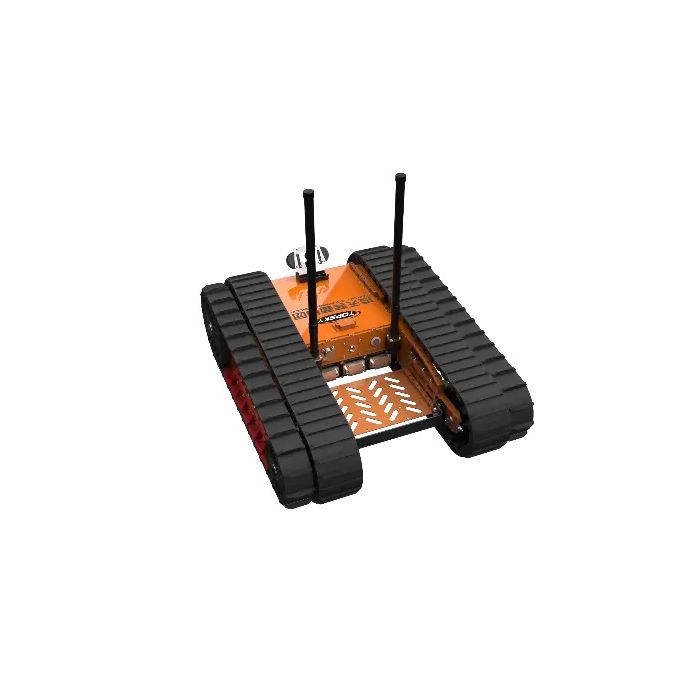
In stock
- BRAND:
- TOPSKY
- MODEL:
- RXR-C10D
- PART #:
- RXR-C10D
- ORIGIN:
- China
- Warranty:
- 12 MONTHS
- AVAILABILITY:
- SUBJECT TO AVAILABILITY
- SKU:
- Topsky-RXR-C10D
Topsky Small Fire Reconnaissance Robot
In any fire involving fuel, gas cylinders or stored chemicals, the most hazardous ground lies between the cordon and the source, where nobody yet knows what the air contains or what lies under the smoke. The Topsky Small fire reconnaissance robot is built to cover that ground instead of a crew. It is a compact tracked platform low enough to slip beneath a vehicle or a line of shelving, sealed for wet and dirty work, and able to return live video and gas readings while the incident commander keeps people at a safe distance.
Robots Europa, based in Dublin, supplies the RXR-C10D to fire and rescue services, industrial safety teams and public-sector buyers across the European Union and the DACH region. Robots Europa prepares each quotation, arranges delivery to your site and remains your point of contact for support once the robot is in service.
Background
Why fire services send a robot in first
Reconnaissance robots have become a standard tool for brigades and industrial fire teams because the opening minutes of an incident are often spent gathering information rather than fighting fire. Before entry is authorised, commanders need to know where the seat of the fire is, whether flammable or toxic gases are present and whether the structure is passable. A small unmanned ground vehicle can gather that picture without exposing a firefighter to an unknown atmosphere. Such robots typically work alongside larger suppression machines from the same family, which you will find in our Firefighting Robots category, and within the wider class of UGVs.
A crawler chassis with a front double swing arm
The RXR-C10D is built around a crawler chassis with a front double swing arm structure. The swing arms lift the front of the tracks onto an obstacle, so the robot can cross vertical obstacles of up to 280mm and climb a 360mm platform, then settle back to a low, stable profile for travel. The dual swing arms can also be removed entirely, which lets the operator adapt the robot to the task at hand. The tracks themselves are made of flame-retardant, anti-static, high-temperature-resistant rubber with Kevlar inside, and the track system has a derailment protection design. A multi-function expansion interface accepts mission modules, so the same chassis can be configured for mapping, gas detection, gimbal-mounted observation or manipulation.
Technical Specifications
| Specification | Value |
|---|---|
| Model | RXR-C10D small fire reconnaissance robot (B) |
| Chassis | Crawler + front double swing arm structure; dual swing arms detachable |
| Vertical obstacle crossing | ≥280mm |
| Platform climbing | 360mm |
| Slope climbing | 45 degrees |
| Stair climbing | 40 degrees |
| Trench crossing | 41 cm wide |
| Maximum linear speed | ≥2.7m/s, remote control stepless speed |
| Continuous walking time | ≥2h |
| Power | Electric, ternary lithium battery |
| Size | ≤length 610mm×width 490mm×height 200mm (without antenna) |
| Weight | ≤25kg |
| Protection level (whole robot) | IP67 |
| Wireless video transmission distance | 500m (open) two-point communication; 800m (open) three-point communication for occluded scenes (optional) |
| Wired remote control distance | 100m |
| Cameras | 2-channel HD camera |
| Expansion modules | Lidar module, gas detection module, reconnaissance gimbal module, robotic arm module |
| Track material | Flame-retardant, anti-static, high-temperature-resistant rubber with Kevlar inside; derailment protection design |
Specifications as published by the manufacturer; confirmed against the datasheet at quotation.
The manufacturer has not published the battery capacity, the charging time, the camera resolution, the operating temperature range, the gas sensor types or the ground clearance; Robots Europa confirms these with you at quotation.
How does the RXR-C10D reach spaces a larger robot cannot?
Most firefighting robots are designed to carry water monitors or smoke exhaust equipment, and their size reflects that payload. The RXR-C10D takes the opposite approach. With a height of no more than 200mm without antenna and a footprint of no more than 610mm by 490mm, it is built to investigate the places where hazards hide: the underside of a car body, the gap beneath warehouse shelving and other small, low spaces where a person would have to crawl and a larger machine could not fit at all.
Low height alone would not be enough if the robot could not reach those spaces in the first place. Here the swing arm chassis does the work. The robot climbs 45 degree slopes and 40 degree stairs, spans trenches 41 cm wide and crosses vertical obstacles of 280mm, so kerbs, loading bays, debris and stairwells do not end the mission. On open ground the operator can drive at a maximum linear speed of at least 2.7m/s with stepless remote control, which shortens the transit from the command point to the area of interest. Because the dual swing arms can be removed, the operator can also strip the robot back to its tracks when a lower, simpler configuration suits the space better.
At no more than 25kg, the robot is also a practical load for two crew members to carry from the appliance to the deployment point, which matters when the approach is blocked by vehicles, hoses or rubble.
Why does a reconnaissance robot need both wireless and wired control?
Radio links are convenient, but the environments in which a reconnaissance robot is most valuable are often the hardest on radio: reinforced concrete, steel racking, tunnels, basements and dense plant rooms. The RXR-C10D offers wireless video transmission of 500m in open conditions using two-point communication, and an optional three-point communication mode extends this to 800m in open conditions while addressing scenes where the line of sight is obstructed. In practice, the three-point arrangement adds a relay so the signal can be carried around a corner or past an obstruction.
Where radio cannot be relied upon, the robot can be operated by wired remote control over a distance of 100m. A physical link is the conventional fallback for unmanned ground vehicles working deep inside structures, and having it available on the same platform means a mission does not have to be abandoned when the wireless picture degrades. Together with the 2-channel HD camera, this gives the commander a continuous view of the route and the target area, whichever link is in use.
Who is the Topsky Small fire reconnaissance robot for?
The primary buyers are municipal and regional fire and rescue services that want a dedicated reconnaissance asset to deploy ahead of entry teams, particularly at incidents involving vehicles, storage facilities or suspected gas leaks. Industrial fire brigades at chemical plants, refineries, logistics centres and underground car parks form a second group: their sites combine flammable materials with confined, low-level spaces, which is exactly the terrain this robot is designed for.
Civil protection agencies and hazardous materials units are a third segment, using the gas detection module to characterise an atmosphere before committing personnel. Training academies and research groups working on unmanned response may also value the modular interface, since one chassis can be reconfigured with lidar, gimbal or robotic arm modules for different exercises.
The RXR-C10D is a reconnaissance tool and does not carry extinguishing equipment. Teams whose main requirement is suppression, smoke extraction or a larger mapping platform should compare it with machines such as the Topsky Firefighting reconnaissance modeling robot or the Topsky All-terrain fire fighting robot, and Robots Europa can advise on how the platforms complement one another.
What is the Topsky Small fire reconnaissance robot used for?
- Pre-entry reconnaissance: sending live video from a fire scene before crews are committed.
- Gas detection: sampling the atmosphere in flammable or explosive environments with the gas detection module.
- Under-vehicle inspection: examining the underside of car bodies at road traffic or car park incidents.
- Warehouse and storage fires: searching beneath shelving and racking where visibility is poorest.
- Complex structures: climbing stairs and crossing trenches and obstacles inside damaged or cluttered buildings.
- Mapping and observation: carrying the lidar or reconnaissance gimbal module to build a picture of the scene.
Pricing and Availability
Robots Europa supplies the Topsky Small fire reconnaissance robot on a quotation basis, so that the configuration, including the communication mode and the expansion modules you require, matches your operational needs. Delivery, customs and support are arranged with the quotation. Our team can also advise on the procurement documentation your organisation needs within the EU. To begin, tell us about your intended deployment using the quotation request available on this page.
Frequently Asked Questions
Is the robot waterproof?
The whole robot carries an IP67 protection level, which suits the wet and dirty conditions found at fire scenes.
How long can it operate on one charge?
The continuous walking time is at least 2h, powered by a ternary lithium battery. Battery capacity and charging time are among the details listed beneath the specification table.
Can it climb stairs?
Yes. The crawler and front double swing arm chassis climbs 40 degree stairs and 45 degree slopes, and crosses vertical obstacles of 280mm.
How far can it be controlled from?
Wireless video transmission reaches 500m in open conditions with two-point communication, or 800m with the optional three-point mode. Wired remote control works over 100m.
Which gases can it detect?
The robot accepts a gas detection module for reconnaissance in flammable and explosive environments. The sensor types are covered in the note beneath the specification table, and our team will discuss which suit the hazards you face.
What are the tracks made of?
The tracks are flame-retardant, anti-static, high-temperature-resistant rubber with Kevlar inside, and the track system includes derailment protection.
Where can I buy the Topsky Small fire reconnaissance robot and what does it cost?
You can buy it from Robots Europa, which supplies customers across the EU and the DACH region. Pricing depends on the configuration and modules you choose, so please request a quotation.
Summary
The hardest information to obtain at a fire is often found in the lowest, tightest and most dangerous places, and the RXR-C10D is designed to go there in place of people. Its crawler and detachable swing arm chassis carries it over stairs, trenches and obstacles; its low profile takes it beneath vehicles and shelving; its IP67 sealing, Kevlar-reinforced tracks and dual wireless and wired control keep it working where conditions are difficult. With lidar, gas detection, gimbal and robotic arm modules available, it gives commanders a clearer picture before anyone crosses the cordon. For fire services and industrial teams in Europe considering a dedicated reconnaissance robot, this page is the starting point.