
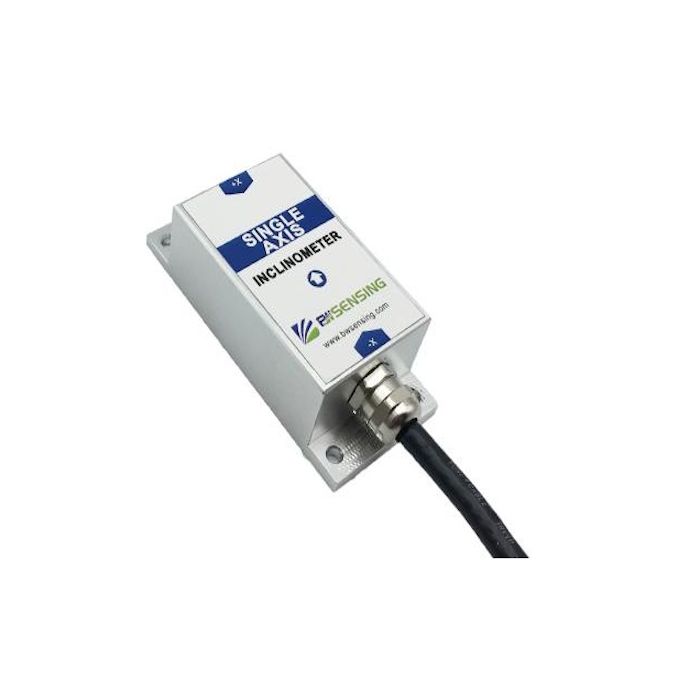
BWSENSING Low Cost Single-Axis Current Output Inclinometer (BWL318)
In stock
- BRAND:
- BWSENSING
- PART #:
- BWL318
- ORIGIN:
- China
- AVAILABILITY:
- SUBJECT TO AVAILABILITY
- SKU:
- BWSENSING-BWL318
BWSENSING Low Cost Single-Axis Current Output Inclinometer (BWL318)
On a solar tracker row, a telecom mast or a crane boom, the angle that matters is often measured several metres away from the controller that has to act on it, and every metre of cable is another opportunity for a reading to be distorted. The BWSENSING Low Cost Single-Axis Current Output Inclinometer (BWL318) meets that problem the way industrial instrumentation has long done: it expresses tilt as a current rather than a voltage, so the signal is far less sensitive to cable resistance and electrical interference on its way to the control cabinet. Built around an industrial level MEMS accelerometer and sealed to IP67, it measures inclination about one axis across ±180° and is intended to connect directly to the analogue input cards that most PLCs and controllers already carry.
Robots Europa, based in Dublin, supplies the BWL318 to system integrators, machine builders and maintenance teams throughout the European Union and the DACH region. We prepare each quotation individually, agree the output option and configuration with you before the order is placed, and remain your point of contact for technical questions and after-sales support once the sensor is in service.
Background
Wuxi Bewis Sensing Technology and the BWSENSING range
The BWL318 is designed by Wuxi Bewis Sensing Technology LLC, which trades as BWSENSING and was established in 2010. The company concentrates on inertial and tilt sensing for industrial customers, and its catalogue is organised less by measuring principle than by interface: the same basic task of reporting an angle is offered with analogue current, digital serial, Modbus and CAN outputs, in single-axis and dual-axis forms. The BWL318 occupies the low-cost, single-axis, current-output position in that family, which makes it the natural choice where a project is built around conventional analogue instrumentation rather than a fieldbus.
MEMS sensing with a current-loop output
Inside the housing, an industrial level MEMS accelerometer detects the direction of gravity relative to the sensor body, and the electronics convert that into an angle about the measured axis. Rather than leaving the integrator to process raw acceleration data, the BWL318 delivers the angle as a ready-scaled current, with 4-20mA, 0-20mA or 0-24mA available as options. A live-zero 4-20mA loop has a practical advantage that engineers value in the field: a reading of zero current indicates a broken wire or a lost supply rather than a genuine angle, so faults are distinguishable from measurements. The sensor accepts a wide 12-36V supply, which suits the 24V rails common in European control panels as well as many mobile and vehicle-mounted systems.
Technical Specifications
| Specification | Value |
|---|---|
| Sensor type | Single-axis inclinometer, industrial level MEMS accelerometer |
| Measurement range | ±180° |
| Highest accuracy | 0.1° |
| Resolution | 0.01° |
| Zero bias (-40~85℃) | ±0.02 °/℃ |
| Output | 4-20mA/0-20mA/0-24mA (optional) |
| Output frequency | 5-100Hz adjustable, up to 100Hz |
| Power supply | 12-36V |
| Start-up time | <3s |
| Protection level | IP67 |
| Impact resistance | 2000g, 0.5ms, 3 times/axis |
| MTBF | ≥90000 h |
| Dimensions | L90*W40.5*H26 (mm) |
| Weight | 210 g (without outer packaging) |
Specifications are as published by the manufacturer and are confirmed against the datasheet at quotation.
The manufacturer has not published the contents of the box, the cable length, the mounting hole spacing or the supply current at full load; we confirm these with you at quotation.
Why choose a current output inclinometer rather than a digital one?
Digital inclinometers communicating over RS232, RS485, Modbus or CAN can carry more information on a single cable, including diagnostics and configuration commands. That flexibility, however, comes at the cost of protocol set-up, addressing and software work on the controller side. A current-output sensor such as the BWL318 asks for none of this: the angle appears as a value on an analogue input channel, scaled across the chosen current range, and can be used by a PLC, a panel indicator or a data logger without any driver or communication stack.
Current loops are also well suited to long cable runs and electrically noisy environments, such as plant with frequency converters, large motors or welding equipment nearby. Because the loop drives a defined current regardless of moderate changes in cable resistance, the reading at the far end remains consistent. For retrofits, where an existing machine already has spare 4-20mA inputs and qualified electricians familiar with them, the BWL318 can often be added with minimal change to the control architecture.
Which output range should I specify for the BWL318?
The choice between 4-20mA, 0-20mA and 0-24mA usually follows the input hardware you already have. The 4-20mA option is the most widely supported range in industrial automation and gives the live-zero fault detection described above, which is why it is the default choice for safety-relevant monitoring such as tower tilt or lifting equipment. The 0-20mA range uses the full span of inputs that start at zero, while 0-24mA suits controllers designed around that wider span. Combined with the 0.01° resolution of the sensor, any of these ranges gives a fine-grained signal; the deciding factor is compatibility with your analogue input cards and your preferred fault-handling logic. Please tell us which range you need when requesting a quotation, so that the sensor is supplied configured accordingly.
Who is the BWL318 for?
The BWL318 is aimed at engineers who need a dependable angle reading on one axis and want it delivered over the analogue wiring they already use. Typical buyers include machine builders adding automatic levelling to platforms and equipment, integrators of photovoltaic tracking systems, operators of masts and towers who need continuous tilt monitoring, and manufacturers of lifting equipment who must keep inclination within safe limits. Its IP67 protection and impact resistance also make it a candidate for oil drilling equipment and other outdoor or rugged installations.
Where your controller works over a fieldbus rather than analogue inputs, another member of the family may suit you better: the BWSENSING Cost-Effective Single-Axis CAN Output Inclinometer (BWM415) addresses CAN-based machines, and the BWSENSING Cost-Effective Single-Axis Digital Output With Modbus Inclinometer (BWM417) addresses Modbus networks. If you need to measure tilt in two directions at once, the BWSENSING Cost-Effective Dual-Axis Inclinometer (BWM427) is worth comparing. The wider selection is available in our Sensors category, and we are glad to advise on the most suitable model for your application.
What is the BWL318 used for?
- Industrial automatic levelling – feeds a continuous angle signal to the controller that keeps a platform, machine bed or vehicle level.
- Photovoltaic automatic tracking – reports panel angle so that the tracker can follow the sun and correct its position.
- Tower tilt monitoring – watches masts, poles and towers for lean that may indicate settlement or structural stress.
- Lifting equipment inclination control – supplies boom or chassis angle to load-moment and safety systems on cranes and lifts.
- Oil drilling equipment – measures the attitude of drilling rigs and associated machinery in harsh outdoor conditions.
- Medical instruments, special valves and industrial converters – provides angle feedback for positioning mechanisms and valve actuators.
Pricing and Availability
Robots Europa supplies the BWL318 on a quotation basis, so that the output range, quantity and any project requirements are reflected in an offer prepared specifically for you. Delivery, customs formalities and technical support are arranged together with your quotation. To begin, simply send us your requirements using the quotation request available on this page.
Frequently Asked Questions
What measurement range does the BWL318 cover?
The BWL318 measures tilt about a single axis across ±180°, with a highest accuracy of 0.1° and a resolution of 0.01°.
Which current outputs are available?
The sensor is offered with 4-20mA, 0-20mA or 0-24mA output as an option. Please state the range you require when requesting a quotation.
Can the BWL318 be installed outdoors?
The sensor has IP67 protection and an impact resistance of 2000g, 0.5ms, 3 times/axis, which suits it to outdoor and rugged installations such as towers, trackers and drilling equipment.
What power supply does it need?
The BWL318 operates from a 12-36V supply, which covers the 24V rails used in most industrial control panels.
How stable is the reading across temperature?
The zero bias is ±0.02 °/℃ over -40~85℃, and the sensor is ready to output within <3s of power-up.
How long can the BWL318 be expected to run in service?
The manufacturer specifies a mean time between failures of ≥90000 h, which suits the sensor to continuous monitoring duties such as tower tilt and tracker positioning.
Where can I buy the BWSENSING Low Cost Single-Axis Current Output Inclinometer (BWL318) and what does it cost?
You can order the BWL318 from Robots Europa, which supplies customers throughout the EU and the DACH region. Pricing depends on quantity and configuration, so please request a quotation and we will send you a tailored offer.
Summary
The BWL318 is built for the gap between where an angle is measured and where it is acted upon. By pairing an industrial level MEMS accelerometer with a selectable current output, it carries a ±180° single-axis tilt reading across long, noisy cable runs into the analogue inputs that control systems already provide, without protocol configuration or additional software. IP67 sealing, a wide 12-36V supply and a robust housing extend that simplicity to outdoor and heavy-duty installations, from solar trackers to lifting equipment. Robots Europa quotes, delivers and supports the sensor across the EU and the DACH region; for an inclinometer that fits straight into analogue instrumentation, this page is the starting point.


