
BWSENSING Cost-Effective Dual-Axis Inclinometer (BWM427)
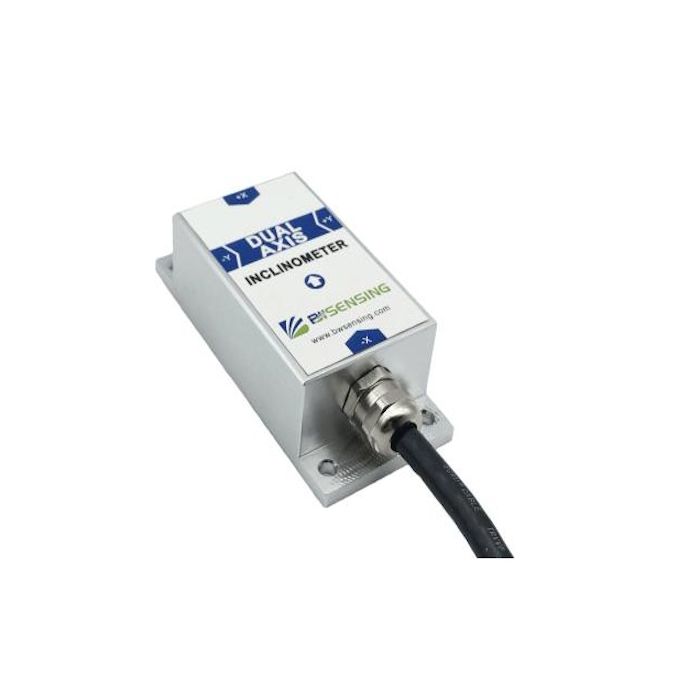
In stock
- BRAND:
- BWSENSING
- PART #:
- BWM427
- ORIGIN:
- China
- AVAILABILITY:
- SUBJECT TO AVAILABILITY
- SKU:
- BWSENSING-BWM427
BWSENSING Cost-Effective Dual-Axis Inclinometer (BWM427)
Gravity is the one reference every machine carries with it, and it never needs recalibrating. The difficulty lies in reading it. A solar tracker frame, a crane boom or a lattice tower moves through very small angles, in frost and in summer heat, and the controller downstream needs those angles as clean numbers rather than a bubble to be checked by eye. The BWSENSING Cost-Effective Dual-Axis Inclinometer (BWM427) addresses exactly that task. It takes the static gravitational field as its reference, measures tilt on two axes at once using MEMS technology, and delivers the result over a digital interface that a PLC, data logger or embedded board can read directly.
Robots Europa, based in Dublin, supplies the BWM427 to customers throughout the EU and the DACH region. We quote each order individually and help you choose between the RS232, RS485 and TTL versions. We also arrange delivery and provide technical support after the sale from within Europe. Integrators, equipment manufacturers and research groups therefore deal with a single contact from the first enquiry through to commissioning.
Background
BWSENSING and its family of inclinometers
BWSENSING builds a broad portfolio of tilt sensors. The BWM427 is one of several closely related models that Robots Europa carries. The range includes single-axis and dual-axis devices, variants with Modbus or CAN output, and digital dual-axis models such as the BWL326S. The words "Cost-Effective" appear in several of these product names and mark the line out as industrial sensors for projects in which many measuring points have to be equipped, not just one. The full selection is listed in our BWSensing category, and the wider range of measurement hardware is in Sensors.
Within this family, the BWM427 is the dual-axis model with a choice of three serial interfaces. It ships in three versions: BWM427-88-232, BWM427-88-485 and BWM427-88-TTL. The measuring element is the same in each, and the versions differ in how the angle data leaves the housing.
Measuring gravity with MEMS
The BWM427 measures the change of the static gravitational field and converts it into an angle change. In practice, a micro-machined sensing element inside the housing reacts to the component of gravity along each axis. The electronics translate those readings into pitch and roll values and then into a digital output. MEMS sensors of this kind are widely used in industrial inclinometers because they are compact, have no moving mechanical parts that wear, and can be sealed in a rugged enclosure.
Static measurement is the key point. An inclinometer of this type is designed to report the attitude of a structure or machine that is stationary or moving slowly. That is why its specifications quote resolution under completely still conditions. The sensor can be installed horizontally, which is the standard configuration. Vertical installation is also possible but requires customisation, so please tell us at the enquiry stage if your mounting surface is vertical.
Technical Specifications
| Specification | Value |
|---|---|
| Versions | BWM427-88-232; BWM427-88-485; BWM427-88-TTL |
| Technology | MEMS, digital output |
| Sensing principle | Change of static gravitational field converted into angle change |
| Measurement range (product page) | ±90° |
| Measuring range (technical manual, BWM427-88) | ±88° |
| Resolution (completely still) | 0.001° |
| Accuracy (room temperature) | 0.01° |
| Zero bias (-40~85℃) | ±0.005 °/℃ |
| Cross axis error (-40~85℃) | 0.01° |
| Output frequency | 5-100Hz adjustable, up to 100 Hz |
| Output interface | RS232/RS485/TTL optional |
| Power supply voltage (min / typical / max) | 9 / 12 / 35 V |
| Working current, no load (min / typical / max) | 20 / 30 / 40 mA |
| Operating temperature (min / typical / max) | -40 / 25 / 85 ℃ |
| Storage temperature (min / typical / max) | -55 / 25 / 100 ℃ |
| Protection level | IP67 |
| MTBF | ≥90000h |
| Insulation resistance | ≥100 MΩ |
| Dimensions | L90*W40.5*H26 (mm) |
| Installation | Horizontal or vertical (vertical installation requires customisation) |
Specifications as published by the manufacturer; confirmed against the datasheet at quotation.
The manufacturer has not published the package contents, the weight with connector, detailed shock and vibration ratings, or the operating systems supported by the debug software; Robots Europa confirms these points at quotation.
Which BWM427 version suits my system: RS232, RS485 or TTL?
All three versions share the same sensing element, the same accuracy and the same housing. The choice depends entirely on the electronics the sensor will connect to. RS232 is the traditional point-to-point serial link. It suits short cable runs to an industrial PC, a laptop used for commissioning, or older controllers that still have a serial port. RS485 is the usual choice in the field. It uses differential signalling that tolerates longer cables and electrical noise, and it allows several devices to share one bus. That is why it is the normal interface for tower, bridge and solar-field monitoring. TTL-level output is for direct connection to a microcontroller or single-board computer inside your own product, with no line driver in between.
The version codes all carry the suffix 88. This corresponds to the ±88° measuring range stated in the technical manual for the BWM427-88, whereas the manufacturer's product page lists ±90°. For most levelling and monitoring work, the angles in question lie far inside either limit. Where your application approaches the end of the range, we clarify the figure that applies to your version before you order.
How does the BWM427 hold its accuracy from -40 to 85 ℃?
An inclinometer that is accurate in the laboratory but drifts outdoors is of little use on a tower or a tracker. The BWM427 specification therefore covers the full operating temperature range, not only room temperature. Zero bias is specified at ±0.005 °/℃ across -40~85℃, and cross axis error at 0.01° across the same span. The cross axis figure matters on a dual-axis sensor because it describes how far tilt on one axis bleeds into the reading of the other. That effect becomes noticeable when a structure leans in two directions at once.
The housing is rated IP67, so the electronics are protected against dust and temporary immersion. Insulation resistance is specified at ≥100 MΩ and MTBF at ≥90000h, which are the figures maintenance planners need for installations that may run unattended for years. The supply range of 9 to 35 V means the sensor can run from the common 12 V and 24 V rails found on vehicles, machines and solar installations. The output frequency can be adjusted between 5 and 100 Hz, so the sensor can feed a fast control loop or a slow monitoring logger without overloading either.
Who is the BWSENSING Cost-Effective Dual-Axis Inclinometer (BWM427) for?
The BWM427 is aimed at engineers who need two-axis tilt data in digital form from a sealed device. Machine builders use it for automatic levelling of platforms, vehicles and industrial equipment. Solar integrators use it to report the position of photovoltaic trackers. Structural monitoring firms and infrastructure owners use it to watch towers and buildings for tilt and deformation over time. Surveying and mapping instrument makers, manufacturers of lifting equipment and developers of medical instruments are further users of the sensor.
Some projects are better served by a sibling model. If your control architecture is built around Modbus, compare the BWSENSING Cost-Effective Dual-Axis Digital Output With Modbus Inclinometer (BWN427), whose name indicates Modbus output. If you need only one axis and work on a CAN network, the BWSENSING Cost-Effective Single-Axis CAN Output Inclinometer (BWM415) is the relevant alternative. Our team will gladly compare the datasheets with you before you decide.
What is the BWSENSING Cost-Effective Dual-Axis Inclinometer (BWM427) used for?
- Industrial automatic levelling – feeds pitch and roll to the controller that brings a platform or machine to level.
- Photovoltaic automatic tracking – reports panel angle so the tracker drive can follow the sun accurately.
- Tower tilt monitoring – watches telecom, power and wind towers for gradual lean over long periods.
- Structural deformation monitoring – records slow movement in buildings, bridges and retaining structures.
- Surveying and mapping – provides attitude reference for instruments that must know their own inclination.
- Lifting equipment inclination control – supplies tilt data to the safety and control systems of cranes and aerial platforms.
Pricing and Availability
Robots Europa supplies the BWM427 on quotation, so that the version, the quantity and any customisation such as vertical installation are clarified before you commit. Delivery, customs and support are arranged with the quotation. Please tell us your interface, mounting orientation and project volume, and we will return a written offer for the version you need. A quotation for the BWSENSING Cost-Effective Dual-Axis Inclinometer (BWM427) is available on this page.
Frequently Asked Questions
How many axes does the BWM427 measure?
It measures two axes simultaneously and provides pitch and roll from a single housing. Both readings are delivered over the chosen digital interface.
What accuracy and resolution does the BWM427 offer?
Accuracy is 0.01° at room temperature and resolution is 0.001° under completely still conditions. Zero bias over -40~85℃ is ±0.005 °/℃.
Is the BWM427 suitable for outdoor installation?
Yes. The housing is rated IP67 and the operating temperature range is -40 to 85 ℃, which suits towers, solar fields and mobile machinery.
Which supply voltage does the sensor require?
The supply voltage range is 9 to 35 V, with 12 V as the typical value. No-load working current is typically 30 mA.
Can the BWM427 be mounted vertically?
The sensor is normally installed horizontally. Vertical installation is possible but requires customisation, which we clarify with you at quotation.
Does the BWM427 support Modbus or CAN?
The published interfaces for the BWM427 are RS232, RS485 and TTL. If you need Modbus or CAN, please look at the related BWSENSING models in our range, and we can advise you on which one fits.
Where can I buy the BWSENSING Cost-Effective Dual-Axis Inclinometer (BWM427) and what does it cost?
You can order it from Robots Europa, which supplies customers across the EU and the DACH region. The price depends on version, quantity and delivery destination and is set out in an individual quotation that you can request on this page.
Summary
Gravity is a free and permanent reference. The value of the BWSENSING Cost-Effective Dual-Axis Inclinometer (BWM427) lies in turning that reference into dependable numbers for two axes, with accuracy specified across the full temperature range, a sealed IP67 housing and a choice of RS232, RS485 or TTL output. It is suited to levelling systems, solar trackers, tower and structural monitoring, surveying and lifting equipment, and wherever tilt has to be known rather than estimated. Robots Europa helps you select the right version and supplies it from Dublin to the EU and the DACH region. For a quotation and technical advice, this page is the starting point.


