
Elephant Robotics Mercury Humanoid Robot B1 (4011300002)
In stock
- BRAND:
- ELEPHANT ROBOTICS
- PART #:
- 4011300002
- ORIGIN:
- China
- AVAILABILITY:
- SUBJECT TO AVAILABILITY
- SKU:
- Elephant-Robotics-4011300002
Elephant Robotics Mercury Humanoid Robot B1 (4011300002)
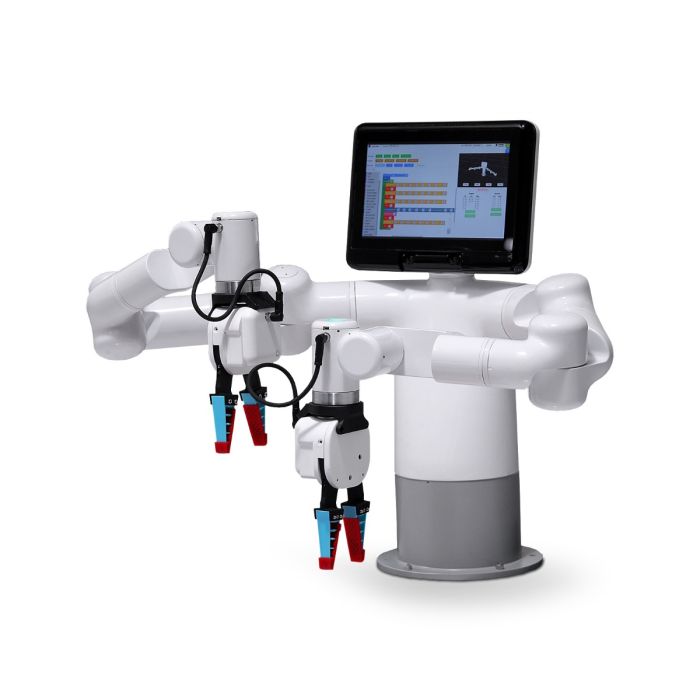
Humanoid research rarely stalls for lack of ambition. It stalls at the bench, where a platform has to be precise enough to trust, compact enough to share a room with people, and open enough to run code that was written last week. The Elephant Robotics Mercury Humanoid Robot B1 (4011300002) is built around that tension. Within a 200*192.5*537mm envelope it combines harmonic reducers, electromagnetic joint brakes, a 3D camera, a microphone array and an NVIDIA-based main controller. Manipulation, perception and teleoperation experiments can therefore take place on an ordinary laboratory table rather than in a fenced industrial cell.
Robots Europa, based in Dublin, supplies the Mercury B1 to universities, research institutes, training centres and companies across the European Union and the DACH region. Robots Europa prepares each quotation, arranges delivery to the customer's site and remains the point of contact for technical questions once the robot is in use.
Background
Elephant Robotics and the Mercury series
Elephant Robotics builds a broad catalogue of robots, from compact educational arms to collaborative manipulators, mobile platforms and companion robots. The Mercury series is the company's line of humanoid robots. It is designed as a development platform rather than a closed appliance: the series supports the major programming languages and widely used simulation platforms, including ROS, Moveit, Gazebo and Mujoco. For research groups this matters as much as the hardware. A humanoid that can be modelled in simulation before a single joint moves shortens the path from idea to experiment and lowers the risk of damaging equipment while algorithms are still immature.
The Mercury B1 sits in this series as a compact humanoid with 17DOF, a 450mm maximum working radius and a 1KG maximum payload. These figures place it firmly among precision platforms for laboratories, classrooms and demonstration spaces, not among heavy industrial manipulators. The emphasis is on accurate, repeatable motion and on the sensing and computing needed to study how a robot perceives and acts, rather than on moving large loads.
Harmonic drives, brakes and a direct human link
Three engineering choices define the character of the Mercury B1. The first is the reduction mechanism: the joints use harmonic reducers, a gear type valued in robotics for compact size, low backlash and high positional accuracy, which is reflected in the published repeatability of ± 0.05mm. The second is the joint brake, an electromagnetic friction plate design that holds the joints in position when they are not being driven. The third is the control interface. Paired with the myController S570 exoskeleton controller, the Mercury B1 achieves 1:1 motion replication, so an operator can guide the robot by moving their own arms rather than by programming every trajectory by hand.
Around this mechanical core, the structure combines carbon fibre, aluminium alloy and engineering plastics, and the robot runs on a 24V working voltage. A 9-inch touch screen provides a local interface for interaction and status display.
Technical Specifications
| Specification | Value |
|---|---|
| Product size | 200*192.5*537mm |
| Working voltage | 24V |
| Degrees of freedom | 17DOF |
| Maximum working radius | 450mm |
| Maximum payload | 1KG |
| Repeatability | ± 0.05mm |
| Net weight (manufacturer specifications page) | 8KG |
| Reduction mechanism | Harmonic Reducer |
| Joint brake | Electromagnetic friction plate |
| Computing power (manufacturer specifications page) | 67 TOPS |
| Main controller CPU (manufacturer specifications page) | 6-core NVIDIA Carmel Arm®v8.2 64-bit CPU 6MB L2 + 4MB L3 1.9GHz |
| Main controller GPU (manufacturer specifications page) | 512 core NVIDIA Volta architecture GPU with 64 Tensor Cores,1100MHz |
| Screen | 9-inch Touching Screen |
| Material | Carbon fiber, Aluminum alloy, Engineering plastics |
| 3D camera | Orbbec Deeyea |
| Microphone | Line array 4 microphones,5m 180° pickup |
| I/O | 24V 6 Input, 6 Output |
| Communication | CAN Bus/WIFI/Network port/Bluetooth/USB serial port |
| Exoskeleton control | 1:1 motion replication with the myController S570 exoskeleton controller |
| ROS support | ROS1 and ROS2, with RVIZ simulation environment support |
| Simulation platforms (Mercury series) | ROS, Moveit, Gazebo, Mujoco |
Specifications are as published by the manufacturer and are confirmed against the datasheet at quotation.
The manufacturer has not published the battery capacity, the operating time, the IP rating, the operating temperature, the power consumption or the contents of the box; Robots Europa confirms these details at quotation.
Which computing configuration does the Mercury B1 use?
Computing power is the figure that most shapes what a humanoid research platform can do on board, and it is also where the manufacturer's own sources differ. The Elephant Robotics specifications page lists the Mercury B1 at 67 TOPS, with a 6-core NVIDIA Carmel CPU and a 512-core NVIDIA Volta GPU with 64 Tensor Cores, and gives a net weight of 8KG. The manufacturer's shop page lists the Mercury B1 at 21 TOPS and 11.2KG. A further Mercury B1 version built on the Jetson Orin Nano 8GB is listed at 40 TOPS.
These are figures for different listings, and each belongs to its own configuration. For a buyer, the practical consequence is simple: the controller fitted determines how much perception and inference can run on the robot itself and how much must be offloaded to an external workstation. Vision models working with the Orbbec Deeyea 3D camera, speech processing from the microphone array and motion planning all compete for the same on-board resources. Robots Europa states in the quotation which controller and computing figure apply to the unit being supplied, so that a research plan can be matched to the hardware before an order is placed.
How does exoskeleton teleoperation work with the Mercury B1?
Programming a humanoid joint by joint is slow, and scripted trajectories rarely capture the subtlety of human movement. The Mercury B1 offers a second route. Paired with the myController S570 exoskeleton controller, it achieves 1:1 motion replication: the operator wears or holds the exoskeleton, moves naturally, and the robot mirrors the motion.
This changes the robot's role in a laboratory. Instead of being only a target for code, the Mercury B1 becomes a tool for capturing demonstrations. Research groups working on imitation learning and embodied intelligence need large sets of recorded human-guided motions paired with camera data, and teleoperation is one of the most direct ways to gather them. The same arrangement is useful in teaching, where students can see the link between a human gesture and a robot's joint space, and in exhibitions, where a live operator can make the robot respond to an audience. Combined with the RVIZ environment and ROS1 or ROS2, recorded motions can be visualised, analysed and replayed in software.
Who is the Mercury B1 for?
The Mercury B1 is aimed first at university departments and research institutes working on embodied AI, humanoid manipulation and human–robot interaction. Its ROS1 and ROS2 support, compatibility with Moveit, Gazebo and Mujoco across the Mercury series, and an open set of interfaces, including CAN Bus, Wi-Fi, a network port, Bluetooth and a USB serial port, allow it to slot into existing research software stacks.
Teaching institutions form a second group. A compact, desk-scale humanoid with a touch screen and precise joints is well suited to courses in robotics, control and computer vision, where students need hands-on access without the space and safety arrangements of an industrial cell. A third group is corporate innovation teams and service-robotics developers who want to prototype interaction, voice and vision applications before committing to larger hardware. Museums, trade-fair exhibitors and science centres complete the picture, using the robot as an engaging demonstration of humanoid technology.
Buyers assessing the wider Mercury family can also review the Elephant Robotics Mercury Humanoid Robot A1 (4011300001) and the Elephant Robotics Mercury X1 Wheeled Humanoid Robot (4011300003). Each model has its own page, and Robots Europa sets out the differences when preparing a comparative quotation.
What is the Mercury B1 used for?
- Embodied AI research: testing perception-to-action pipelines that link the 3D camera and on-board computing to real joint motion.
- Imitation learning data collection: recording human demonstrations through 1:1 motion replication with the myController S570.
- Robotics education: teaching ROS1, ROS2 and RVIZ on a physical humanoid rather than in simulation alone.
- Simulation-to-reality studies: developing behaviour in Gazebo or Mujoco and validating it on the real robot.
- Human–robot interaction: studying voice and gesture interaction with the microphone array and the touch screen.
- Exhibitions and demonstrations: presenting humanoid technology live at trade fairs, museums and open days.
Pricing and Availability
Robots Europa supplies the Mercury B1 on a quotation basis, so that each offer reflects the confirmed configuration, any accessories such as the myController S570, and the requirements of the receiving institution. Delivery, customs and support are arranged with the quotation. To begin, please send a short description of your project and the delivery country; the form to request a quotation is available on this page.
Frequently Asked Questions
How many degrees of freedom does the Mercury B1 have?
The Mercury B1 has 17DOF. Together with a maximum working radius of 450mm, this gives it a flexible workspace for tabletop manipulation tasks.
How precise is the Mercury B1?
The manufacturer specifies a repeatability of ± 0.05mm. The joints use harmonic reducers and electromagnetic friction plate brakes.
Which software environments does it support?
The Mercury B1 supports both ROS1 and ROS2 and provides RVIZ simulation environment support. The Mercury series also works with Moveit, Gazebo and Mujoco.
Can the robot be controlled by human movement?
Yes. Paired with the myController S570 exoskeleton controller, the Mercury B1 achieves 1:1 motion replication of the operator's movements.
What sensors does the Mercury B1 carry?
It carries an Orbbec Deeyea 3D camera and a line array of 4 microphones with 5m 180° pickup, alongside a 9-inch touch screen for interaction.
Is the battery life published?
No. The manufacturer has not published the battery capacity or the operating time, and Robots Europa confirms these details when preparing the quotation.
Where can I buy the Mercury B1 and what does it cost?
Robots Europa, based in Dublin, supplies the Mercury B1 across the European Union and the DACH region. The cost depends on the configuration and delivery requirements, and is set out in an individual quotation requested through this page.
Summary
The Mercury B1 answers the bench-level problem that holds back so much humanoid research: how to fit precise joints, 3D vision, voice pickup, on-board computing and a direct human control link into a robot that shares a table with its researchers. With 17DOF, ± 0.05mm repeatability, harmonic reducers, ROS1 and ROS2 support and 1:1 teleoperation through the myController S570, it turns a compact footprint into a working platform for embodied AI, teaching and demonstration. Robots Europa confirms the exact configuration, arranges delivery and provides support across the EU and the DACH region. For a quotation tailored to your laboratory or classroom, this page is the starting point.


