
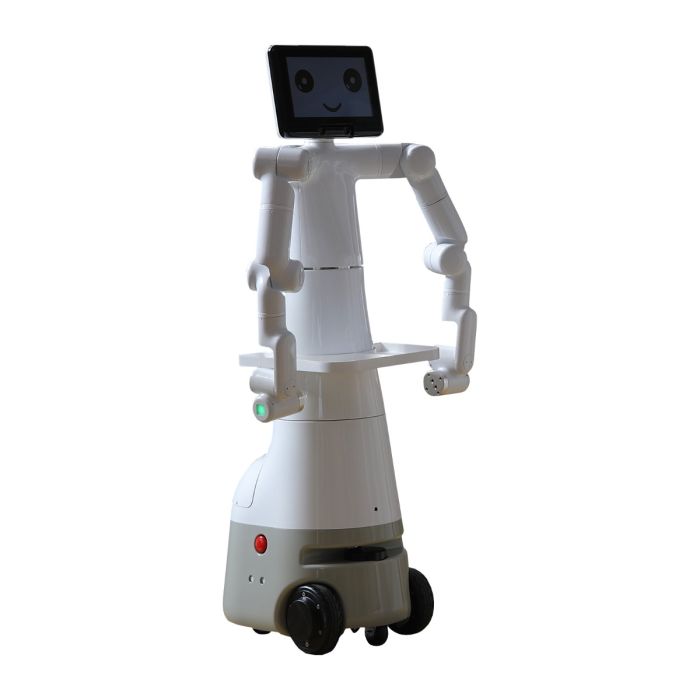
Elephant Robotics Mercury X1 Wheeled Humanoid Robot (4011300003)
In stock
- BRAND:
- ELEPHANT ROBOTICS
- PART #:
- 4011300003
- ORIGIN:
- China
- Warranty:
- 12 MONTHS
- AVAILABILITY:
- ALLOW 4-6 WEEKS FOR DELIVERY
- SKU:
- Elephant-Robotics-4011300003
Elephant Robotics Mercury X1 Wheeled Humanoid Robot (4011300003)
Most dual-arm research rigs are clamped to a bench, so the experiment has to be brought to the robot: objects are staged within reach, cameras are fixed in place and the real room remains out of scope. The Elephant Robotics Mercury X1 Wheeled Humanoid Robot (4011300003) turns that relationship around. It places a two-armed upper body on a powered mobile base, brings its own sensing, screen, microphones and AI computer along, and goes to the task, whether that is a shelf at the far end of the laboratory, a visitor at reception or a test bench in another room.
Robots Europa, based in Dublin, supplies the Mercury X1 to universities, research institutes, corporate innovation teams and system integrators throughout the European Union and the DACH region. Robots Europa prepares each quotation, arranges delivery to your site and remains your point of contact for technical questions once the robot is in service.
Background
Elephant Robotics and the Mercury lineage
Elephant Robotics builds a broad family of robots for education, research and light commercial work, from compact desktop arms such as the myCobot range to the myBuddy dual-arm platform and the myAGV mobile robots. The Mercury series is the company's step towards full humanoid form factors, and it is built in modules. The Mercury X1 is not a separate design from first principles: it combines the Mercury B1 dual-arm robot with a high-performance mobile base. For a laboratory this matters, because the upper body, its kinematics and its software remain consistent across the series, while the base adds the ability to move through a building.
Positioning: embodied intelligence on wheels
Elephant Robotics designs the Mercury X1 for embodied intelligence applications, the field in which AI models perceive, decide and act through a physical body rather than through a screen alone. Wheeled humanoids occupy a pragmatic position within the wider humanoid category. A wheeled base avoids the balance and gait problems of bipedal walking, keeps the platform stable while the arms work, and frees researchers to concentrate on manipulation, perception and interaction. The X1 supports this with onboard edge computing on a Jetson Orin Nano SUPER 8GB module rated at 67 TOPS of AI performance, a dedicated ESP32 sub-controller for the arms, and a sensor set on the base comprising LIDAR, ultrasonic radar and 2D vision. Software development runs on both ROS1 and ROS2, with RVIZ simulation environment support.
Technical Specifications
| Specification | Value |
|---|---|
| Product type | Wheeled dual-arm humanoid robot |
| Composition | Mercury B1 dual-arm robot + high-performance mobile base |
| Degree of Freedom | 19DOF |
| Product Height | 1.18m |
| Net weight | 55KG |
| Working Voltage | 24V |
| Battery life | 8 hours |
| Maximum Payload | 1KG |
| Repeatability | ± 0.05mm |
| Maximum Operating Speed | 1.2m/s |
| Maximum Climbing Angle | 15° |
| Maximum Climbing Height | 2CM |
| Storage Space | 15L |
| Main Control | Jetson Orin Nano SUPER 8GB |
| AI Performance | 67 TOPS |
| Sub Control Model | ESP32 |
| Mobile Sensors | LIDAR, Ultrasonic Radar, 2D Vision |
| Screen | 9-inch Touching Screen |
| Microphone | Line array 4 microphones, 5m 180° pickup |
| Communication | WIFI/Network port/Bluetooth/USB serial port |
| IO | 24V 6 Input, 6 Output |
| ROS support | ROS1 and ROS2, RVIZ simulation environment |
| Operating systems | Windows, Linux, MAC |
Specifications are as published by the manufacturer and are confirmed against the datasheet at quotation.
The manufacturer has not published the battery capacity, charging time, IP rating, package contents, arm reach, operating temperature, power consumption or chassis dimensions; Robots Europa confirms these details with the quotation.
What does the mobile base add to the Mercury B1?
The most useful way to understand the Mercury X1 is as the Mercury B1 dual-arm robot given a means of transport. A stationary dual-arm system is limited to the workspace its arms can cover. The X1's base removes that limit: with direct drive motors, a maximum operating speed of 1.2m/s, a maximum climbing angle of 15° and a maximum climbing height of 2CM, it can move between rooms, cross typical floor thresholds and approach a workstation rather than waiting for the work to arrive.
Mobility also changes what the robot needs to know about its surroundings. The base carries LIDAR, ultrasonic radar and 2D vision, giving developers the data required for mapping, localisation and obstacle avoidance. Combined with 15L of storage space, the platform can collect an item, carry it and present it elsewhere, which is the core loop of mobile manipulation research. A battery life of 8 hours allows a full working day of experiments or demonstrations without returning to the charger between sessions.
Is the Mercury X1 a practical platform for ROS and AI development?
For software teams, the deciding factors are usually compute, interfaces and ecosystem, and the X1 addresses all three. The Jetson Orin Nano SUPER 8GB main controller delivers 67 TOPS of AI performance on the robot itself, so vision models, speech processing and planning can run locally rather than depending on a tethered workstation. Arm control is delegated to an ESP32 sub-controller, which separates real-time motion from higher-level reasoning.
Connectivity covers WIFI, a network port, Bluetooth and a USB serial port, and the 24V IO with 6 inputs and 6 outputs allows the robot to interact with external equipment such as sensors, fixtures or signalling devices. Support for both ROS1 and ROS2 means that existing code bases can be brought across, while RVIZ simulation environment support helps teams visualise and test behaviour before running it on hardware. Development is supported from Windows, Linux and MAC. With 19DOF and a repeatability of ± 0.05mm, the arms offer the consistency needed when a manipulation routine must be repeated many times for evaluation or data collection.
Who is the Mercury X1 for?
The X1 is aimed first at research groups working on embodied intelligence, mobile manipulation and human-robot interaction. University laboratories gain a single platform on which students can study navigation, dual-arm coordination, perception and speech together, rather than integrating separate arms and bases themselves. Corporate innovation and R&D teams can use it to prototype service scenarios, such as fetching, guiding or greeting, before committing to a larger deployment.
Educators running robotics and AI programmes will value the ROS1 and ROS2 support and the onboard computer, which allow course material to move from simulation in RVIZ to physical tests on the same machine. The 9-inch touch screen and the line array of 4 microphones make the robot suitable for interaction studies and public demonstrations in museums, showrooms or exhibition stands.
Not every buyer needs the mobile base. Where the work takes place at a fixed station and mobility adds nothing, the Elephant Robotics Mercury Humanoid Robot B1 (4011300002), the dual-arm robot on which the X1 is built, is the more focused choice. The series also includes the Elephant Robotics Mercury Humanoid Robot A1 (4011300001), and Robots Europa can compare the versions for your application. To see the wider range, browse our Wheeled Humanoids and Humanoids categories.
What is the Mercury X1 used for?
- Embodied AI research: running perception and decision models on the robot's own Jetson computer and testing them through physical action.
- Mobile manipulation: combining navigation and dual-arm handling to collect, carry and place light objects across a building.
- Human-robot interaction studies: using the touch screen and microphone array to explore speech, gesture and on-screen dialogue with people.
- Robotics teaching: giving students a single ROS1 and ROS2 platform for navigation, manipulation and simulation coursework.
- Service robot prototyping: trialling reception, guidance and delivery scenarios before a commercial roll-out.
- Demonstration data collection: recording repeatable manipulation sequences for training and evaluating learning-based control.
Pricing and Availability
Robots Europa supplies the Mercury X1 on quotation, so that the offer reflects your configuration, your project and your delivery location within the EU or the DACH region. Delivery, customs and support are arranged with the quotation. If you would like us to confirm the unpublished details, such as package contents or operating temperature, before you commit, simply mention them in your request. To begin, use the quotation request available on this page.
Frequently Asked Questions
Does the Mercury X1 support ROS2?
Yes. The Mercury X1 supports both ROS1 and ROS2 and provides RVIZ simulation environment support.
Which computer controls the robot?
The main controller is a Jetson Orin Nano SUPER 8GB with 67 TOPS of AI performance. An ESP32 serves as the sub-controller for the arms.
How long does the Mercury X1 run on one charge?
Battery life is 8 hours. The charging time and battery capacity have not been published, and Robots Europa confirms them at quotation.
Can the robot handle ramps and door thresholds?
The mobile base has a maximum climbing angle of 15° and a maximum climbing height of 2CM, which suits typical indoor ramps and low thresholds.
What payload can the Mercury X1 handle?
The maximum payload is 1KG, which makes it well suited to light objects such as tools, samples and everyday items. A 15L storage space on the base can be used to carry items between locations.
How does the Mercury X1 differ from the Mercury B1?
The Mercury X1 is the Mercury B1 dual-arm robot combined with a high-performance mobile base. The B1 suits fixed-station work, while the X1 adds navigation, base sensors and the ability to move between workspaces.
Where can I buy the Mercury X1 and what does it cost?
You can buy the Mercury X1 from Robots Europa, which supplies customers across the EU and the DACH region. The cost depends on your configuration and delivery requirements, so Robots Europa provides it in a tailored quotation.
Summary
The Mercury X1 answers a simple limitation of bench-mounted dual-arm robots: the world they can study ends where their arms stop. By placing the Mercury B1 upper body on a mobile base with LIDAR, ultrasonic radar and 2D vision, and by running AI workloads on an onboard Jetson Orin Nano SUPER 8GB, it lets research and teaching move into corridors, reception areas and multi-room laboratories. ROS1 and ROS2 support, 19DOF, 8 hours of battery life and practical interfaces make it a coherent platform for embodied intelligence work. If your next project needs a robot that goes to the task, this page is the starting point.


