
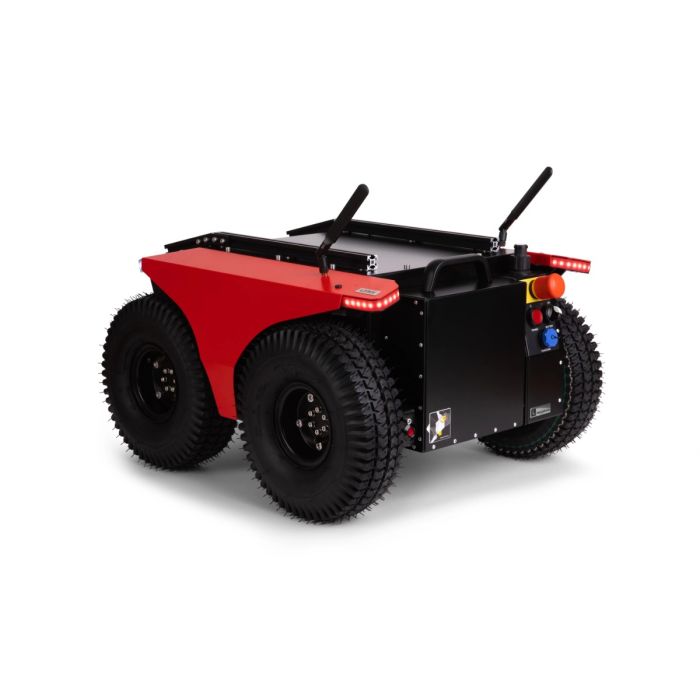
Husarion Lynx UGV
In stock
- BRAND:
- HUSARION
- MODEL:
- PANTHER
- PART #:
- PTH12
- ORIGIN:
- Poland
- AVAILABILITY:
- SUBJECT TO AVAILABILITY
- SKU:
- Husarion-Lynx-UGV
Husarion Lynx UGV
There is a familiar gap between the robots that live on laboratory benches and the vehicles that work in yards, on gravel tracks and along the edges of fields. The first are easy to program but rarely survive the outdoors; the second are rugged but closed to the developer. The Husarion Lynx UGV is built to close that gap. It is a compact, robust unmanned ground vehicle platform designed for both indoor and outdoor environments, with an open-source ROS 2 driver at its core and a T-slot mounting rail ready for the sensors and manipulators a project calls for. It can leave the corridor, cross the car park and carry on over rough ground, while the team behind it keeps working in the same software environment.
Robots Europa, based in Dublin, supplies the Husarion Lynx UGV to universities, research institutes, system integrators and industrial development teams across the European Union and the DACH region. Robots Europa prepares each quotation, arranges delivery to the customer's site and remains the point of contact for technical questions once the platform is in service.
Background
Husarion and its development platforms
Husarion builds mobile robots for developers rather than for end users. Its range, which can be browsed in the Husarion category, shares one principle: the robot is a base on which a team builds its own application, supported by ROS-oriented software, examples and documentation that shorten the path from unpacking to the first experiment. The Lynx takes its place in that range as a platform for mixed indoor and outdoor work. The manufacturer names two versions, LNX02L (Husarion Lynx UGV Lite) and LNX02S (Husarion Lynx UGV Standard), lists IP54 and IP66 protection options, and also uses the configuration codes UC01 and UC02. Which combination suits a given project is clarified with Robots Europa when the quotation is prepared.
An open base for payloads
The defining idea of the Lynx is integration. A T-slot mounting rail runs along the platform, so LIDARs, 3D cameras, manipulators and other components can be fixed securely and repositioned as an experiment evolves. User power ports supply up to 780 W in total, with 5 V, 12 V, 19 V and 32–42 V outputs, which means most sensors and many actuators can draw power directly from the robot rather than from separate batteries. Extensive communication interfaces connect those payloads to the onboard computing.
On the software side, the open-source ROS 2 driver is accompanied by a comprehensive suite of software examples, including an open-source autonomy stack. The robot carries a built-in computer with a quad-core 64-bit SoC at 1.5GHz and 4GB RAM, and a PhidgetSpatial 3/3/3 Precision IMU combining a 3-axis compass, a 3-axis gyroscope and a 3-axis accelerometer. For heavier perception and planning workloads, a dedicated user computer can be specified: an ASUS NUC, a Lenovo ThinkStation P360 Tiny or an NVIDIA Jetson Orin NX.
Technical Specifications
| Specification | Value |
|---|---|
| Product type | Compact and robust UGV platform for indoor and outdoor environments |
| Dimensions (L x W x H) | 0.65 x 0.55 x 0.38 m |
| Weight (overview) | 40 kg (including battery) |
| Weight (with WH05 wheels, manual) | 38.8 kg |
| Ground clearance | 85 mm |
| Protection index | IP54 / IP66 |
| Operating temperature | -20°C to 50°C |
| Max speed | 1.5 m/s |
| Max carrying capacity | 65 kg |
| Hill climb grade (with 36 / 65 kg cargo) | 90% (42°) / 56% (29°) |
| Traction force (nominal / max) | 362 N / 755 N |
| Motors | 2 x BLDC, 473 W each |
| Battery capacity / voltage | 720 Wh / 36V (nominal) |
| Battery chemistry | Lithium-Ion |
| Runtime | 4.5 h - 9 h |
| Output power (total / peak) | 1.0 kW / 1.8 kW |
| Charging temperature | 0°C to 45°C |
| User power ports | Up to 780 W total; 5 V, 12 V, 19 V, 32–42 V |
| Built-in computer | Quad-core 64-bit SoC @ 1.5GHz, 4GB RAM |
| IMU | PhidgetSpatial 3/3/3 Precision (3-axis compass, 3-axis gyroscope, 3-axis accelerometer) |
| Wheels (WH05) | All-terrain pneumatic wheels, tire size 4.00-4 |
| User computer options | ASUS NUC (Intel Core i7-1360P, 16GB RAM, 500GB SSD, Intel Iris Xe); Lenovo ThinkStation P360 Tiny (Intel Core i7-12700T, 16GB RAM, 512GB SSD, NVIDIA T1000); NVIDIA Jetson Orin NX (ARM Cortex A78AE, 16GB RAM, 512GB SSD, NVIDIA Ampere) |
| Software | Open-source ROS 2 driver, software examples including an open-source autonomy stack |
| Package content | Lynx mobile base, charger, gamepad |
Specifications as published by the manufacturer; confirmed against the datasheet at quotation.
The manufacturer has not published the exact weight of the Lite version, a test certificate for the ingress rating, a list of the communication interfaces or a service life independent of the warranty; these points are confirmed at quotation.
What makes the Husarion Lynx UGV suited to outdoor work?
Many development robots are, in practice, indoor machines that tolerate a dry pavement. The Lynx is specified differently. Its protection index is offered at IP54 or IP66, and its operating temperature range of -20°C to 50°C covers a winter morning in Bavaria as well as a summer afternoon in southern Europe. Charging is specified between 0°C and 45°C, which is worth bearing in mind when planning a field station in cold weather.
The running gear supports the same ambition. All-terrain pneumatic WH05 wheels with a 4.00-4 tire size absorb uneven surfaces, and 85 mm of ground clearance lets the chassis pass over kerbs, roots and debris. Two BLDC motors of 473 W each deliver a nominal traction force of 362 N and a maximum of 755 N. With 36 kg of cargo the platform climbs a 90% (42°) grade; at its full 65 kg it still manages 56% (29°). For a vehicle of 0.65 x 0.55 x 0.38 m, that combination allows test routes that leave the tarmac behind.
How much payload and computing can the Lynx carry?
A field robot is only as useful as what it can carry and power. The Lynx accepts a maximum carrying capacity of 65 kg, enough for a sensor mast, a robotic arm or a sampling module. The 720 Wh Lithium-Ion battery at 36V nominal provides a runtime of 4.5 h - 9 h, depending on load and terrain, while total output power is 1.0 kW with a 1.8 kW peak. The user power ports, with up to 780 W across four voltage options, mean that payloads can be fed from the same energy source as the drive.
Computing scales in the same way. The built-in computer handles the base functions, and the choice of an ASUS NUC, a Lenovo ThinkStation P360 Tiny or an NVIDIA Jetson Orin NX lets a team match processing power and GPU architecture to its perception pipeline, whether that relies on CPU-based mapping or on GPU-accelerated neural networks.
Who is the Husarion Lynx UGV for?
The Lynx is aimed first at research groups in field and mobile robotics who need a platform that behaves consistently indoors and outdoors, so that algorithms developed in the laboratory can be tested on real terrain without changing hardware. University departments teaching ROS 2 will appreciate the open-source driver and the autonomy examples, which give students a working baseline from the first session.
System integrators and product developers form the second group. Companies prototyping inspection, logistics or agricultural applications can use the Lynx as a proven mobile base and concentrate their effort on the payload and the application logic. Industrial innovation teams evaluating autonomous ground vehicles for site security or monitoring may also find it a practical test bed before committing to a dedicated design.
The choice between the Lite (LNX02L) and Standard (LNX02S) versions, and between the IP54 and IP66 protection options, depends on the environment and the payload; Robots Europa clarifies the differences with the customer during the quotation. Teams whose requirements point to a different size class can compare the wider range of UGVs in the catalogue.
What is the Husarion Lynx UGV used for?
- Autonomous navigation research – developing and testing mapping, localisation and path planning with the open-source ROS 2 driver and autonomy stack.
- Outdoor perception testing – carrying LIDARs and 3D cameras over uneven ground to gather real-world datasets.
- Mobile manipulation – mounting a manipulator on the T-slot rail to combine driving and grasping tasks.
- Inspection prototypes – building patrol or monitoring robots for yards, plants and infrastructure sites.
- Agricultural robotics development – trialling sensing and sampling payloads between crop rows or on farm tracks.
- Robotics education – giving students a robust platform for hands-on ROS 2 projects indoors and outdoors.
Pricing and Availability
Robots Europa supplies the Husarion Lynx UGV on the basis of an individual quotation, which reflects the chosen version, the protection option, the user computer and any additional payload components. Delivery, customs and after-sales support are arranged together with the quotation. To receive an offer tailored to your project, use the quotation request available on this page.
Frequently Asked Questions
Can the Husarion Lynx UGV operate outdoors?
Yes. It is designed for indoor and outdoor environments, is offered with IP54 or IP66 protection and operates from -20°C to 50°C.
How much weight can the Lynx carry?
The maximum carrying capacity is 65 kg. With that load the platform climbs a 56% (29°) grade.
How long does the battery last?
The 720 Wh Lithium-Ion battery gives a runtime of 4.5 h - 9 h, depending on load and conditions.
Which software does the Lynx support?
It is supported by an open-source ROS 2 driver and a suite of software examples, including an open-source autonomy stack.
Can I add my own sensors and computer?
Yes. The T-slot mounting rail, user power ports of up to 780 W and communication interfaces accept LIDARs, 3D cameras and manipulators, and an ASUS NUC, Lenovo ThinkStation P360 Tiny or NVIDIA Jetson Orin NX can be specified as the user computer.
What is included in the package?
The default package contains the Lynx mobile base, a charger and a gamepad.
Where can I buy the Husarion Lynx UGV and what does it cost?
Robots Europa supplies the Husarion Lynx UGV across the EU and the DACH region. The cost depends on the configuration, so please request a quotation on this page.
Summary
The Husarion Lynx UGV answers the question every mobile robotics team eventually faces: what happens when the experiment has to leave the laboratory? With all-terrain pneumatic wheels, IP54 or IP66 protection, a wide operating temperature range and a 65 kg carrying capacity, it handles the outdoors; with its T-slot rail, generous user power and open-source ROS 2 driver, it remains as open as a bench robot. That combination lets a project move from corridor to field without changing platform or software. Robots Europa supplies, delivers and supports the Lynx across Europe, and for anyone planning that move, this page is the starting point.


