
Husarion ROSbot 3 PRO UGV
In stock
- BRAND:
- HUSARION
- MODEL:
- ROSbot 3
- ORIGIN:
- Poland
- Warranty:
- 12 MONTHS
- AVAILABILITY:
- SUBJECT TO AVAILABILITY
- SKU:
- Husarion-ROSbot-3-PRO
Husarion ROSbot 3 PRO UGV
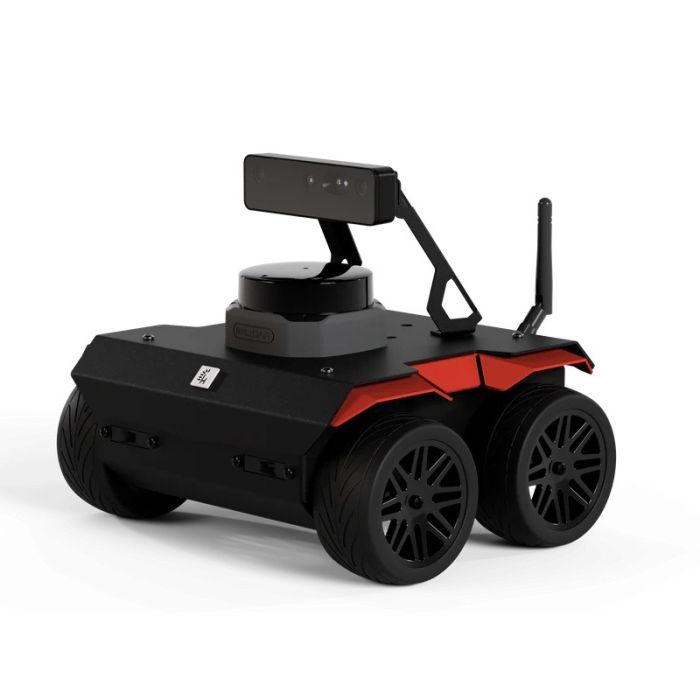
Every robotics laboratory knows the hidden cost of a new platform: the weeks spent mounting sensors, writing drivers and chasing calibration faults before a single experiment can begin. The Husarion ROSbot 3 PRO UGV is built to remove that cost. It arrives as a compact indoor robot with its LiDAR, depth camera, inertial sensor and distance sensors already integrated, and with the software that ties them together already installed. A research group can therefore start its first week with its own algorithms rather than with the robot's wiring. The platform fits on a desk, yet it carries a perception stack that would otherwise take considerable effort to assemble.
Robots Europa, based in Dublin, supplies the Husarion ROSbot 3 PRO UGV to universities, research institutes, schools and development teams throughout the European Union and the DACH region. Robots Europa prepares each quotation, arranges delivery to the customer's site and remains the point of contact for support after the robot has been commissioned.
Background
Husarion and the ROSbot family
Husarion develops mobile robots designed around the Robot Operating System, ranging from small indoor platforms for teaching and research to larger vehicles such as the Husarion Panther Industrial Grade Indoor / Outdoor UGV (PTH12). The ROSbot line occupies the compact end of that range. The current generation is offered in two versions: the ROSbot 3 and the ROSbot 3 PRO. Both share the same chassis, computer, drive sensing and software; the difference lies in the perception hardware mounted on top. The manufacturer describes the platform as an indoor mobile robot built for research and education, and every design decision reflects that purpose: a robust aluminium body, open-source drivers and a simulation model that mirrors the physical robot.
A complete perception stack on a Raspberry Pi 5
At the centre of the ROSbot 3 PRO sits a Raspberry Pi 5 single-board computer with a quad-core ARM Cortex-A76 processor at 2.4GHz, 8GB of RAM and 64 GB of MicroSD storage. It runs Ubuntu 24.04 with ROS 2 Jazzy preinstalled. Low-level control is handled by a dedicated STM32F407 microcontroller, which leaves the main computer free for mapping, localisation and planning. Around this core the PRO version places a Slamtec RPLIDAR S2 with 360-degree coverage and a Luxonis OAK-D Pro 3D camera, supported by a BNO055 9-axis absolute orientation sensor, four VL53L0X Time-of-Flight distance sensors and four magnetic wheel encoders. The result is a robot that can sense its surroundings in several complementary ways from the moment it is switched on.
Technical Specifications
| Specification | Value |
|---|---|
| Platform type | Indoor mobile robot platform for research and education |
| 3D camera | Luxonis OAK-D Pro |
| LIDAR | RPLIDAR S2, 360 degree |
| Single-board computer | Raspberry Pi 5 (ARM64 architecture), quad-core ARM-8 Cortex A76 @ 2.4GHz, 8GB RAM, 64 GB MicroSD flash memory |
| Operating system | Ubuntu 24.04 with ROS 2 Jazzy preinstalled |
| Built-in microcontroller | STM32F407 |
| Dimensions with camera and LiDAR (L x W x H) | 200 x 233 x 197 mm / 7.9 x 9.2 x 7.7 in |
| Weight | 2,84 kg / 100 oz (with camera and LiDAR); 2,45 kg / 86 oz (without camera and LiDAR) |
| Chassis material | Powder-coated aluminium plate, 1.5 mm thick |
| Maximum translational velocity | 1.0 m/s |
| Maximum rotational velocity | 420 deg/s (7.33 rad/s) |
| Maximum load capacity | Up to 5 kg / 176 oz (not in continuous work) |
| Battery life | 1.5h - 5h |
| Batteries | 3 x Li-Ion 18650, protected, rechargeable, 3500mAh capacity, 3.7V nominal voltage |
| Infrared distance sensors | 4 x VL53L0X Time-of-Flight, up to 200 cm range |
| IMU | BNO055 intelligent 9-axis absolute orientation sensor |
| Encoders | 4 x magnetic, 48cpr, 12 poles |
| USB | 2 x USB 2.0 host ports from SBC (rear panel) |
| Antenna | Dual-band, connected to the Wi-Fi USB adapter |
| Simulation | Simulation model available in Gazebo |
| Set contents | ROSbot 3 PRO, dedicated charger, USB Ethernet adapter, aluminium case |
Specifications are as published by the manufacturer and are confirmed against the datasheet at quotation.
The manufacturer has not published the IP rating, the operating temperature range, the camera resolution, the voltage of the battery pack or the power consumption; these are confirmed at quotation.
What does the ROSbot 3 PRO add over the ROSbot 3?
The two versions are identical in their chassis, computer, drive sensing, battery arrangement and software. What changes is the perception hardware. The standard Husarion ROSbot 3 UGV carries an RPLIDAR C1 and a Luxonis OAK-D Lite, whereas the ROSbot 3 PRO carries an RPLIDAR S2 and a Luxonis OAK-D Pro. In other words, the PRO is the version for those whose work depends most heavily on the quality of the sensor data itself.
For a teaching laboratory that introduces students to ROS 2 topics, teleoperation and basic mapping, the standard version already provides everything needed. For a research group publishing work on SLAM, visual odometry, depth perception or sensor fusion, the upgraded sensors of the PRO allow experiments to be built on stronger hardware without changing the rest of the platform. Because the software, the simulation model and the mechanical design are shared, code developed on one version transfers to the other, and a department can equip a teaching fleet with the standard robot while reserving the PRO for its research projects.
Can work on the ROSbot 3 PRO begin before the robot arrives?
It can. Husarion provides a simulation model of the ROSbot in the Gazebo environment, so that navigation stacks, mapping pipelines and control nodes can be developed and tested in software first. Once the physical robot is delivered, the same ROS 2 interfaces are already in place: the open-source drivers are preinstalled and configured, and the robot works out of the box on Ubuntu 24.04 with ROS 2 Jazzy. This continuity between simulation and hardware is particularly valuable in teaching, where a whole class can work in simulation while a smaller number of physical robots are shared for validation runs. It also suits project planning, since the first weeks of a grant or a thesis need not wait for hardware.
Connectivity supports the same workflow. A dual-band antenna connected to the Wi-Fi USB adapter allows remote development and visualisation, a USB Ethernet adapter is included in the set for wired connections, and two USB 2.0 host ports on the rear panel accept additional peripherals.
Who is the Husarion ROSbot 3 PRO UGV for?
The ROSbot 3 PRO is aimed first at university research groups working on indoor autonomy: mapping, localisation, path planning, perception and human-robot interaction. Its combination of a 360-degree LiDAR, a 3D camera, an inertial sensor and wheel encoders gives such groups a multi-sensor platform on which algorithms can be compared under repeatable conditions. Doctoral and master's students benefit from a robot compact enough to operate in an office or a corridor, and robust enough, with its powder-coated aluminium chassis, to withstand daily use.
Engineering faculties and technical colleges form a second group. Here the PRO is typically chosen for advanced modules and capstone projects, while introductory courses can be served by the Husarion ROSbot 3 UGV, which shares the same software and simulation model. Corporate research and development teams make up a third group: companies prototyping indoor service robots or evaluating navigation software can use the ROSbot 3 PRO as a reference platform before committing to custom hardware.
Buyers who need more space for their own payloads may wish to compare the Husarion ROSbot XL UGV, and those whose projects leave the building should look at the larger vehicles in the UGVs category, since the ROSbot 3 PRO is specified as an indoor platform.
What is the Husarion ROSbot 3 PRO UGV used for?
- SLAM research – building and evaluating maps from the RPLIDAR S2 and the OAK-D Pro in indoor environments.
- Autonomous navigation – developing and tuning ROS 2 navigation stacks for path planning and obstacle avoidance.
- Depth perception and computer vision – experimenting with 3D camera data for object detection and scene understanding.
- Sensor fusion – combining LiDAR, camera, IMU, encoder and Time-of-Flight data into robust state estimation.
- Robotics teaching – giving students a ready-configured ROS 2 robot for laboratory exercises and project work.
- Simulation-to-reality validation – testing algorithms in Gazebo first and then confirming them on the physical robot.
Pricing and Availability
Robots Europa supplies the Husarion ROSbot 3 PRO UGV on the basis of a written quotation prepared for each customer, whether the order concerns a single research robot or a set of platforms for a teaching laboratory. Delivery, customs formalities and support are arranged together with the quotation. To receive an offer for your institution or company, please use the quotation request available on this page.
Frequently Asked Questions
Which operating system does the ROSbot 3 PRO run?
The robot runs Ubuntu 24.04 with ROS 2 Jazzy preinstalled on its Raspberry Pi 5. The open-source ROS 2 drivers are installed and configured, so the robot works out of the box.
Which sensors are fitted to the ROSbot 3 PRO?
It carries a Slamtec RPLIDAR S2 with 360-degree coverage, a Luxonis OAK-D Pro 3D camera, a BNO055 9-axis orientation sensor, four VL53L0X Time-of-Flight distance sensors and four magnetic encoders.
How fast can the robot move?
The maximum translational velocity is 1.0 m/s and the maximum rotational velocity is 420 deg/s (7.33 rad/s).
How long does the battery last?
Battery life is 1.5h - 5h, depending on use. Power comes from three protected, rechargeable Li-Ion 18650 cells of 3500mAh each.
What is included in the set?
The set contains the ROSbot 3 PRO, a dedicated charger, a USB Ethernet adapter and an aluminium case.
Can the ROSbot 3 PRO be used outdoors?
The manufacturer specifies it as an indoor mobile robot platform, and no IP rating or operating temperature range has been published. For outdoor projects, Robots Europa can advise on larger Husarion platforms.
Where can I buy the Husarion ROSbot 3 PRO UGV and what does it cost?
Robots Europa supplies the robot throughout the EU and the DACH region. The price is set out in an individual quotation, which you can request on this page.
Summary
The value of a research robot is measured in the time it returns to its users. The Husarion ROSbot 3 PRO UGV returns that time by arriving with its RPLIDAR S2, OAK-D Pro, inertial sensor and distance sensors already integrated, its ROS 2 Jazzy software already configured and a Gazebo model ready for development before the hardware is unpacked. Within a compact, aluminium-bodied platform it offers the upgraded perception that distinguishes it from the standard ROSbot 3, while sharing the same software foundation. For research groups and faculties that would rather begin with their experiments than with integration work, and that want a supplier in Robots Europa to handle quotation, delivery and support, this page is the starting point.