
Husarion ROSbot 3 UGV
In stock
- BRAND:
- HUSARION
- MODEL:
- ROSbot 3
- ORIGIN:
- Poland
- Warranty:
- 12 MONTHS
- AVAILABILITY:
- SUBJECT TO AVAILABILITY
- SKU:
- Husarion-ROSbot-3
Husarion ROSbot 3 UGV
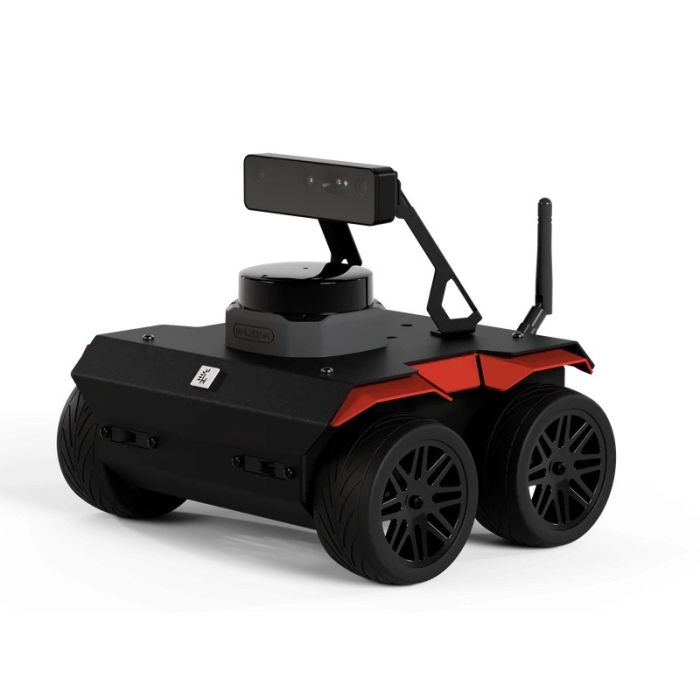
A robot small enough to carry under one arm rarely carries a complete research stack. A depth camera, a 360 degree LiDAR, an absolute orientation sensor, four time-of-flight rangefinders and a full Linux computer usually mean a larger platform, a larger budget and a larger room. The Husarion ROSbot 3 UGV takes the opposite approach. It puts the sensors a mobile robotics course or laboratory needs onto a four-wheel chassis that runs comfortably on a classroom floor, a corridor or a lab bench, and it arrives with Ubuntu 24.04 and ROS 2 Jazzy already installed.
Robots Europa, based in Dublin, sells the Husarion ROSbot 3 UGV to universities, schools, research institutes and engineering teams throughout the European Union and the DACH region. Robots Europa prepares each quotation, arranges delivery to your institution and remains your point of contact for support once the robot is in use.
Background
Husarion and the ROSbot family
Husarion builds mobile robots for the Robot Operating System community, with a range that runs from compact platforms for teaching to industrial-grade vehicles such as the Husarion Panther Industrial Grade Indoor / Outdoor UGV (PTH12). The ROSbot family sits at the accessible end of that range: robots meant to be unpacked, switched on and programmed, so that the platform becomes a tool for the work rather than a project of its own. The ROSbot 3 is offered in two versions, the ROSbot 3 described on this page and the Husarion ROSbot 3 PRO UGV, which share the same chassis, drive and computer and differ in their camera and LiDAR.
Two processors, one clear division of labour
The central design choice in the ROSbot 3 is a split between high-level and low-level computing. A Raspberry Pi 5 with 8GB RAM and a VideoCore VII GPU runs Ubuntu 24.04 and ROS 2 Jazzy, handling mapping, perception and the user's own nodes, and boots from a 64GB microSD card. Beneath it, an STM32F407 microcontroller looks after the real-time tasks: reading the four magnetic encoders, driving the motors and serving the six PWM servo outputs. This arrangement is common in research robots for good reason, as it keeps timing-critical motor control independent of whatever load the Linux side is carrying. Dual-band 2.4 GHz and 5 GHz 802.11b/g/n/ac wireless LAN connects the robot to the lab network, and two USB 2.0 host ports on the rear panel, taken from the single-board computer, accept additional peripherals.
Technical Specifications
| Specification | ROSbot 3 | ROSbot 3 PRO |
|---|---|---|
| Product type | Indoor mobile robot platform for research and education | Indoor mobile robot platform for research and education |
| Dimensions with camera and LiDAR (L x W x H) | 200 x 233 x 197 mm / 7.9 x 9.2 x 7.7 in | 200 x 233 x 197 mm / 7.9 x 9.2 x 7.7 in |
| Dimensions without camera and LiDAR (L x W x H) | 200 x 233 x 103 mm / 7.9 x 9.2 x 4.0 in | 200 x 233 x 103 mm / 7.9 x 9.2 x 4.0 in |
| Weight | 2,84 kg / 100 oz (with camera and LiDAR), 2,45 kg / 86 oz (without camera and LiDAR) | 2,84 kg / 100 oz (with camera and LiDAR), 2,45 kg / 86 oz (without camera and LiDAR) |
| Standard wheel diameter / Clearance / Wheelbase | 84 mm / 23 mm / 106 mm | 84 mm / 23 mm / 106 mm |
| Chassis material | Powder-coated aluminium plate, 1.5 mm thick | Powder-coated aluminium plate, 1.5 mm thick |
| Maximum translational velocity | 1.0 m/s | 1.0 m/s |
| Maximum rotational velocity | 420 deg/s (7.33 rad/s) | 420 deg/s (7.33 rad/s) |
| Maximum load capacity | Up to 5 kg / 176 oz (not in continuous work) | Up to 5 kg / 176 oz (not in continuous work) |
| Battery life | 1.5h - 5h | 1.5h - 5h |
| Batteries | 3 x Li-Ion 18650 protected, rechargeable, 3500mAh, 3.7V nominal | 3 x Li-Ion 18650 protected, rechargeable, 3500mAh, 3.7V nominal |
| Computer | Raspberry Pi 5 (8GB RAM, VideoCore VII GPU) | Raspberry Pi 5 (8GB RAM, VideoCore VII GPU) |
| Storage | 64GB microSD card | 64GB microSD card |
| Networking | 2.4 GHz and 5 GHz 802.11b/g/n/ac wireless LAN | 2.4 GHz and 5 GHz 802.11b/g/n/ac wireless LAN |
| Built-in microcontroller | STM32F407 | STM32F407 |
| 3D camera | Luxonis OAK-D Lite | Luxonis OAK-D Pro |
| LiDAR | RPLIDAR C1, 360 degree | RPLIDAR S2, 360 degree |
| IMU sensor | BNO055 intelligent 9-axis absolute orientation sensor | BNO055 intelligent 9-axis absolute orientation sensor |
| Infrared distance sensors | 4 x VL53L0X Time-of-Flight, up to 200 cm range | 4 x VL53L0X Time-of-Flight, up to 200 cm range |
| Encoders | 4 x magnetic, 48cpr, 12 poles | 4 x magnetic, 48cpr, 12 poles |
| USB (rear panel) | 2 x USB 2.0 host ports from SBC | 2 x USB 2.0 host ports from SBC |
| Servo outputs | 6, PWM | 6, PWM |
| Operating system | Ubuntu 24.04 with ROS 2 Jazzy preinstalled | Ubuntu 24.04 with ROS 2 Jazzy preinstalled |
Specifications are as published by the manufacturer and are confirmed against the datasheet at quotation.
The manufacturer has not published an IP rating, an operating temperature range, the camera resolution, the motor power of the robot as a whole or its climbing ability; Robots Europa confirms these points at quotation.
What does the ROSbot 3 PRO add over the ROSbot 3?
The two versions are built on the same foundation. Chassis, dimensions, weight, drive, speed, battery pack, computer, microcontroller, IMU, time-of-flight sensors and software are identical, so code written for one runs on the other without changes to the platform layer. The difference lies entirely in the two principal perception sensors. The ROSbot 3 carries a Luxonis OAK-D Lite depth camera and an RPLIDAR C1 scanner; the ROSbot 3 PRO carries a Luxonis OAK-D Pro and an RPLIDAR S2. Both LiDAR units scan through 360 degrees.
For most teaching and a great deal of research, the standard ROSbot 3 gives every student and every project the same capabilities that matter: a depth camera, a full-circle LiDAR and the complete ROS 2 Jazzy environment. The PRO version makes sense where a research group has a specific reason to work with the OAK-D Pro or the RPLIDAR S2, for example to match equipment already used elsewhere in the laboratory. Robots Europa is glad to discuss which of the two sensor pairs fits your work before you decide.
Can the Husarion ROSbot 3 UGV be driven without programming?
Yes. The robot can be controlled without writing any code by using a Logitech F710 gamepad, which allows a lecturer to demonstrate mapping or a student to collect sensor data on the first day. The gamepad is not part of the standard set, so it should be requested with the quotation if it is wanted. Once the class moves on to software, the preinstalled Ubuntu 24.04 and ROS 2 Jazzy environment means the first session can be spent on ROS concepts rather than on installing an operating system.
Who is the Husarion ROSbot 3 UGV for?
The first audience is higher education. Universities and technical colleges teaching robotics, mechatronics or computer science need robots that are robust enough for repeated handling, small enough to store several in one cupboard and complete enough to cover localisation, mapping, perception and control within a single course. The powder-coated aluminium chassis and the indoor footprint suit exactly that pattern of use.
The second audience is research. Groups working on SLAM, sensor fusion, multi-robot coordination or human-robot interaction often want a common, reproducible platform so that results can be compared across experiments and across institutions. A robot that ships with a standard ROS 2 distribution and a documented sensor set is easier to describe in a paper and easier to replace.
The third audience is corporate R&D and start-ups prototyping indoor applications before committing to larger hardware. The ROSbot 3 lets an algorithm be proven at desk scale; when the project grows, Husarion's larger platforms, such as the Husarion ROSbot XL UGV or the outdoor-capable Panther, are the natural next step. Teams that have a defined need for the OAK-D Pro camera or the RPLIDAR S2 should look at the ROSbot 3 PRO, and buyers comparing platform types more widely will find the full range under UGVs.
What is the Husarion ROSbot 3 UGV used for?
- Teaching ROS 2: a ready-installed ROS 2 Jazzy robot on which students learn nodes, topics, transforms and launch files on real hardware.
- SLAM and mapping: building maps of rooms and corridors with the 360 degree RPLIDAR C1 while the robot is driven or navigates on its own.
- Sensor fusion: combining wheel encoder odometry, the BNO055 orientation sensor and LiDAR data into a robust position estimate.
- Computer vision and depth perception: object detection, tracking and obstacle mapping with the Luxonis OAK-D Lite depth camera.
- Autonomous navigation research: developing and benchmarking path planning and obstacle avoidance, with the four time-of-flight sensors guarding the close range.
- Prototyping with add-ons: attaching grippers, pan-tilt mechanisms or small actuators through the six PWM servo outputs and the rear USB ports.
Pricing and Availability
Robots Europa supplies the Husarion ROSbot 3 UGV on quotation, so that each offer reflects the version, the quantity and any accessories you require, such as a Logitech F710 gamepad or spare batteries. Delivery, customs and support are arranged together with your quotation. Institutions ordering several robots for a teaching laboratory are welcome to describe their course or project, which allows Robots Europa to suggest the most suitable mix of ROSbot 3 and ROSbot 3 PRO units. To begin, the quotation request is available on this page.
Frequently Asked Questions
Which operating system does the ROSbot 3 run?
The robot runs Ubuntu 24.04 with ROS 2 Jazzy preinstalled on its Raspberry Pi 5, booting from a 64GB microSD card.
Which camera and LiDAR does the standard ROSbot 3 carry?
The ROSbot 3 carries a Luxonis OAK-D Lite depth camera and an RPLIDAR C1 360 degree LiDAR. The ROSbot 3 PRO uses an OAK-D Pro and an RPLIDAR S2 instead.
How long does the battery last?
Battery life is 1.5h - 5h, depending on how the robot is used. Power comes from three protected, rechargeable Li-Ion 18650 cells of 3500mAh at 3.7V nominal.
How much can the robot carry?
The maximum load capacity is up to 5 kg / 176 oz, but not in continuous work. For sustained payloads, Robots Europa can advise on a suitable operating profile.
Is a gamepad included?
No. The robot can be driven without coding using a Logitech F710 gamepad, but it is not part of the standard set and can be added to your quotation.
Can the ROSbot 3 be used outdoors?
The ROSbot 3 is designed as an indoor mobile robot platform for research and education. For outdoor projects, Husarion's Panther, an indoor and outdoor UGV, is the more appropriate platform.
Where can I buy the Husarion ROSbot 3 UGV and what does it cost?
You can buy the Husarion ROSbot 3 UGV from Robots Europa, which supplies it across the EU and the DACH region. The cost depends on version, quantity and accessories, so Robots Europa provides it in a tailored quotation requested from this page.
Summary
The Husarion ROSbot 3 UGV resolves the tension between a small robot and a serious research stack. Within a footprint of 200 x 233 mm it combines a Raspberry Pi 5, an STM32F407 real-time controller, a 360 degree LiDAR, a depth camera, an absolute orientation sensor and four time-of-flight sensors, all running Ubuntu 24.04 and ROS 2 Jazzy from the moment it is unpacked. It suits lecture rooms and laboratories equally well, and its PRO sibling offers an alternative sensor pair on the same platform. For a quotation from Robots Europa, including delivery, customs and support across the EU and the DACH region, this page is the starting point.


