
Paxini TORA ONE Multi-Dimensional Tactile Wheeled Humanoid Robot
In stock
- BRAND:
- PAXINI
- PART #:
- TORA-ONE
- ORIGIN:
- China
- AVAILABILITY:
- SUBJECT TO AVAILABILITY
- SKU:
- Paxini-TORA-ONE
Paxini TORA ONE Multi-Dimensional Tactile Wheeled Humanoid Robot
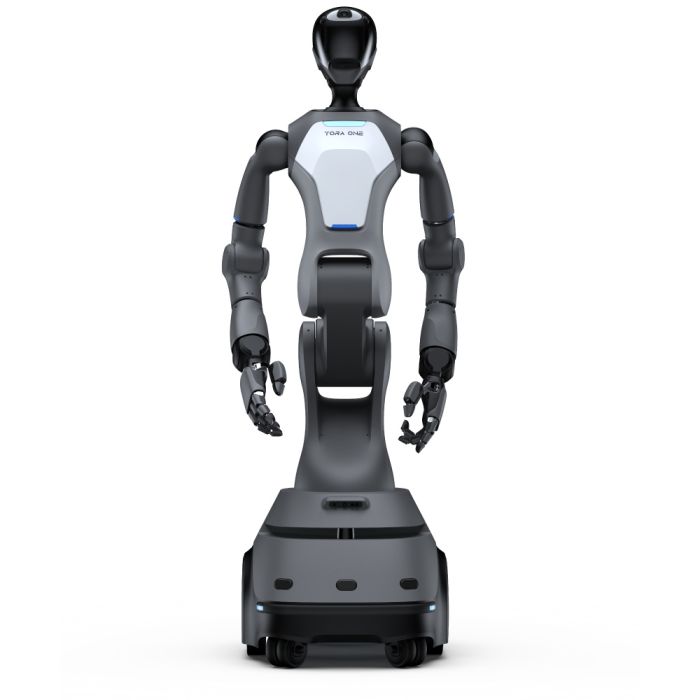
Most robots that pick things up work, in a sense, with numb fingertips: they see an object, calculate a grip and trust that the force will be right. The Paxini TORA ONE Multi-Dimensional Tactile Wheeled Humanoid Robot is built on the opposite premise. A machine that handles real objects should feel them as well as see them, and it should be able to roll to wherever the work happens rather than wait for the work to be brought to a fixed cell. Touch, sight and mobility are combined in one upright platform, and that combination is what sets it apart from a conventional manipulator on a stand.
Robots Europa, based in Dublin, supplies the TORA ONE to research institutions, integrators and industrial users throughout the European Union and the DACH region. Robots Europa prepares each quotation, arranges delivery to your site and remains your point of contact for support once the robot is in service, so that a single partner handles the project from first enquiry to commissioning.
Background
PaXini and the pursuit of robotic touch
PaXini is known above all for its work on tactile sensing, the technology that lets a robotic finger register not just whether it is touching something but how that contact is distributed and directed. The company’s range includes standalone dexterous hands as well as complete humanoid platforms, and the TORA ONE brings that sensing expertise into a full mobile body. It is the first multidimensional tactile humanoid robot in the embodied AI industry, and its dexterous hand is the industry’s first integrated multidimensional tactile and AI vision dual-modal dexterous hand.
Visual-tactile embodied intelligence
Embodied AI is the branch of robotics concerned with machines that learn and act through a physical body rather than purely in software. The TORA ONE is driven by PaXini’s VTLA-Model, short for Visual-Tactile-Language-Action, which links what the robot sees, what it feels, the instructions it receives in language and the actions it carries out. Each hand carries its own RGB camera, so vision and touch meet at the point of contact. For laboratories working on manipulation policies, this pairing of camera data with dense tactile signals is the central attraction of the platform.
Technical Specifications
| Specification | Value |
|---|---|
| Product type | The First Multidimensional Tactile Humanoid Robot in Embodied AI industry |
| Height | Deformable structure, waist folded 1.46 m, extended 1.86 m |
| Body degrees of freedom (excluding dexterous hands) | 21 |
| Bimanual degrees of freedom | 32 |
| Fingers on each hand | 4 |
| Dexterous hand degrees of freedom (single hand) | 16 DOF (13 active + 3 passive) |
| Dexterous hand drive mode | Coreless motor |
| Tactile perception | 2280 ITPU multi-dimensional tactile sensing units |
| Number of tactile signals | 6840 channels |
| Fingertip force control | 0.01N high-precision force control |
| Visual capacity | 5 RGB cameras (3 in head + 1 in each hand) + 2 RGBD cameras (1 in head + 1 in chassis) |
| Environment detection | SLAM navigation and LIDAR system with 5 HD cameras and 2 depth cameras; 360-degree all-around environment depth detection |
| Navigation method | Laser SLAM autonomous navigation |
| Single arm straight-arm load capacity (including dexterous hand) | Rated 5 kg |
| Chassis maximum moving speed | 0.6 m/s |
| Chassis maximum turning speed | 0.4 rad/s |
| Chassis repeatability accuracy | 1.5 cm |
| Chassis absolute accuracy | 3 cm |
| Heading angle error | 3 degrees |
| Obstacle crossing height | 2 cm |
| Ditch width | 2 cm |
| Climbing angle | 7 degrees |
| Charging time | 6 h |
| Endurance | 8 h |
| AI model | VTLA-Model: Visual-Tactile-Language-Action |
Specifications as published by the manufacturer; they are confirmed against the datasheet at quotation.
The manufacturer has not published the weight, footprint dimensions, power consumption, onboard compute, IP rating, connectivity, operating temperature or the contents of the box; Robots Europa confirms these at quotation.
How does multi-dimensional tactile sensing change what a humanoid robot can handle?
A camera can tell a robot where a cup is and roughly what shape it has. It cannot tell the robot whether the cup is slipping, whether it is thinner-walled than expected or whether the grip is pressing harder on one side than the other. Those are questions of contact, and they are exactly what the TORA ONE is equipped to answer. Across its hands the robot carries 2280 ITPU multi-dimensional tactile sensing units producing 6840 channels of tactile signal, which gives its control software a detailed, continuous picture of every contact surface.
That information is only useful if the hand can act on it finely, and here the fingertip force control of 0.01N matters. Each four-fingered hand offers 16 DOF, of which 13 are active and 3 passive, driven by coreless motors, so the robot can adjust its grip in small, deliberate steps rather than simply opening and closing. Combined with the camera in each palm, the result is a hand that can see what it is about to touch and then feel what it is holding. For tasks involving fragile, deformable or irregular items, this is the difference between a demonstration that works once and a behaviour that can be trained and repeated.
Why does TORA ONE use a wheeled chassis and a folding waist?
Legged humanoids attract attention, but many real workplaces are flat indoor floors where stability and endurance count for more than the ability to climb stairs. The TORA ONE rides on a wheeled chassis with a maximum moving speed of 0.6 m/s, a repeatability accuracy of 1.5 cm and laser SLAM autonomous navigation, supported by LIDAR and 360-degree depth detection from its cameras. The chassis crosses obstacles of 2 cm, spans ditches of 2 cm and handles slopes up to 7 degrees, which makes clear that it is intended for laboratories, workshops, warehouses and public indoor spaces rather than rough terrain.
The deformable structure adds reach. With the waist folded the robot stands 1.46 m tall; extended, it reaches 1.86 m, so the same platform can work at a low bench and then rise to a high shelf. An endurance of 8 h against a charging time of 6 h supports a full working shift between charges, which matters when the robot is collecting training data or running long trials.
Who is the Paxini TORA ONE for?
The clearest fit is the embodied AI research group: university laboratories and corporate research teams developing manipulation policies that draw on vision, touch and language together. The VTLA-Model and the dense tactile output give such teams a platform designed around the very data they need. Industrial innovation departments form a second segment, particularly those exploring how a mobile humanoid might handle mixed or delicate items in assembly, inspection or intralogistics where fixed automation has proven too rigid.
Systems integrators building demonstrators for clients, and organisations investigating service applications in retail, hospitality or healthcare settings, will also find the combination of mobility and sensitive hands relevant. Buyers comparing platforms within the same family should also look at the PaXini TORA DOUBLE ONE Lightweight Humanoid Robot, and Robots Europa can set the two side by side in a quotation. Teams that need tactile manipulation on an existing arm rather than a full humanoid may prefer a standalone hand such as the Paxini DexH13 Dexterous Robot Hand (DexH13). The wider choice of platforms is gathered under Wheeled Humanoids and Humanoids.
What is the Paxini TORA ONE used for?
- Embodied AI research — training and testing visual-tactile-language-action models on a physical body.
- Tactile dataset collection — recording synchronised camera and tactile signals for manipulation learning.
- Delicate object handling — grasping fragile or deformable items where controlled fingertip force matters.
- Indoor intralogistics trials — moving between stations to pick, place and hand over light items.
- Service robotics pilots — evaluating humanoid assistance in retail, hospitality or care environments.
- Teaching and demonstration — showing students and stakeholders how touch and vision combine in robot control.
Pricing and Availability
Robots Europa supplies the TORA ONE on quotation, so that the configuration, documentation and any project requirements can be reviewed before an order is placed. Delivery, customs and support are arranged with the quotation. Requirements such as specific documentation for your organisation, training needs or the comparison with other platforms in the range can be raised at the same stage. To begin, please request a quotation using the enquiry option available on this page.
Frequently Asked Questions
How many tactile sensing units does the TORA ONE have?
The robot carries 2280 ITPU multi-dimensional tactile sensing units, which together produce 6840 channels of tactile signal.
How long does the TORA ONE operate on one charge?
The TORA ONE offers an endurance of 8 h, with a charging time of 6 h.
How tall is the robot?
The TORA ONE has a deformable structure: 1.46 m with the waist folded and 1.86 m when extended.
Can the TORA ONE navigate on its own?
Yes. It uses laser SLAM autonomous navigation with a LIDAR system and 360-degree environment depth detection from its cameras.
What is the VTLA-Model?
VTLA stands for Visual-Tactile-Language-Action. It is the AI model that connects what the robot sees and feels with language instructions and the actions it performs.
Does the TORA ONE have cameras in its hands?
Yes. Each hand carries one RGB camera, complementing the three RGB cameras and one RGBD camera in the head and the RGBD camera in the chassis.
Where can I buy the Paxini TORA ONE and what does it cost?
You can buy the TORA ONE from Robots Europa, which supplies customers across the EU and the DACH region. Pricing is provided on quotation, tailored to your configuration and delivery requirements.
Summary
The TORA ONE answers a simple shortcoming of conventional robots: they can see but cannot feel. With thousands of tactile sensing units, four-fingered hands with fine force control, cameras in the palms and a visual-tactile-language-action model to tie it together, it treats touch as a primary sense rather than an afterthought. A wheeled, autonomously navigating chassis and a folding waist then carry that sense of touch to the bench, the shelf or the next workstation. For research teams and industrial pioneers who want a humanoid that learns through contact, and who would like Robots Europa to handle supply and support, this page is the starting point.


