
SEER Robotics Robotic Automatic Charging Station (SCS-C48100D)
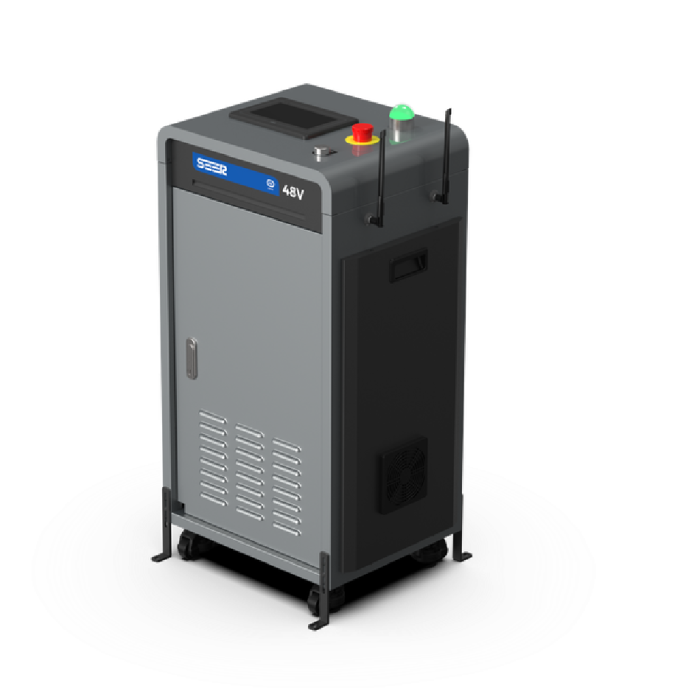
In stock
- BRAND:
- SEER ROBOTICS
- MODEL:
- SCS-C48100D
- PART #:
- SCS-C48100D
- ORIGIN:
- China
- Warranty:
- 12 MONTHS
- AVAILABILITY:
- SUBJECT TO AVAILABILITY
- SKU:
- SEER-Robotics-SCS-C48100D
SEER Robotics Robotic Automatic Charging Station (SCS-C48100D)
Every hour an autonomous forklift spends parked at a charger is an hour in which no pallets move. In a warehouse running around the clock, the charger is therefore not an accessory at the edge of the floor plan. It is part of the throughput calculation itself. The SEER Robotics Robotic Automatic Charging Station (SCS-C48100D) is built for that calculation. It is a station for 48 V autonomous forklifts that delivers up to 6 kW and can bring a battery to full charge in as fast as 1 hour, whether the vehicle docks itself or an operator connects it by hand.
Robots Europa, based in Dublin, supplies the SCS-C48100D to customers across the European Union and the DACH region. We prepare the quotation for your site, coordinate delivery to your facility and remain your point of contact for technical questions once the station is in service.
Background
SEER Robotics and the Robot Brain
SEER Robotics (06106.HK) describes itself as a platform-based embodied intelligent robotics company built around the Robot Brain, and it serves more than 2,500 customers worldwide with intelligent robotics solutions. A platform approach matters when you choose infrastructure such as a charger. A company that builds the controllers, software and supporting equipment for mobile robots tends to treat charging as one function within a coordinated system, not as a separate power supply bolted on afterwards. The SCS-C48100D reflects that thinking. It can be supervised remotely through Roboshop, it carries its own operator interface, and it connects to the site network over several routes.
Charging as part of the fleet's workflow
In automated intralogistics, charging strategy shapes how many vehicles a site needs. Fleets that wait for long charging cycles usually need spare vehicles to cover the gaps. Fleets that can top up quickly and automatically between missions keep more of their vehicles working. Automatic charging stations exist to close that gap: the vehicle drives to the station, connects, charges and returns to work without anyone walking across the floor. The SCS-C48100D combines that automatic mode with a manual fast-charging option. One station can therefore serve routine docking as well as situations where a person needs to connect a vehicle directly, for example during commissioning, maintenance or recovery after an unplanned stop.
Technical Specifications
| Specification | Value |
|---|---|
| Output power | Up to 6 kW |
| Voltage and current | 48 V / 100 A |
| Full charge time | As fast as 1 hour |
| DC output voltage | 32 V to 60 V |
| AC input voltage | 380±10% V |
| Input frequency | 50 / 60 Hz |
| Plug specification | Industrial 32A |
| Connector for manual charging | REMA160 |
| Charging modes | Protocol-based, state-based and voltage-based, with user-customisable charging curves |
| Charging options | Automatic and manual fast charging |
| Battery compatibility | Various lithium batteries |
| Protections | Over-voltage, over-current, short-circuit, reverse connection, leakage, overheating |
| HMI functions | Data display, parameter adjustment, network setup, log event query, device control |
| Remote monitoring | Via Roboshop |
| Network | Wi-Fi (recommended), Wired, 5G |
| Working temperature | 0℃ to 40℃ |
| Dimensions (L x W x H) | 580 x 460 x 980 mm |
| Reference standard | EN 62477-1:2012+A11:2014+A1:2017+A12:2021 |
| Suitable product model | 48 V, autonomous forklift |
Specifications as published by the manufacturer; they are confirmed against the datasheet at quotation.
SEER Robotics has not published the package contents, the cooling method, the efficiency, the certifications or the mounting method; we confirm these details with the quotation.
What makes the SCS-C48100D different from a conventional forklift charger?
A conventional charger is usually a fixed power source. Someone connects the vehicle, waits and disconnects it again. The SCS-C48100D is built around a different idea, in which the charger is a managed node in an automated fleet. Four characteristics support that.
The first is flexibility in how the charge is delivered. The station supports three charging modes, namely protocol-based, state-based and voltage-based charging, and the charging curves can be customised by the user. A site with more than one battery configuration therefore does not have to accept a single fixed profile. It can match the charging behaviour to the battery it is serving. The station is compatible with various lithium batteries, which reinforces this point.
The second is the choice between automatic and manual fast charging. Automatic charging supports unattended operation, while the REMA160 connector allows direct manual connection when a vehicle has to be charged outside the normal docking routine.
The third is protection. The station has built-in safeguards against over-voltage, over-current, short-circuit, reverse connection, leakage and overheating. For an operator, this is the difference between a charger that has to be watched and one that can be left to run through a night shift.
The fourth is supervision. An integrated HMI handles data display, parameter adjustment, network setup, log event queries and device control, so the station can operate independently as soon as it is deployed. Through Roboshop, the same station can be monitored and controlled remotely, keeping its operating status visible to the team responsible for the fleet.
How does the SCS-C48100D fit into an existing site?
Three practical questions decide whether a charging station can be installed without surprises: power supply, network and environment. On power, the SCS-C48100D takes an AC input of 380±10% V at 50 / 60 Hz and uses an industrial 32A plug. Facilities planners should therefore check the supply at the intended charging position before installation. On networking, the station offers Wi-Fi, which the manufacturer recommends, as well as wired and 5G connections. This gives integrators room to follow the site's existing IT policy, not work around it. On environment, the working temperature range is 0℃ to 40℃, which covers typical heated warehouses and production halls. Installations in cold stores or unheated outdoor canopies need separate consideration. With dimensions of 580 x 460 x 980 mm, the station's footprint can be planned into aisle layouts and charging bays at an early stage. The station references EN 62477-1:2012+A11:2014+A1:2017+A12:2021. We are happy to discuss documentation for your conformity file as part of the quotation.
Who is the SCS-C48100D for?
The manufacturer names the 48 V autonomous forklift as the suitable product model, and that defines the core audience. The station is intended for warehouse and distribution operators who run, or are introducing, fleets of 48 V autonomous forklifts and want charging to happen without staff intervention. It also suits system integrators who design automated material flow for clients and need a charger that can be supervised from the same software environment as the fleet. Manufacturers with internal logistics, such as those feeding production lines or moving finished goods to dispatch, will find the combination of automatic and manual charging useful wherever vehicles move between routine missions and occasional manual handling. Sites with strict uptime targets benefit from the remote monitoring and the event log, which help maintenance teams trace and resolve charging issues.
If your vehicles are not 48 V autonomous forklifts, another station may be the better match. SEER's range also includes models such as the SEER Robotics Robotic Automatic Charging Station (SCS-C4850D) and the SEER Robotics Robotic Automatic Charging Station (SCS-C24100D). The full selection is listed under Charging Stations, and the vehicles themselves can be found among our Factory Robots. Robots Europa will confirm which station matches your fleet before you commit.
What is the SCS-C48100D used for?
- Automatic docking between missions: autonomous forklifts recharge at the station during idle periods without an operator present.
- Round-the-clock warehouse operation: fast charging helps keep vehicles available across consecutive shifts.
- Manual fast charging: technicians connect a vehicle directly through the REMA160 connector during commissioning or maintenance.
- Mixed lithium battery fleets: selectable charging modes and customisable curves adapt the charge to different lithium batteries.
- Remote fleet supervision: operations teams monitor and control charging status through Roboshop from a central workstation.
- Production intralogistics: forklifts supplying assembly lines return to charge without interrupting the material flow.
Pricing and Availability
Robots Europa supplies the SCS-C48100D on a quotation basis, so that the offer reflects your fleet, your site's power and network set-up and the number of stations required. Tell us which vehicles you operate, how many charging positions you plan and where the station will be installed, and we will prepare a quotation that confirms the specification against the current datasheet. Delivery, customs and support are arranged together with your quotation. To begin, the quotation request for the SEER Robotics Robotic Automatic Charging Station (SCS-C48100D) is available on this page.
Frequently Asked Questions
Which vehicles is the SCS-C48100D designed for?
The manufacturer lists the 48 V autonomous forklift as the suitable product model. Its DC output voltage range is 32 V to 60 V.
How quickly can the station charge a battery?
The station delivers up to 6 kW at 48 V / 100 A and can fully charge a battery in as fast as 1 hour. The time you see in operation also depends on the battery and its state when charging begins.
Can the station be used without automatic docking?
Yes. Besides automatic charging, it offers manual fast charging through the REMA160 connector.
What power supply does the installation require?
The station requires an AC input of 380±10% V at 50 / 60 Hz and uses an industrial 32A plug. We recommend checking the supply at the planned location before installation.
Which batteries can it charge?
It is compatible with various lithium batteries. It supports protocol-based, state-based and voltage-based charging, with user-customisable charging curves.
How is the station connected and monitored?
It connects over Wi-Fi, which is recommended, or over a wired or 5G connection. It can be monitored and controlled remotely via Roboshop, and an on-board HMI provides data display, parameter adjustment, network setup, log event queries and device control.
Where can I buy the SEER Robotics Robotic Automatic Charging Station (SCS-C48100D) and what does it cost?
Robots Europa supplies the station across the EU and the DACH region. The cost is set out in a quotation prepared for your site, which you can request on this page.
Summary
A forklift that waits at a charger is capacity a site has paid for but cannot use. The SCS-C48100D addresses that cost directly. It offers up to 6 kW at 48 V / 100 A, a full charge in as fast as 1 hour, and automatic and manual charging from one unit. Three charging modes with customisable curves cover various lithium batteries. Six built-in protections, an independent HMI and remote supervision through Roboshop let the station run unattended while remaining visible to the people responsible for the fleet. For operators and integrators planning 48 V autonomous forklift charging in Europe, Robots Europa handles the quotation, delivery and support, and this page is the starting point.


