
SIASUN Collaborative Robot (GCR16-960)
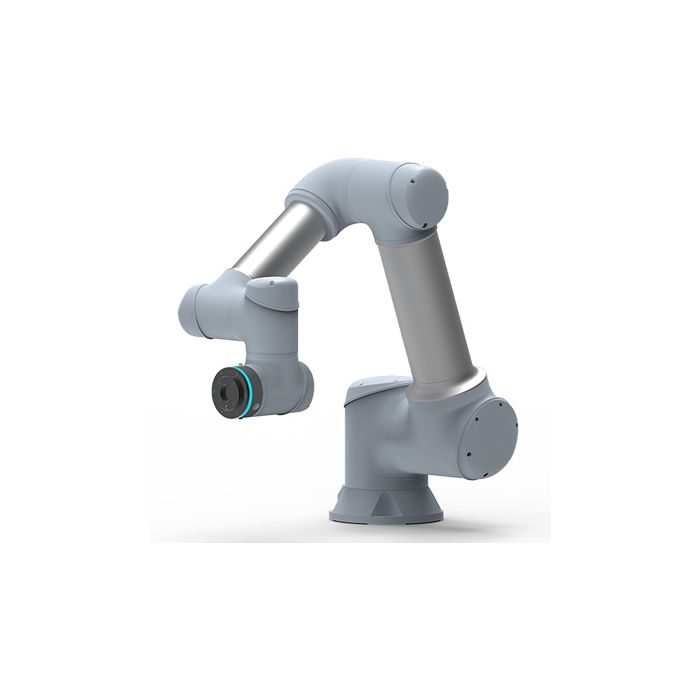
In stock
- BRAND:
- SIASUN
- PART #:
- GCR16-960
- ORIGIN:
- China
- AVAILABILITY:
- SUBJECT TO AVAILABILITY
- SKU:
- SIASUN-GCR16-960
SIASUN Collaborative Robot (GCR16-960)
Collaborative robots usually force a choice between a compact footprint and a meaningful load at the wrist. The SIASUN Collaborative Robot (GCR16-960) is built for the stronger side of that trade-off. It carries a 16 kg payload on an arm with 960 mm of reach, so the working envelope stays tight enough for a crowded bench or the front of a machine tool, with capacity left for a substantial gripper, a screwdriving unit or a heavier workpiece. For production engineers who have outgrown a light cobot but have no floor space for a long arm, it is a model worth examining closely.
Robots Europa, based in Dublin, sells and supplies the GCR16-960 to customers throughout the European Union and the DACH region. Our team prepares each quotation around your application, coordinates delivery to your site and remains your point of contact for technical questions and after-sales support once the robot is in production.
Background
SIASUN and the GCR series
SIASUN is a Chinese robotics and automation manufacturer whose portfolio covers industrial robots, mobile robots and complete automation systems. The GCR range is its family of collaborative arms, and the sources list ten versions: GCR3-618, GCR5-910, GCR7-910, GCR10-1300, GCR12-1300, GCR16-960, GCR16-2000, GCR20-1400, GCR25-1800 and GCR30-1100. Each version addresses a different combination of load and working radius, which lets a plant standardise on one platform and one programming environment across several cells. In the case of the GCR16-960, the designation reflects its 16 kg payload and its 960 mm reach. You can compare the whole family in our SIASUN GCR series cobots category.
Sensing, safety and simplified programming
SIASUN describes the GCR16-960 as a high-end, general-purpose collaborative robot, and the technology behind that description rests on four elements. First, it offers 16 TUV-certified safety features intended for human-robot collaboration in which safety comes first. Second, it integrates 2D/3D vision depth fusion together with high-sensitivity force perception and control, so the robot can locate parts and react to contact rather than simply replaying fixed positions. Third, drag-and-drop teach programming lowers the threshold for operators: a path is taught by guiding the arm by hand instead of writing code line by line. Fourth, the software side includes a range of scenario-specific packages, compatibility with multiple external interfaces, cloud-based monitoring of robot data and remote OTA updates. Taken together, these features make the arm practical for teams that do not employ a dedicated robot programmer.
Technical Specifications
| Specification | Value |
|---|---|
| Product type | High-end, general-purpose collaborative robot of the GCR series |
| Degrees of freedom | 6 |
| Maximum payload | 16 kg |
| Reach | 960 mm |
| Repeatability | ±0.03 mm |
| Maximum TCP speed | 3.0 m/s |
| Maximum straight-line speed | 1.5 m/s |
| IP class | IP54/IP65 |
| Safety | 16 TUV-certified safety features for human-robot collaboration |
| Vision and force sensing | 2D/3D vision depth fusion; high-sensitivity force perception and control |
| Programming | Drag-and-drop teach programming |
| Software and connectivity | Scenario-specific software packages; multiple external interfaces; cloud-based robot data monitoring; remote OTA updates |
Specifications as published by the manufacturer; they are confirmed against the datasheet at quotation.
SIASUN has not published the rated power, the controller model, the pose accuracy, the noise level, the software version, the service life or the accessories included in the delivery; Robots Europa confirms these details at quotation.
What makes the GCR16-960 different from longer-reach GCR models?
The defining characteristic of this version is proportion. A 960 mm reach is short relative to the load the arm is rated to carry, and that balance has practical consequences on the shop floor. A compact arm can be mounted directly beside a CNC machine, an assembly fixture or a conveyor without pushing the cell boundary outwards, which matters in factories where every square metre is already allocated. It also keeps the movements of a heavy tool closer to the base, which suits applications where the load, rather than the distance travelled, is the main demand.
The figures support work that needs precision as well as strength. Repeatability of ±0.03 mm allows the GCR16-960 to return reliably to fixture positions, insertion points and pick locations, while a maximum TCP speed of 3.0 m/s and a maximum straight-line speed of 1.5 m/s give it the pace for cycle-driven tasks once the risk assessment permits those speeds. Six degrees of freedom let it approach a part from awkward angles, for instance when tending a machine door or presenting a component to a fixture at an incline.
Where parts must travel further than this arm can reach, a longer GCR model is the more natural choice. The SIASUN Collaborative Robot (GCR16-2000) and the SIASUN Collaborative Robot (GCR25-1800) each have their own pages with their full specifications.
How does the GCR16-960 work safely alongside people?
A collaborative robot earns its name only if staff can work in its vicinity with confidence. The GCR16-960 contributes to this with its 16 TUV-certified safety features, combined with high-sensitivity force perception that allows the arm to detect contact and respond to it. The vision depth fusion adds awareness of the surroundings and of the parts being handled, which reduces the need to present components in perfectly repeatable positions.
As with any cobot, however, the safety of the finished installation depends on the whole application: the gripper, the workpiece, the speeds programmed and the layout of the cell. A risk assessment of the complete system is therefore part of every project, and it determines whether the robot can run without guarding or whether scanners and protected zones are advisable. Robots Europa discusses these questions with you during the quotation, so that the configuration you order matches the way you intend to operate it.
Who is the GCR16-960 for?
The first group is manufacturers taking a second step into automation. Many plants begin with a light cobot for simple handling and then encounter tasks where the tool or the part is too heavy. The GCR16-960 meets that need without demanding a larger cell. The second group is small and medium-sized enterprises that lack in-house robot programmers: drag-and-drop teach programming and the scenario-specific software packages shorten the path from delivery to productive operation.
System integrators are a third audience. Multiple external interfaces make it simpler to connect the arm to PLCs, vision systems and peripheral equipment, and cloud-based data monitoring with remote OTA updates helps integrators support installations across several sites. Finally, production managers responsible for a fleet of robots benefit from remote monitoring when they track the state of their equipment.
If your loads are lighter and your cell needs a longer working radius, the SIASUN GCR12-1300 (GCR12-1300) deserves comparison. For heavier loads, look at the SIASUN Collaborative Robot (GCR20-1400) or the GCR30-1100, each described on its own page.
What is the GCR16-960 used for?
- Machine tending – loading and unloading CNC machines, presses or moulding machines in a compact cell beside the machine.
- Assembly and screwdriving – carrying heavier tools and using force control for insertion and fastening operations.
- Vision-guided pick-and-place – locating parts with 2D/3D vision depth fusion and transferring them between conveyors, trays and fixtures.
- End-of-line packaging – placing products into cartons or onto trays at the end of a production line.
- Surface finishing – polishing, grinding or deburring where high-sensitivity force control keeps contact pressure consistent.
- Inspection and testing – presenting parts to cameras or test stations with repeatable positioning.
Pricing and Availability
Robots Europa supplies the GCR16-960 on the basis of a project quotation, because the right configuration depends on your application, your tooling and the environment in which the robot will run. Delivery, customs and support are arranged with the quotation, so you receive one clear proposal covering the robot and its arrival at your site. To discuss your requirements with our team, please use the quotation request available on this page.
Frequently Asked Questions
What payload and reach does the GCR16-960 offer?
The GCR16-960 has a maximum payload of 16 kg and a reach of 960 mm. Remember that the payload includes the weight of the gripper or tool as well as the part.
How precise is the GCR16-960?
Its repeatability is ±0.03 mm, which allows it to return reliably to taught positions such as fixtures and pick points.
Can the GCR16-960 work next to people without fencing?
The robot offers 16 TUV-certified safety features for human-robot collaboration. Whether guarding is needed depends on the risk assessment of the complete application, which we address during the quotation.
Do my staff need programming experience?
No specialist knowledge is required to teach basic tasks, because the robot supports drag-and-drop teach programming. Scenario-specific software packages further simplify common applications.
Is the GCR16-960 suitable for dusty or damp environments?
The GCR16-960 has an IP class of IP54/IP65. Our team is happy to discuss the conditions in your cell during the quotation.
Can the robot be monitored and updated remotely?
Yes. The GCR16-960 supports cloud-based monitoring of robot data and remote OTA updates.
Where can I buy the SIASUN Collaborative Robot (GCR16-960) and what does it cost?
You can buy it from Robots Europa, which supplies customers across the EU and the DACH region. The cost depends on your configuration and is set out in a personal quotation that you can request on this page.
Summary
The GCR16-960 resolves the tension between strength and space that limits many collaborative cells: a 16 kg payload on a compact 960 mm arm, with ±0.03 mm repeatability, six degrees of freedom and a sensing package that combines 2D/3D vision with high-sensitivity force control. Its 16 TUV-certified safety features, drag-and-drop teaching and cloud-connected software make it accessible to teams without dedicated robot programmers. Robots Europa quotes, delivers and supports it throughout the EU and the DACH region. If your application calls for a strong arm in a small footprint, this page is the starting point.


