
Unitree R1 Edu Pro B Humanoid Robot (R1 EDU U4)
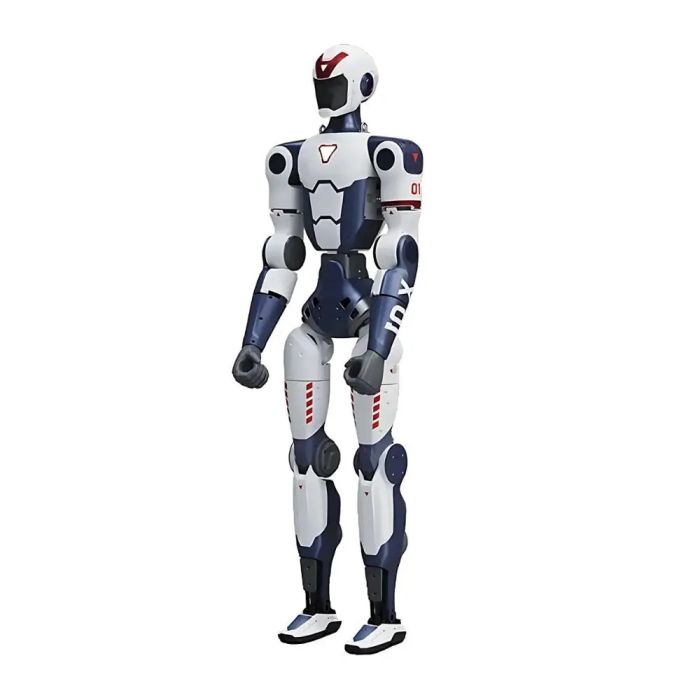
In stock
- BRAND:
- UNITREE ROBOTICS
- MODEL:
- R1 EDU PRO B
- PART #:
- R1 EDU U4
- ORIGIN:
- China
- Warranty:
- 12 MONTHS
- AVAILABILITY:
- SUBJECT TO AVAILABILITY
- SKU:
- Unitree-Robotics-R1-EDU-U4
Unitree R1 Edu Pro B Humanoid Robot (R1 EDU U4)
A trade-show visitor and a doctoral researcher want very different things from a humanoid. The visitor wants a robot that turns its head, answers a question and holds out a hand. The researcher wants joint-level access, a serious onboard computer and hands that report what they touch. Most platforms serve one of these audiences and disappoint the other. The Unitree R1 Edu Pro B Humanoid Robot (R1 EDU U4) is built to serve both. It is a compact bipedal humanoid with two Dex3 dexterous hands carrying tactile sensors, an NVIDIA Jetson Orin for onboard AI, and a development stack that runs from ROS 2 MoveIt2 to Isaac Sim. It also has a microphone array, a speaker and a multimodal model that let it hold a conversation in a busy hall.
Robots Europa sells the R1 EDU U4 from Dublin and supplies it to universities, research institutes, schools and companies throughout the European Union and the DACH region. Robots Europa prepares each quotation, organises delivery to your site and remains your point of contact for technical support once the robot is in service.
Background
Unitree Robotics and the R1 line
Unitree Robotics is known for legged robots that move dynamically and remain accessible to laboratories that cannot fund a bespoke research platform. The R1 family applies that thinking to the humanoid form. It is a compact, lightweight body intended to be carried, set up and programmed by a small team rather than installed in a dedicated facility. The line is offered in several versions: the R1 AIR, the R1, the R1 EDU and a series of R1 EDU Pro configurations, including the Pro A (U3), Pro B (U4), Pro C (U5) and Pro D (U6). The EDU versions are the ones opened up for secondary development, and Unitree supports them with a dedicated secondary development manual.
Where the Pro B configuration sits
The R1 family offers 20 to 26 degrees of freedom and a 2-DOF head that widens the robot's view of its surroundings. The Pro B configuration builds on this with two Unitree Dex3 dexterous hands. Each hand has 7 degrees of freedom and 33 tactile sensors, which give real-time contact feedback while the robot grasps and manipulates objects. The result is a humanoid with 40 degrees of freedom in total across its bipedal body, arms, waist and hands. An NVIDIA Jetson Orin providing 100 TOPS of onboard AI compute handles the vision, language and tactile workloads that this kind of research produces, so models can run on the robot rather than on a tethered workstation.
Technical Specifications
| Specification | R1 EDU Pro B (U4) | R1 EDU |
|---|---|---|
| Total degrees of freedom | 40, across bipedal body, arms, waist and hands | — |
| Hands | Dual Dex3 dexterous hands, 7 DOF each | — |
| Tactile sensors | 33 per hand | — |
| AI compute | NVIDIA Jetson Orin, 100 TOPS | — |
| Basic computing | — | 8-Core High-Performance Processor |
| Height (standing) | 123 cm | — |
| Dimensions (height x width x thickness, standing) | — | 1230x357x190mm |
| Weight with battery | — | About 29kg |
| Arm payload | 2 kg per arm | — |
| Battery | Hot-swap system, approximately 1 hour of runtime | — |
| Joint motor | — | Low inertia high-speed internal rotor PMSM |
| Camera | — | Binocular camera |
| Wireless | — | WiFi 6, Bluetooth 5.2 |
| Audio | 4-mic array, speaker | — |
| Multimodal AI | Multimodal voice and vision AI | — |
| Developer ecosystem | ROS 2 MoveIt2, Isaac Sim, SDK2 | Secondary development: YES (EDU) |
Specifications are as published by the manufacturer and are confirmed against the datasheet at quotation.
The manufacturer has not published the walking speed, IP rating, battery capacity, operating temperature, charging time or operating system; these are confirmed with your quotation.
What does the Pro B configuration add to the R1 EDU?
The base R1 EDU is a capable, open humanoid. It has binocular vision, an 8-core processor, low-inertia PMSM joint motors chosen for response speed and heat dissipation, and wireless connectivity over WiFi 6 and Bluetooth 5.2. What the Pro B adds is mainly at the end of the arm and inside the head.
At the end of the arm, the two Dex3 hands turn the robot from a platform that can reach into one that can manipulate. With 7 degrees of freedom per hand, a grasp can be shaped around the object rather than simply closed on it. The 33 tactile sensors in each hand report contact as it happens. A grasping policy can therefore respond to what the fingers actually feel instead of inferring grip from joint positions and camera frames alone.
Inside the head, the NVIDIA Jetson Orin provides 100 TOPS for onboard inference. Tactile data, stereo images and audio can be processed on the robot itself, which matters for experiments in which latency or untethered operation is part of the question.
The development stack completes the picture. Compatibility with ROS 2 MoveIt2 brings an established motion-planning framework. Isaac Sim allows behaviours to be trained and tested in simulation before they reach the hardware. SDK2 gives direct access to the robot. A research group can therefore move from a simulated grasp to a physical one without changing ecosystems.
Why does tactile sensing matter on a research humanoid?
Cameras are good at locating an object and poor at describing a grasp once the fingers have closed. Whether an object is slipping, how firmly it is held and where it touches the palm are questions about contact, and contact is what tactile sensors measure.
On the R1 EDU U4, that feedback arrives in real time from both hands. This makes the robot suitable for work on grip-force control, slip detection, in-hand adjustment and learning policies that combine vision with touch. For a teaching laboratory, it also makes an abstract topic visible: students can watch a sensor stream change as the robot handles objects of different shapes and stiffness.
Who is the Unitree R1 Edu Pro B Humanoid Robot (R1 EDU U4) for?
The first audience is university and institute laboratories working on dexterous manipulation, embodied AI and human–robot interaction. These groups need tactile hands, onboard compute and an open software stack in one compact body. The second is engineering faculties and technical schools. For them, a humanoid that one team can transport in its case, set up under its protective gantry and program through ROS 2 is a practical teaching tool. The third is corporate innovation teams and event organisers. Its 4-mic array, speaker and multimodal voice and vision AI allow it to greet visitors, answer common questions and guide people through a space, while the same unit remains available for internal development.
Buyers still deciding on a hand configuration can compare the other Pro versions of the line: the Unitree R1 Edu Pro A Humanoid Robot (R1 EDU U3), the Unitree R1 Edu Pro C Humanoid Robot with BrainCo Revo 2 Basic Dexterous Hands (R1 EDU U5) and the Unitree R1 Edu Pro D Humanoid Robot with BrainCo Revo 2 Touch Dexterous Hands (R1 EDU U6). The complete range is gathered under Unitree R1 EDU and the wider Unitree R1 family. Robots Europa can set out the differences in a side-by-side quotation.
What is the Unitree R1 Edu Pro B Humanoid Robot (R1 EDU U4) used for?
- Dexterous manipulation research – shaping and adjusting grasps with two 7-DOF Dex3 hands.
- Tactile learning – training policies on real-time contact feedback from 33 sensors per hand.
- Simulation-to-reality work – developing behaviours in Isaac Sim and transferring them to the physical robot.
- Motion planning studies – planning arm and hand trajectories with ROS 2 MoveIt2.
- Teaching and demonstration – giving classrooms and lecture halls a full-size subject for robotics education.
- Visitor interaction and light transport – greeting and guiding people, and carrying tools or light supplies between stations within its 2 kg per-arm capacity.
Pricing and Availability
Robots Europa supplies the R1 EDU U4 on quotation, so that the configuration, accessories and documentation match the project. Delivery, customs and support are arranged with the quotation. To begin, use the quotation request available on this page.
Frequently Asked Questions
How many degrees of freedom does the R1 EDU U4 have?
The R1 EDU Pro B (U4) has 40 degrees of freedom across its bipedal body, arms, waist and hands. Each Dex3 hand contributes 7 degrees of freedom.
What tactile sensing do the hands provide?
Each Dex3 hand carries 33 tactile sensors that give real-time contact feedback during grasping and manipulation.
Which computer runs the AI workloads?
An NVIDIA Jetson Orin provides 100 TOPS of onboard AI compute for perception, interaction and manipulation models.
Which software tools can be used for development?
The robot is compatible with ROS 2 MoveIt2, Isaac Sim and Unitree's SDK2. As an EDU version, it is open for secondary development, which Unitree documents in its secondary development manual.
How long does it run on one battery?
The hot-swap battery system supports approximately 1 hour of runtime, and the quick-release smart battery can be exchanged to continue work.
What is included in the box?
The delivery comprises the Unitree R1 EDU Pro B (U4) robot, two Unitree Dex3 dexterous hands, a quick-release smart battery, a battery charger, a handheld remote control, a robot transport case and a protective gantry.
Where can I buy the Unitree R1 Edu Pro B Humanoid Robot (R1 EDU U4) and what does it cost?
Robots Europa, based in Dublin, supplies the R1 EDU U4 throughout the EU and the DACH region. The cost is set out in a personal quotation, which you can request on this page.
Summary
The R1 EDU U4 resolves the old choice between a humanoid to show and a humanoid to study. Its voice, vision and conversational AI suit the exhibition stand and the open day. Its Dex3 hands with tactile sensing, its 40 degrees of freedom, its Jetson Orin and its ROS 2 and Isaac Sim stack suit the laboratory bench. For teams that need a single compact platform to serve both audiences, supplied and supported by Robots Europa, this page is the starting point.


