
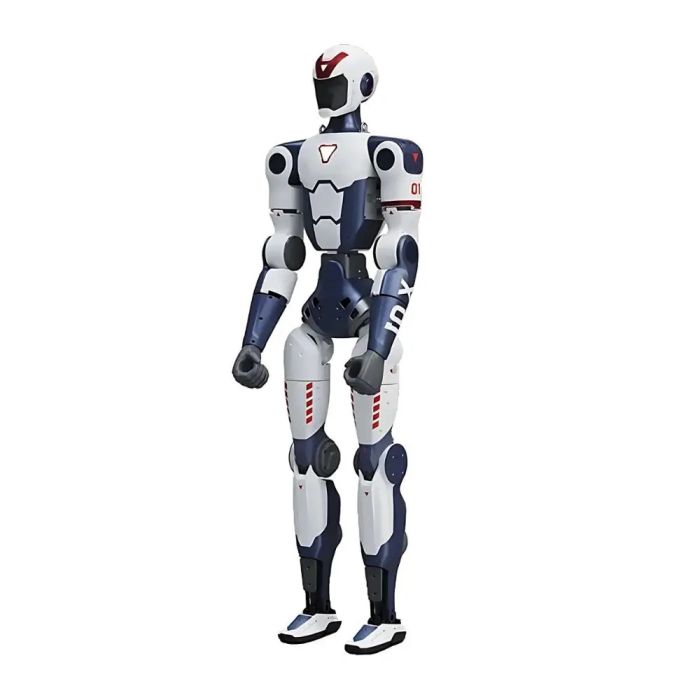
Unitree R1 Edu Pro D Humanoid Robot with BrainCo Revo 2 Touch Dexterous Hands (R1 EDU U6)
In stock
- BRAND:
- UNITREE ROBOTICS
- MODEL:
- R1 EDU PRO D
- PART #:
- R1 EDU U6
- ORIGIN:
- China
- Warranty:
- 12 MONTHS
- AVAILABILITY:
- ALLOW 2-4 WEEKS FOR DELIVERY
- SKU:
- Unitree Robotics-R1-EDU-U6
Unitree R1 Edu Pro D Humanoid Robot with BrainCo Revo 2 Touch Dexterous Hands (R1 EDU U6)
An hour is not long in a laboratory. It is enough for a calibration routine, a series of grasp trials and a short walking sequence before the battery needs attention. On a humanoid with 38 actuated joints and two hands that report contact as they close, every one of those minutes produces a great deal of useful data. The Unitree R1 Edu Pro D Humanoid Robot with BrainCo Revo 2 Touch Dexterous Hands (R1 EDU U6) rewards that kind of planning. It is a full-body humanoid whose legs, arms, waist and head are all actuated, and whose hands carry tactile sensing. The question it puts to a research group is not whether it can do many things, but how best to spend each session on the experiments that matter.
Robots Europa, based in Dublin, supplies the R1 EDU U6 to universities, research institutes and industrial laboratories across the European Union and the DACH region. Robots Europa prepares the quotation, arranges delivery and the import formalities for EU member states, Germany, Austria and Switzerland, and remains the point of contact for technical support once the robot is in your laboratory.
Background
Unitree Robotics and the R1 ladder
Unitree Robotics made its name with legged robots, first quadrupeds and then full-size and compact humanoids, and it has become one of the most widely used suppliers of legged platforms in academic research. The R1 family follows a familiar Unitree pattern: one body, offered in a ladder of configurations, so that an institution can buy the level of equipment its programme needs. The range comprises an R1 Basic, the R1 EDU Standard (U1), the R1 EDU Smart (U2) and a series of Pro configurations, including Pro A (U3), Pro B (U4), Pro C (U5) and Pro D (U6), the configuration described on this page. The complete range of educational and research configurations is collected under Unitree R1 EDU, and the wider family under Unitree R1.
BrainCo hands with a sense of touch
What sets the Pro D apart within the R1 range is at the end of its arms. The U6 is fitted with BrainCo Revo 2 Touch hands: five-finger dexterous hands with six degrees of freedom each and 4-channel tactile sensing. BrainCo is known for its work in neurotechnology and prosthetic hands, an area in which a hand must be both capable and gentle around people. On a humanoid research platform, that design approach gives researchers anthropomorphic hands that do more than move. They also return contact information to the control software, which is the raw material for much of current manipulation research.
Technical Specifications
| Specification | Value |
|---|---|
| Total degrees of freedom | 38 total actuated DOF across legs, arms, waist, and head |
| Dexterous hands | BrainCo Revo 2 Touch five-finger dexterous hands |
| Hand degrees of freedom | 6 DOF per hand |
| Tactile sensing | 4-channel tactile sensing |
| Calf + thigh length | 675 mm |
| Forearm + upper arm length | 435 mm |
| Battery life | ~ 1 hour |
Specifications are given as published by the manufacturer and are confirmed against the datasheet at quotation. The manufacturer has not published the IP rating, battery capacity, charging time, walking speed, power consumption, operating temperature, hand grip force or operating system; Robots Europa confirms these with the quotation.
What do the BrainCo Revo 2 Touch hands add to the R1 EDU U6?
A humanoid can be remarkably agile and still be clumsy with objects. Walking and balance depend on knowing where the body is, while manipulation depends on knowing what the hand is touching. The Revo 2 Touch hands address the second problem directly. Each hand has five fingers driven through six degrees of freedom, enough to form the precision pinches, power grasps and finger-and-thumb oppositions that anthropomorphic manipulation research studies. The 4-channel tactile sensing then tells the controller when and where contact has occurred.
For a research group, that changes which questions can be asked. Without touch, a grasp policy relies on vision and joint positions alone and has to infer contact from indirect signals. With tactile channels, contact becomes something the policy can observe. Grasp stability, contact-triggered behaviour, the transition from approach to hold, and the comparison of vision-only and vision-plus-touch controllers all become experiments that can be run on the robot itself rather than only in simulation.
The hands sit on a body that is itself highly articulated. The R1 EDU U6 has 38 actuated degrees of freedom across legs, arms, waist and head, and each hand has six degrees of freedom of its own. That combination lets a manipulation experiment involve the whole body: a robot that turns its head to look, leans at the waist to reach and closes its fingers with tactile feedback is far closer to the way a person handles objects than an arm bolted to a table. Tasks that depend on a particular holding force are best discussed with Robots Europa when the quotation is prepared.
How long can the R1 EDU U6 run in a single session?
The R1 EDU U6 has a battery life of about one hour. That figure shapes how a laboratory works with the robot more than almost any other. An hour suits structured sessions: a defined set of manipulation trials, a data-collection run, a teaching demonstration or a controlled walking test, each prepared in advance so that runtime is spent on the experiment rather than on set-up.
Groups that expect long days of continuous data collection should discuss charging arrangements and how sessions can be scheduled around them with Robots Europa at quotation. The limb dimensions give a working picture of the robot's stride and reach: a calf-plus-thigh length of 675 mm and a forearm-plus-upper-arm length of 435 mm. Together they help when a test area, a workbench or a motion-capture volume is being prepared.
Who is the R1 EDU U6 for?
The Pro D is aimed at groups for whom the hands are the point of the purchase. University manipulation laboratories studying grasping, in-hand adjustment and bimanual tasks will find the combination of anthropomorphic fingers and tactile feedback on a full humanoid body hard to replicate with a fixed arm and gripper. Embodied-AI teams training learned policies gain a platform on which contact data can be recorded together with whole-body motion. Human-robot interaction researchers, who need a robot that can hand over and receive objects in a human-like way, are a natural audience as well.
Teaching institutions are another segment. A humanoid that walks, turns its head and grasps with human-shaped hands makes robotics, control and machine learning tangible for students, provided the course is designed around sessions of about an hour. Corporate research and development groups exploring humanoid manipulation for future service or logistics applications may value the Pro D as a reference platform for internal studies.
Not every programme needs tactile hands. Where the research questions concern locomotion, perception or whole-body control rather than touch, a less specialised configuration may be the more sensible investment. The Unitree R1 Edu Pro C Humanoid Robot with BrainCo Revo 2 Basic Dexterous Hands (R1 EDU U5) is the closest sibling for teams that want BrainCo hands without the Touch variant. Groups weighing the earlier Pro configurations should compare the Unitree R1 Edu Pro A Humanoid Robot (R1 EDU U3) and the Unitree R1 Edu Pro B Humanoid Robot (R1 EDU U4). Robots Europa can set out the differences side by side in a quotation.
What is the R1 EDU U6 used for?
- Tactile grasping research – studying how contact feedback improves grasp stability and the handling of delicate or irregular objects.
- Bimanual manipulation – coordinating two dexterous hands for tasks such as opening, passing and assembling objects.
- Demonstration data collection – recording contact and motion data to train and evaluate learned manipulation policies.
- Loco-manipulation studies – combining walking, balance and grasping in tasks that require the whole body to cooperate.
- Human-robot interaction – investigating handovers, gestures and shared tasks between people and a human-shaped robot.
- Robotics and AI teaching – giving students hands-on experience with control, perception and learning on a full humanoid.
Pricing and Availability
The R1 EDU U6 is supplied on quotation. Robots Europa prepares each offer around the institution's programme, so that the configuration, accessories and documentation match the research or teaching it will support. Delivery, customs and support are arranged with the quotation, so the offer you receive covers the robot's journey into your laboratory as well as the robot itself. A quotation for the Unitree R1 EDU U6 is available on this page.
Frequently Asked Questions
Which hands does the R1 EDU U6 use?
It uses BrainCo Revo 2 Touch five-finger dexterous hands, with six degrees of freedom per hand and 4-channel tactile sensing.
How many degrees of freedom does the robot have?
The R1 EDU U6 has 38 total actuated degrees of freedom across legs, arms, waist and head. Each hand has six degrees of freedom.
What is the battery life?
The R1 EDU U6 has a battery life of about one hour. Charging arrangements can be discussed with Robots Europa when you request a quotation.
What are the limb lengths?
The calf-plus-thigh length is 675 mm and the forearm-plus-upper-arm length is 435 mm. These figures help when planning a test area or workbench.
Does Robots Europa deliver to Switzerland?
Yes. Robots Europa supplies the R1 EDU U6 across the EU and the DACH region, including Switzerland, and arranges delivery and customs with the quotation.
How does the Pro D differ from the Pro C?
The Pro D (U6) is fitted with BrainCo Revo 2 Touch hands with tactile sensing. The Pro C (U5) carries BrainCo Revo 2 Basic hands, and Robots Europa can compare both configurations in detail.
Where can I buy the Unitree R1 EDU U6 and what does it cost?
Robots Europa supplies the R1 EDU U6 across the EU and the DACH region on quotation. The offer is prepared for your programme, with delivery, customs and support arranged as part of it.
Summary
The R1 EDU U6 brings a full humanoid body and a pair of tactile, five-finger BrainCo hands into one research platform. Its 38 actuated degrees of freedom, six degrees of freedom in each hand and its limb lengths give laboratories a clear basis for planning experiments. Its battery life of about an hour turns each session into a deliberate, well-prepared piece of work. For groups whose questions begin where a fingertip meets an object, and who are ready to plan their time around it, the Pro D is the configuration to consider, supplied, delivered and supported by Robots Europa. For a quotation tailored to your institution, this page is the starting point.


