
BWSENSING Digital Dual-Axis Inclinometer (BWL326S)
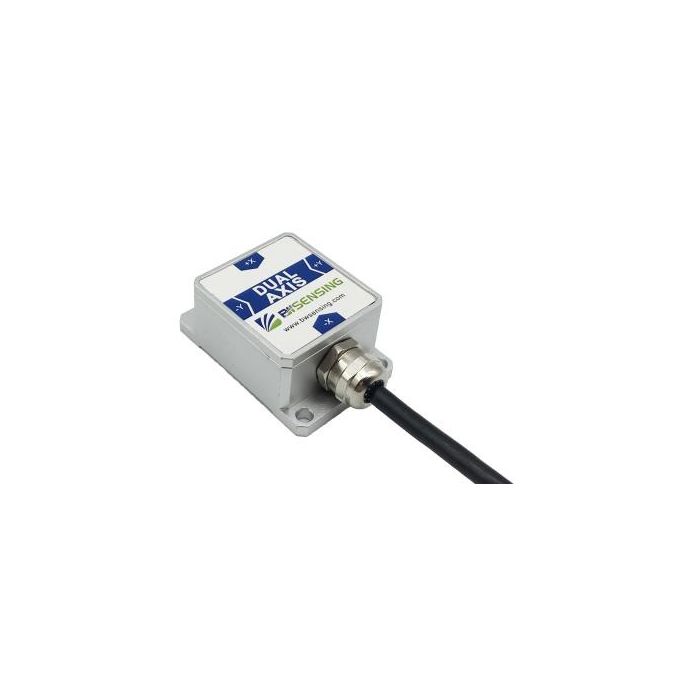
In stock
- BRAND:
- BWSENSING
- PART #:
- BWL326S
- ORIGIN:
- China
- AVAILABILITY:
- SUBJECT TO AVAILABILITY
- SKU:
- BWSENSING-BWL326S
BWSENSING Digital Dual-Axis Inclinometer (BWL326S)
Every inclinometer quotes two small numbers that are easily confused, and the gap between them decides whether a tilt sensor suits the job. On the BWSENSING Digital Dual-Axis Inclinometer (BWL326S), the resolution is 0.01° and the accuracy is 0.1°. The sensor registers a change ten times finer than the tolerance it holds on the absolute angle. For a machine that must stay level, react to a slow drift or stop before it leans too far, that distinction matters more than any headline figure. It also shapes how this compact pitch-and-roll sensor should be specified.
Robots Europa, based in Dublin, supplies the BWL326S to machine builders, system integrators and research teams across the EU and the DACH region. Robots Europa prepares each quotation, arranges delivery to the country of installation and provides technical support from the first enquiry through to commissioning. The output interface and mounting version are therefore agreed before an order is placed.
Background
The designer behind the sensor
The BWL326S is designed by Bewis Sensing Technology LLC and sold under the BWSENSING brand. It is a digital-output, low-cost dual-axis inclinometer. That places it at the accessible end of an industrial tilt-sensing portfolio rather than among laboratory instruments: it is intended to be fitted in numbers to machines and assets, not kept on a calibration bench. BWSENSING offers a range of related inclinometers with different axis counts and interfaces, gathered in the BWSensing category.
MEMS sensing in a sealed housing
At its core the BWL326S uses an industrial-level MEMS accelerometer. A MEMS accelerometer senses the direction of gravity relative to its own axes. When the housing tilts, gravity is shared differently between those axes, and the electronics convert that change into two angles. Because the sensing element is micro-machined silicon rather than a liquid bubble or a mechanical pendulum, this approach suits small housings and copes well with the vibration found on vehicles and plant. In the BWL326S the element sits in an IP67-rated enclosure measuring L55mm×W37mm×H24mm, a size that can be customised for a project.
Technical Specifications
| Specification | Value |
|---|---|
| Designer | Bewis Sensing Technology LLC |
| Measurement | Dual-axis inclinometer measurement |
| Measuring range | ±90° |
| Resolution | 0.01° |
| Accuracy | 0.1° |
| Output interface | RS232/485/TTL optional |
| Output frequency | 5-100Hz adjustable, up to 100 Hz |
| Start-up time | <50ms |
| Voltage input | 9~35V |
| Protection rating | IP67 |
| Product size | L55mm×W37mm×H24mm (customizable) |
| Weight | 210 g (without outer packaging) |
| Mean time between failures (MTBF) | ≥90000 h |
Specifications are as published by the manufacturer and are confirmed against the datasheet at quotation.
The manufacturer has not published the package contents, the cable length, the supply current range, the supported baud rates or the zero temperature drift; Robots Europa confirms these at quotation.
What is the difference between the resolution and the accuracy of the BWL326S?
Resolution is the smallest change in angle the sensor can report: on the BWL326S, 0.01°. Accuracy is how closely the reported angle matches the true angle: here, 0.1°. The two answer different questions, and an application usually depends on one more than the other.
Where a controller watches for movement, for example a structure that begins to settle or a platform that starts to drift during a lift, the fine resolution is what counts. The sensor reports small changes well before they would add up to the accuracy figure. Where the task is to set something to a known absolute angle, such as levelling a chassis to true horizontal, the 0.1° accuracy is the relevant limit. Specifying the BWL326S correctly means deciding which of these questions the machine is asking, and stating it clearly in the enquiry.
Which output should you choose: RS232, RS485 or TTL?
The BWL326S is offered with RS232, RS485 or TTL output as options, so the interface is a decision made at ordering rather than a fixed feature. Each suits a different installation. TTL levels connect most directly to a microcontroller or single-board computer sitting close to the sensor, which is common in robotics prototypes and embedded products. RS232 suits a point-to-point link to a PC, a data logger or older industrial equipment with a serial port. RS485 is the usual choice on machinery and in plant: its differential signalling tolerates longer cable runs and electrical noise, and it allows several devices to share one bus.
The wide 9~35V input fits the supply rails typically found on vehicles and in control cabinets, and the output frequency can be set between 5 and 100Hz. A slow rate keeps bus traffic light on a monitoring network. A fast rate supports closed-loop control.
Who is the BWSENSING Digital Dual-Axis Inclinometer (BWL326S) for?
The BWL326S is aimed at buyers who need pitch and roll in a compact, sealed package without paying for laboratory-grade performance. Builders of mobile machinery, such as access platforms, cranes, agricultural and construction equipment, will value the IP67 enclosure, the rated impact resistance and the broad supply range. Integrators of fixed outdoor assets, including solar trackers, antenna mounts and monitored structures, can use the ±90° range and the adjustable output rate to suit slow, long-term observation.
Robotics developers and university laboratories form a third group. For them the TTL option and the short start-up time make it straightforward to add attitude sensing to a mobile robot or a test rig. OEMs building the sensor into their own product may find the customisable housing size relevant. The sources also name a BWL326S bare plate version for integration into an existing enclosure, and Robots Europa can advise which of the two versions fits a given design.
Where a project needs a different combination of axes or interface, the wider family is worth comparing. The BWSENSING Cost-Effective Single-Axis CAN Output Inclinometer (BWM415) addresses single-axis measurement over CAN, and further tilt and orientation sensors are listed in the Sensors category.
What is the BWSENSING Digital Dual-Axis Inclinometer (BWL326S) used for?
- Platform levelling — reporting pitch and roll so that an outrigger or hydraulic system can bring a chassis to level.
- Boom and mast angle monitoring — tracking the inclination of lifting equipment as part of its control or display system.
- Tilt safety interlocks — triggering a warning or a stop when a vehicle or machine approaches an unsafe angle.
- Solar tracker and antenna positioning — checking the elevation and tilt of panels, dishes and antenna mounts outdoors.
- Structural monitoring — detecting slow inclination changes in walls, towers, bridges or retaining structures over time.
- Mobile robot attitude sensing — supplying pitch and roll to a robot controller for stability and terrain handling.
Pricing and Availability
Robots Europa supplies the BWL326S on quotation, so that the output interface, the mounting version and any custom housing size are matched to the project before an order is placed. Delivery, customs and technical support are arranged together with the quotation. To begin, state the intended interface, the quantity and the application. The request form for the BWSENSING Digital Dual-Axis Inclinometer (BWL326S) is available on this page.
Frequently Asked Questions
How many axes does the BWL326S measure?
It is a dual-axis inclinometer, measuring inclination on two axes, typically pitch and roll. The measuring range is ±90°.
Which output interfaces are available?
The output interface is RS232, RS485 or TTL, chosen as an option when the sensor is ordered.
What supply voltage does the sensor need?
The voltage input is 9~35V, which suits the supply rails common on vehicles and in control cabinets.
Can the BWL326S be installed outdoors?
The enclosure carries an IP67 protection rating. The sensor is also rated for impact resistance, which suits mobile machinery.
How quickly does it deliver data?
The start-up time is <50ms, and the output frequency is adjustable from 5 to 100Hz. That covers both slow monitoring and faster control loops.
What sensing technology does the BWL326S use?
It uses an industrial-level MEMS accelerometer, which derives both tilt angles from the direction of gravity. The element is housed in a compact enclosure measuring L55mm×W37mm×H24mm.
Where can I buy the BWSENSING Digital Dual-Axis Inclinometer (BWL326S) and what does it cost?
Robots Europa supplies the BWL326S across the EU and the DACH region on quotation. The quotation reflects the chosen interface, version and quantity, and includes the arrangements for delivery and support.
Summary
The BWL326S is best read through the two figures that opened this page. A resolution of 0.01° lets it register small movements, while an accuracy of 0.1° sets how far its absolute readings can be relied upon. Around that core, Bewis Sensing Technology LLC has built a practical field instrument: an industrial-level MEMS accelerometer, a ±90° range on two axes, an IP67 housing, a choice of RS232, RS485 or TTL output and a 9~35V supply input. Buyers who decide early whether their machine needs to detect change or hold an absolute angle will specify it well. For a quotation from Robots Europa, this page is the starting point.


