
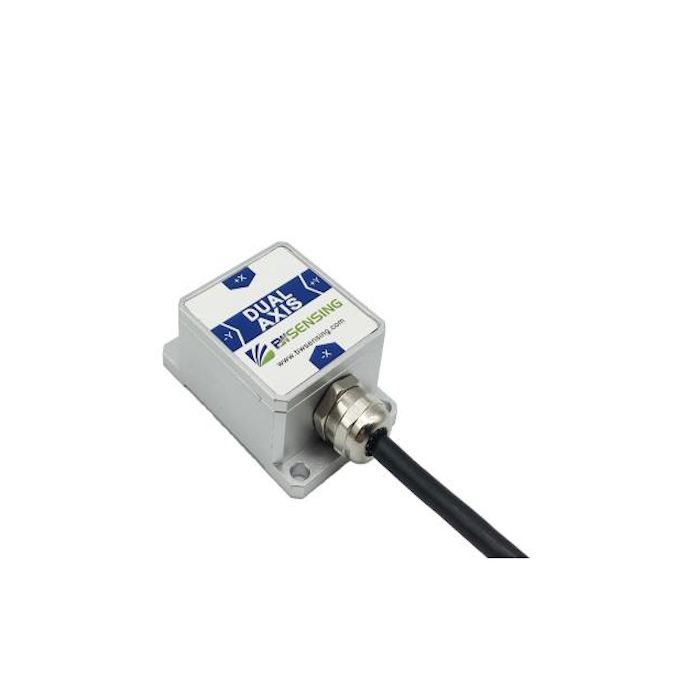
BWSENSING Low Cost Dual-Axis Digital Output With Modbus Inclinometer (BWL327S)
In stock
- BRAND:
- BWSENSING
- PART #:
- BWL327S
- ORIGIN:
- China
- AVAILABILITY:
- SUBJECT TO AVAILABILITY
- SKU:
- BWSENSING-BWL327S
BWSENSING Low Cost Dual-Axis Digital Output With Modbus Inclinometer (BWL327S)
A solar tracker on an exposed hillside, a telecom mast in a gale, a hospital bed that must sit perfectly level: each depends on knowing, continuously and without fuss, exactly how far something has tipped. The BWSENSING Low Cost Dual-Axis Digital Output With Modbus Inclinometer (BWL327S) addresses that need with a sensor whose budget-conscious design does not compromise on ruggedness. It reads inclination on two axes across ±90° with 0.01° resolution, sits in an IP67 housing measuring L55mm×W37mm×H24mm, and reports its readings over a serial link that plugs directly into the controllers already running most automation and monitoring systems.
Robots Europa, based in Dublin, supplies the BWL327S to integrators, OEMs and research teams throughout the European Union and the DACH region. We prepare a formal quotation for each enquiry, agree the output variant and configuration with you, and arrange delivery and post-sale technical support from our European base, so that the sensor arrives ready for the project it was ordered for.
Background
BWSENSING and its inclinometer range
BWSENSING builds a broad catalogue of tilt sensors, and the BWL327S sits within a family of cost-conscious models that spans single-axis and dual-axis designs with a choice of digital interfaces. Elsewhere in our BWSensing range you will find single-axis units with CAN or Modbus output alongside further dual-axis digital models, which lets an engineer standardise on a single manufacturer across machines with very different requirements. The manufacturer also names related versions in the same series as the BWL327S, namely the BWL327, BWL326S and BWL325S; this page covers the BWL327S alone.
Gravity-referenced tilt sensing at an accessible cost
An inclinometer of this class measures its orientation relative to the Earth's gravity vector, so it requires no external reference point: once mounted, it reports how far the surface beneath it deviates from horizontal. A dual-axis design resolves that deviation into two orthogonal angles, conventionally pitch and roll, giving a complete picture of a plane's attitude from a single device. The BWL327S pairs this approach with a fully digital output, so the angle arrives at the controller as a number rather than as an analogue voltage needing calibration and filtering, which simplifies integration and keeps long cable runs from degrading the reading.
Technical Specifications
| Specification | Value |
|---|---|
| Axes | Dual-axis inclinometer measurement |
| Range | ±90° |
| Resolution | 0.01° |
| Highest accuracy | 0.1° |
| Output | RS232/RS485/TTL optional |
| Output frequency | 5-100Hz adjustable |
| Start-up time | <50ms |
| Voltage input | 9~35V |
| Protection level | IP67 |
| Product size | L55mm×W37mm×H24mm (customizable) |
| Weight | 210 g (without outer packaging) |
| Mean time between failures (MTBF) | ≥90000 h |
| Insulation resistance | ≥100 MΩ |
| Impact resistance | 2000g, 0.5ms, 3 times/axis |
Specifications as published by the manufacturer; confirmed against the datasheet at quotation.
The manufacturer has not published the package contents, cable length, baud rate options, power consumption in watts, operating temperature range or mounting method, so these details are confirmed at quotation.
How does the BWL327S balance low cost with field durability?
Lower-cost sensors usually economise somewhere, and the obvious places are the enclosure and the electronics' tolerance of real-world conditions. The BWL327S does not take that route. Its IP67 protection level means the housing is sealed against dust and temporary immersion, which matters on rooftops, masts and outdoor machinery where rain and grime are routine. The impact resistance rating of 2000g, 0.5ms, 3 times/axis indicates a unit designed to withstand the knocks of transport, installation and vibrating equipment, while an MTBF of ≥90000 h and insulation resistance of ≥100 MΩ point to electronics intended for long, unattended service.
The economy shows instead in the specification's focus. Highest accuracy is given as 0.1°, with 0.01° resolution, which suits levelling, tracking and structural monitoring rather than metrology-grade work. The wide 9~35V input accepts the supply rails common on industrial and vehicle systems without a dedicated regulator, and a start-up time under 50ms means the reading is available almost as soon as power is applied, a useful property for equipment that cycles its sensors on and off.
Which output should I choose: RS232, RS485 or TTL?
The BWL327S is offered with RS232, RS485 or TTL output, and the choice is best made around the host system rather than the sensor. RS485 is the usual preference for industrial networks: it is differential, tolerates long cable runs and electrical noise well, and supports several devices on a single bus, which is why it is the customary carrier for Modbus in factories and outdoor installations. RS232 suits short point-to-point connections to legacy PLCs, industrial PCs or test benches. TTL-level output is the natural fit when the sensor connects directly to a microcontroller or embedded board inside a product, avoiding an interface converter altogether.
Whichever interface you select, the adjustable output frequency of 5-100Hz lets you match the update rate to the application: a slow rate keeps bus traffic light on a structural monitoring network, while the upper end gives a control loop the responsiveness it needs on a tracker or levelling platform. Robots Europa agrees the interface variant, protocol and configuration with you as part of the quotation.
Who is the BWL327S for?
The first group comprises solar and renewable energy integrators who need a sealed, affordable sensor to feed tracker controllers across many rows of panels, where unit cost multiplies quickly. The second comprises engineers responsible for towers, masts, poles and other structures, who want continuous tilt data from instruments able to live outdoors for years. The third comprises OEMs building machinery, medical equipment or platforms that must level themselves automatically and want to embed a compact sensor with a digital output that their firmware can read directly.
Where only one axis of tilt matters, a single-axis model such as the BWSENSING Cost-Effective Single-Axis Digital Output With Modbus Inclinometer (BWM417) may be the simpler choice, and teams whose machines run on a CAN bus may prefer the BWSENSING Cost-Effective Single-Axis CAN Output Inclinometer (BWM415). For a wider comparison, our Sensors category brings together the inclinometers and other sensing hardware we supply.
What is the BWL327S used for?
- Photovoltaic automatic tracking: feeding panel angle back to a tracker controller so that arrays follow the sun accurately.
- Tower tilt monitoring: watching masts, pylons and towers for gradual lean or sudden movement that warrants inspection.
- Industrial automatic levelling: giving platforms, machines and outriggers the feedback they need to level themselves.
- Medical instruments: reporting the orientation of beds, tables and equipment that must hold a defined angle.
- Equipment orientation feedback: supplying pitch and roll data to controllers on mobile machinery and robotic platforms.
- Embedded product design: integrating tilt sensing into a device through the TTL output and a compact, customisable housing.
Pricing and Availability
Robots Europa supplies the BWL327S on a quotation basis, as the output variant, configuration and quantity all shape the final offer. Tell us the interface you need, the number of units and the application, and we will prepare an offer for the right configuration. Delivery, customs and technical support are arranged with the quotation. To start the process, use the quotation request available on this page.
Frequently Asked Questions
How many axes does the BWL327S measure?
It is a dual-axis inclinometer, measuring tilt on two axes across a range of ±90°.
How precise are its readings?
Resolution is 0.01° and highest accuracy is 0.1°.
Which outputs are available?
The BWL327S is offered with RS232, RS485 or TTL output; you choose the variant that matches your controller.
Can it be installed outdoors?
Yes, the housing carries an IP67 protection level, sealing it against dust and temporary immersion.
What power supply does it need?
It accepts a voltage input of 9~35V, covering the supply rails common on industrial and vehicle systems.
Can the housing size be changed?
The standard size is L55mm×W37mm×H24mm, and the housing is customizable; Robots Europa can discuss custom requirements as part of your quotation.
Where can I buy the BWSENSING BWL327S and what does it cost?
You can buy the BWL327S from Robots Europa, which supplies it throughout the EU and the DACH region. The cost depends on the variant and quantity, so please request a quotation and we will reply with a tailored offer.
Summary
The BWL327S answers a practical question: how to give many machines and structures reliable tilt sensing without allowing the cost of sensors to dominate the project budget. It measures two axes across ±90°, resolves to 0.01°, survives outdoor conditions behind IP67 sealing and hard knocks within its impact rating, and delivers its readings digitally over RS232, RS485 or TTL. For solar trackers, monitored towers, self-levelling equipment and embedded designs alike, it offers a sensible balance of capability and economy. If you are ready to specify it for your next installation, this page is the starting point.


