
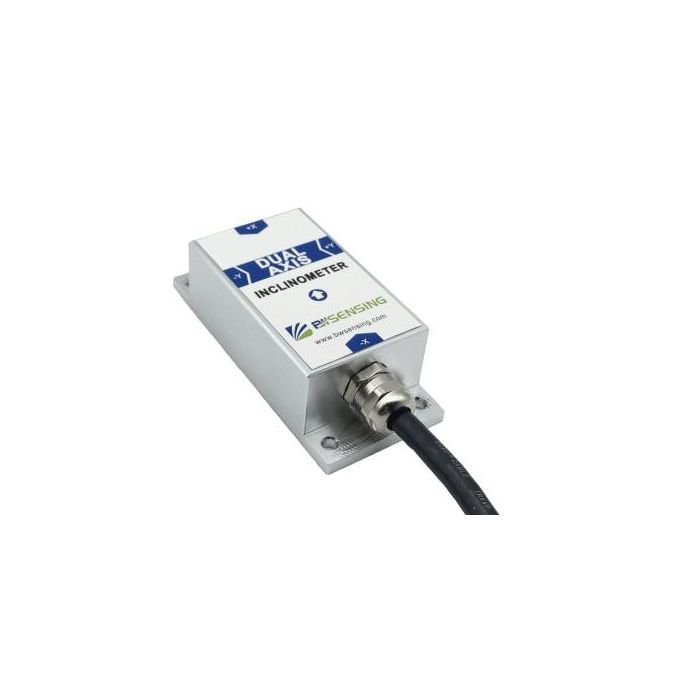
BWSENSING Cost-Effective Dual-Axis Digital Output Inclinometer (BWM426)
In stock
- BRAND:
- BWSENSING
- PART #:
- BWM426
- ORIGIN:
- China
- AVAILABILITY:
- SUBJECT TO AVAILABILITY
- SKU:
- BWSENSING-BWM426
BWSENSING Cost-Effective Dual-Axis Digital Output Inclinometer (BWM426)
Tilt is easy to see and surprisingly awkward to measure well. A bubble level tells a technician what is happening, but it tells a controller, a data logger or a remote monitoring platform nothing at all. The BWSENSING Cost-Effective Dual-Axis Digital Output Inclinometer (BWM426) closes that gap at the economical end of the market. It turns the lean of a machine, mast or platform into a digital value on two axes, with a resolution of 0.001° and a highest accuracy of 0.01°, in a housing compact enough to fit a bracket that is already on the equipment.
Robots Europa, based in Dublin, supplies the BWM426 to customers across the European Union and the DACH region. Robots Europa prepares each quotation and helps you confirm the version and output interface that suit your project. It then arranges delivery and provides support after installation, so integrators, OEMs and research teams keep a single point of contact from the first enquiry to commissioning.
Background
BEWIS Sensing Technology and the BWSENSING range
The BWM426 is designed by BEWIS Sensing Technology LLC and carries the BWSENSING name. It belongs to a family of inclinometers that spans single-axis and dual-axis models with a choice of analogue, digital, Modbus and CAN outputs. That breadth matters to anyone standardising on one supplier, because a project can use different interfaces on different machines and still work with one family of mechanical formats and one configuration approach. The wider line-up is collected on the BWSensing page.
A low-cost Modbus inclinometer for everyday integration
BEWIS describes the BWM426 as a low-cost, small double-axes inclinometer with Modbus protocol output. The design brief is clear from that description. It is not a laboratory reference instrument but a practical sensor for machines and installations, where a digital tilt reading has to reach a controller reliably without the cost of a high-end attitude system. The output can be specified as RS232, RS485 or TTL. The shell is anodised magnesium alloy, and the housing carries an IP67 protection level, which suits the sensor to equipment that works outdoors or is washed down. BEWIS also supplies serial debugging software, so the inclinometer can be connected to a computer and its angles displayed before it is wired into the final system.
Technical Specifications
| Specification | Value |
|---|---|
| Measurement axes | Dual axis inclination measurement |
| Measuring range (BWM426) | ±90° |
| Measuring range (BWM426-88) | ± 88° |
| Resolution | 0.001° |
| Highest accuracy | 0.01° |
| Output | RS232/RS485/TTL optional (Modbus protocol output) |
| Power supply | 9-35V |
| Operating temperature (BWM426) | -40℃~+85℃ |
| Protection level | IP67 |
| Shell material (BWM426) | Magnesium alloy anodizing |
| Dimensions | L90*W40.5*H26(mm) |
| Installation (BWM426) | Horizontal or vertical (vertical installation requires customization) |
| Software (BWM426) | Supporting serial debugging software for angle display on a computer |
Specifications are as published by the manufacturer and are confirmed against the datasheet at quotation.
The manufacturer has not published the weight, the cable length or the details of the output protocol, so these are confirmed with your quotation.
What is the difference between the BWM426 and the BWM426-88?
The sources name three designations: the BWM426, the BWM426-88 and the BWM426S. The measuring range is where they visibly differ. The product page gives the BWM426 a range of ±90°, and the manual describes the BWM426-88 with a measuring range of ± 88°. In practice, the full ±90° matters where a structure or machine may be tilted right up to the vertical. The ± 88° variant suits applications where the useful angle never reaches that extreme.
The sources do not publish separate figures for the BWM426S. If that designation interests you, Robots Europa confirms what distinguishes it from the standard model when preparing your quotation. Choose the version according to the angle your equipment will actually reach, not the largest number on offer. Then confirm it in writing, because the version code decides what is supplied.
Which output should I choose: RS232, RS485 or TTL?
All three outputs carry the same measurement. The choice depends on where the reading has to go. RS232 is the familiar point-to-point serial link, convenient for connecting a single sensor directly to a computer or an older controller during set-up and testing. RS485 is the usual choice in industrial installations, because its differential signalling tolerates electrical noise and longer cable runs. It also allows several devices to share one bus, which suits the Modbus protocol output of the BWM426. TTL-level serial is intended for embedded designs, where the inclinometer talks directly to a microcontroller on a custom board without a line driver in between.
Because the output is selected when the sensor is ordered, decide on the interface before the quotation is finalised. The supporting serial debugging software helps here. It lets your engineers watch the angle readings on a computer and check orientation, zero and behaviour before any integration code is written.
Who is the BWM426 for?
The BWM426 suits buyers who need a genuine two-axis digital tilt reading at a moderate cost. The first group is machine builders and OEMs fitting tilt feedback to platforms, booms, vehicles and mobile robots. For them, the 9-35V supply range and the compact housing ease integration into existing electrical and mechanical designs. The second is systems integrators working on structural and infrastructure monitoring, who value the IP67 protection and the Modbus protocol output when many sensors report to one data acquisition system. The third is universities, research groups and test laboratories that want a ready-made, well-documented sensor for experiments in attitude, levelling and vibration-free static measurement.
Not every project needs two axes or a serial bus. If only one tilt angle matters, the single-axis BWSENSING Cost-Effective Single-Axis Digital Output With Modbus Inclinometer (BWM417) is worth comparing. Where the host network is CAN-based, as on many vehicles, the BWSENSING Cost-Effective Single-Axis CAN Output Inclinometer (BWM415) is the more natural fit. Other tilt, position and environmental sensors are listed in the Sensors category.
What is the BWM426 used for?
- Platform levelling – feeding live tilt values to the controller that drives levelling jacks or outriggers.
- Boom and aerial work equipment – monitoring the attitude of lifting machinery so that safety logic can act on excessive inclination.
- Structural health monitoring – tracking slow changes in the tilt of towers, retaining walls, bridges and buildings over time.
- Antenna and satellite dish alignment – checking the elevation and lean of a mount during installation and in service.
- Mobile robotics – reporting chassis pitch and roll so that navigation and stability routines can respond to uneven ground.
- Agricultural and construction machinery – giving implements and attachments angle feedback for consistent working depth or grade.
Pricing and Availability
Robots Europa supplies the BWM426 on quotation, so that the version, the measuring range and the output interface are agreed before the order is placed. Tell us about your application, the controller or bus the sensor will connect to, and the quantity you need, and we will prepare an offer. Delivery, customs and support are arranged together with the quotation. To begin, use the quotation request available on this page.
Frequently Asked Questions
Does the BWM426 measure tilt on two axes?
Yes. The BWM426 provides dual axis inclination measurement, so a single sensor reports inclination on both axes.
Which output interfaces are available?
The output can be specified as RS232, RS485 or TTL, and the inclinometer uses Modbus protocol output. The interface is chosen when ordering, so please state it in your quotation request.
Can the sensor be mounted vertically?
The product can be installed horizontally or vertically, but vertical installation requires customisation. Please mention the intended mounting orientation when you request a quotation.
Is the BWM426 suitable for outdoor installations?
The housing carries an IP67 protection level, and the manual gives the BWM426 an operating temperature of -40℃~+85℃. Both make it a reasonable candidate for equipment exposed to weather.
What power supply does it need?
The BWM426 accepts a power supply of 9-35V. That covers the supply rails common on industrial machinery and vehicles.
How can I test the sensor before integrating it?
BEWIS provides supporting serial debugging software. It connects the inclinometer to a computer and displays the measured angles, which lets you verify readings before writing any integration code.
Where can I buy the BWSENSING BWM426 and what does it cost?
You can buy the BWM426 from Robots Europa, which supplies customers across the EU and the DACH region. The cost depends on the version, output and quantity, and is set out in a quotation prepared for your project.
Summary
The BWM426 answers a simple need: tilt that a technician can see should also be something a machine can read. In a compact anodised magnesium alloy housing with IP67 protection, it delivers a two-axis measurement with a resolution of 0.001° and a highest accuracy of 0.01°. It sends that measurement over RS232, RS485 or TTL with Modbus protocol output, from a supply anywhere between 9 and 35V. The choice between the ±90° BWM426 and the ± 88° BWM426-88 depends on the angles your equipment really reaches, and Robots Europa confirms that detail, along with any vertical-mounting customisation, before the order is placed. For a cost-conscious, two-axis digital inclinometer supplied and supported within Europe, this page is the starting point.


