
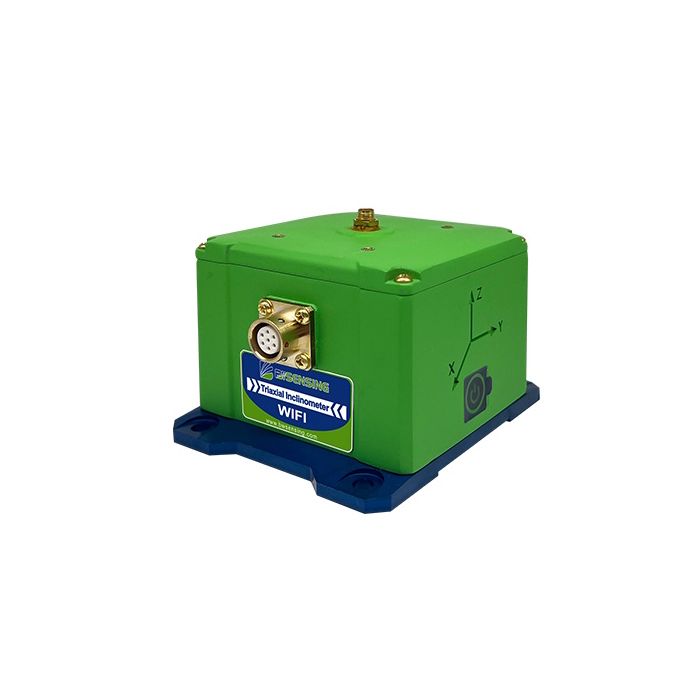
BWSENSING High-Speed Wifi Triaxial Inclinometer (WF-WM400)
In stock
- BRAND:
- BWSENSING
- PART #:
- WF-WM400
- ORIGIN:
- China
- AVAILABILITY:
- SUBJECT TO AVAILABILITY
- SKU:
- BWSENSING-WF-WM400
BWSENSING High-Speed Wifi Triaxial Inclinometer (WF-WM400)
A bridge pier that has rotated by a few thousandths of a degree looks exactly like one that has not moved at all. The difference only becomes visible to an instrument that is fixed to the structure, resolves angles finely enough to register the drift, and keeps reporting through winter nights and summer heat long after the installation crew has left. The BWSENSING High-Speed Wifi Triaxial Inclinometer (WF-WM400) is built for that patient work: a compact, intelligent digital inclination sensor for structural health monitoring that measures tilt on three axes and sends its readings over WiFi, so that a monitoring point can be established without a signal cable running back to a cabinet.
Robots Europa, based in Dublin, supplies the WF-WM400 to organisations throughout the European Union and the DACH region. Our team prepares the quotation, arranges delivery to the site or office, and remains your point of contact for technical questions once the sensors are installed. The inclinometer belongs to our Sensors range, and the wider BWSensing catalogue is available for projects that combine wireless and wired measurement points.
Background
Wuxi Bewis Sensing Technology LLC and the BWSENSING range
The WF-WM400 is manufactured by Wuxi Bewis Sensing Technology LLC, which markets its inclination sensors under the BWSENSING name. The brand's catalogue runs from cost-effective single-axis and dual-axis inclinometers with digital, CAN and Modbus outputs, which are wired into a control or acquisition system, to wireless instruments such as this one, intended for measurement points where a cable would be impractical, expensive or vulnerable. That breadth matters to engineers who plan a monitoring scheme as a whole: wired sensors can serve the points close to a logger, while wireless units cover the far end of a bridge deck, the top of a slope or the crown of a tunnel.
One sensing platform, three ways to communicate
The manufacturer's sources name three versions of this inclinometer: the WF-WM400, which communicates over WiFi; the LWHD-WM400, which uses LoRaWAN; and the FG-WM400-EU, which uses 4G LTE Cat-1. This page covers the WiFi version. In general terms, WiFi suits sites where a local access point or gateway can be placed within reach of the sensors, LoRaWAN is commonly chosen for low-power networks spread over a wider area, and cellular connectivity serves locations without any local network infrastructure. The figures in the table below are those published for the WF-WM400; the antenna height in particular is stated for the WiFi version, and no figure on this page should be read as applying to the LoRaWAN or 4G versions.
Technical Specifications
| Specification | Value |
|---|---|
| Measurement | Triaxial, range ±60° |
| Resolution | 0.001° |
| Accuracy | 0.005° |
| Output frequency | Up to 50 Hz |
| Operating temperature | -40℃ ~ +85℃ |
| Protection level | IP68 (1 m water depth, 24 hours continuous test) |
| Shell material | ABS+30% glass fiber + magnesium aluminum alloy anodized base |
| Installation | Four M6 screws |
| Connector | Aviation connector |
| Dimensions (antenna not included) | L105.2*W85*H76 (mm); length and width may vary by 1mm |
| Standard antenna height | 159mm (WiFi version without radome) |
| Weight | 450 (±10) (with battery) |
| Power supply voltage | 3.6VDC~5VDC |
| Disposable battery capacity | 19000mAh |
| Battery life | More than 3 years when uploading data once an hour |
| Communication distance | Maximum: 200m |
| Power-saving and wake functions | Automatic sleep mode, timed wake-up, exercise wake |
Specifications are as published by the manufacturer and are confirmed against the datasheet at quotation.
The manufacturer has not published the WiFi standard version, the operating humidity, software compatibility or any details of a cloud platform; these points are confirmed at quotation.
What makes the WF-WM400 different from a wired inclinometer?
On many monitoring projects the sensor is the smallest part of the cost. Trenching, cable trays, conduit across a river pier or up a cutting, and the repairs after a mower or an excavator has found the cable often outweigh the instrument itself. The WF-WM400 removes that run: it carries its own 19000mAh disposable battery, sends data over WiFi, and is fixed to the structure with four M6 screws on a magnesium aluminium alloy anodised base. The housing of ABS with 30% glass fibre is rated IP68, tested at 1 m water depth for 24 hours continuously, and the unit operates from -40℃ to +85℃, which covers exposed steelwork in a continental winter as well as a dark enclosure in summer sun.
Wireless operation does not mean a compromise in measurement. The sensor resolves 0.001° with an accuracy of 0.005° across a triaxial range of ±60°, and it can output data at up to 50 Hz. That last figure is what the "High-Speed" in the name refers to: many battery-powered tilt sensors are designed only for slow, periodic readings, whereas the WF-WM400 can also capture faster angular changes when a project calls for it. The practical limit to plan around is the communication distance, published as a maximum of 200m, so the layout of access points or gateways belongs in the design stage rather than on the day of installation.
How long does the WF-WM400 run on its battery?
The manufacturer states a battery life of more than 3 years when the sensor uploads data once an hour, which suits the long observation periods typical of structural and geotechnical monitoring. Three functions support that endurance: an automatic sleep mode, a timed wake-up, and what the manufacturer calls exercise wake, a trigger that brings the sensor out of sleep outside its schedule. A monitoring regime that reports more often, or uses the faster output rates, will draw more energy, so the reporting interval is best agreed alongside the expected service period of each installation. Where an external supply is available, the published power supply voltage is 3.6VDC~5VDC.
Who is the WF-WM400 for?
The WF-WM400 is aimed first at engineering consultancies and monitoring contractors who instrument bridges, dams, slopes, tunnels and excavations, and who need many measurement points without the expense of cabling each one. Infrastructure owners and operators who want long-term evidence of how an asset behaves, rather than occasional manual surveys, form a second group. Research teams at universities and institutes, who instrument test structures or field sites for a defined campaign, will find a self-contained wireless sensor convenient to deploy and recover.
The WiFi version is the right choice where a local network can be provided within the published communication distance. For sites spread over a larger area, or with no local infrastructure at all, the LoRaWAN version (LWHD-WM400) or the 4G LTE Cat-1 version (FG-WM400-EU) is worth discussing with us before you order. Projects that connect inclinometers directly to a PLC or data logger by cable may be better served by one of the wired models in the BWSensing range.
What is the WF-WM400 used for?
- Bridge towers and piers — tracking rotation and settlement of supports over seasons and under traffic.
- Dams and retaining walls — watching for gradual tilt in structures that hold back water or soil.
- Slope disaster prevention — giving early warning of movement on cuttings, embankments and natural hillsides.
- Tunnels and foundation pits — following deformation of linings, struts and pit walls during and after construction.
- Buildings next to excavations — documenting whether neighbouring structures move while works proceed.
- Towers, masts and heritage structures — long-term observation of tall or sensitive structures where cabling is unwelcome.
Pricing and Availability
Robots Europa supplies the WF-WM400 on quotation, so that the number of sensors, the connectivity version and the reporting regime can be matched to your project before an order is placed. Delivery, customs and support are arranged with the quotation. If you are planning a larger monitoring scheme, we recommend including a brief description of the site, so that our team can comment on the network layout and the choice between the WiFi, LoRaWAN and 4G versions. To begin, the quotation request is available on this page.
Frequently Asked Questions
How many axes does the WF-WM400 measure?
It is a triaxial inclinometer with a measurement range of ±60°. Its resolution is 0.001° and its accuracy 0.005°.
Can the WF-WM400 be installed outdoors?
Yes. It is rated IP68, tested at 1 m water depth for 24 hours continuously, and operates from -40℃ to +85℃.
How is the sensor mounted?
It is fixed with four M6 screws through its magnesium aluminium alloy anodised base. The body measures L105.2*W85*H76 (mm) without the antenna, and the standard antenna of the WiFi version is 159mm high without a radome.
How far can the sensor be from the receiving point?
The manufacturer publishes a maximum communication distance of 200m. Site conditions should be reviewed when the network layout is planned.
How fast can it report data?
The output frequency reaches up to 50 Hz. For long-term monitoring on battery power, a slower reporting interval such as hourly uploads preserves battery life.
Is a version with longer-range connectivity available?
The manufacturer also names a LoRaWAN version (LWHD-WM400) and a 4G LTE Cat-1 version (FG-WM400-EU). Robots Europa can advise which suits your site when preparing the quotation.
Where can I buy the WF-WM400 and what does it cost?
You can buy it from Robots Europa, which supplies customers across the EU and the DACH region. The cost depends on quantity, version and project requirements, so please request a quotation on this page.
Summary
The movements that matter most in a structure are often the ones nobody can see, and catching them depends on an instrument that stays in place, resolves fine angles and keeps reporting for years. The WF-WM400 combines a triaxial ±60° range, 0.001° resolution and output of up to 50 Hz with a sealed IP68 housing, an industrial temperature range and a battery rated for more than 3 years at hourly uploads, all without a signal cable to install or maintain. Supplied, delivered and supported by Robots Europa across the EU and the DACH region, it is a practical way to place precise tilt monitoring where wiring would be difficult. For your next monitoring project, this page is the starting point.


