
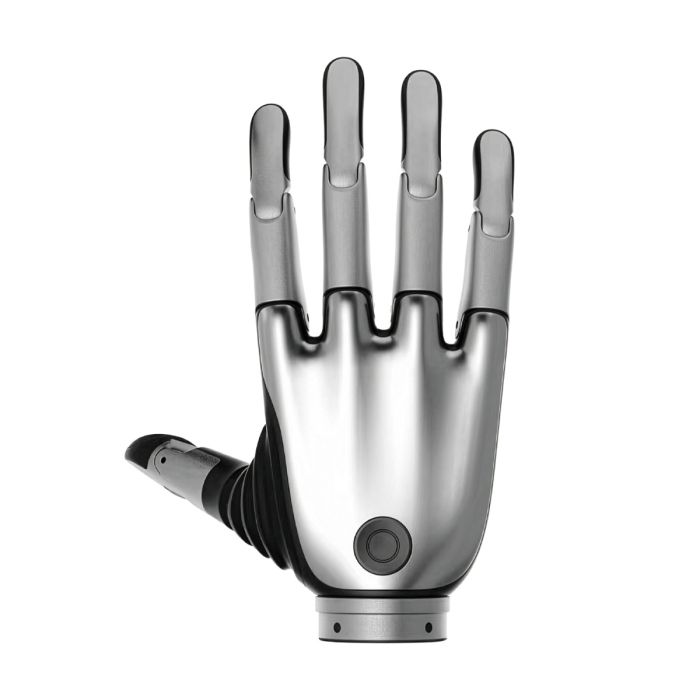
BrainCo Revo 2 Pro Dexterous Right Hand (XER)
In stock
- BRAND:
- BRAINCO
- MODEL:
- REVO 2 PRO
- PART #:
- XER
- ORIGIN:
- China
- Warranty:
- 12 MONTHS
- AVAILABILITY:
- SUBJECT TO AVAILABILITY
- SKU:
- BrainCo-Revo-2-Pro
BrainCo Revo 2 Pro Dexterous Right Hand (XER)
Product ranges pull buyers towards their edges: the entry trim to protect the budget, the flagship to avoid regret. The middle tier only earns its place when it removes a genuine constraint — and in the Revo 2 family, that constraint is the robot's control bus. The BrainCo Revo 2 Pro Dexterous Right Hand (XER) is, per the published specification, a bionic dexterous hand for robot integration and research, and the Pro trim is where EtherCAT joins RS485 and CAN FD, alongside a reported supply window broad enough to sit on platforms that the entry trim's electrical envelope would exclude. For a laboratory whose controller already speaks EtherCAT, that is not a luxury; it is the difference between a drop-in end-effector and an adapter project.
Robots Europa, based in Dublin, supplies the Revo 2 Pro Right Hand across the EU and the DACH region, with quotations, delivery, customs handling and after-sales support arranged for European research institutes, universities and robotics integrators. Enquiries in English or German are handled by the same team that quotes the rest of the Revo 2 range, so paired left-and-right configurations can be specified in a single quotation.
Background
BrainCo and the Revo lineage
BrainCo is a robotics and human-machine interface company whose work on dexterous bionic hands grew out of research into neural and prosthetic control — a field in which a hand must be compact, quiet and predictable because it operates close to a person. The Revo line applies that discipline to robot end-effectors: the first-generation Revo 1 established the format, and the Revo 2 family extends it into a three-trim range. The sources name three versions — Basic (XRL/XRR), Pro (XEL/XER) and Touch (XTL/XTR) — each offered in mirrored left and right configurations, with the XER being the right-hand Pro unit described on this page.
Where the Pro sits in the range
The Pro trim's positioning is defined less by mechanics than by integration. According to the published specification, the mechanical core — 6 active joints and 11 degrees of freedom — is the family's shared architecture, while the Pro adds EtherCAT to the RS485 and CAN FD interfaces and widens the reported supply voltage to 12–64 V, compared with 12–28 V on the Basic. The Touch trim shares the Pro's electrical and communication envelope and layers a tactile sensing capability on top, though the sources do not publish a tactile specification. The Pro is therefore the trim for programmes that need industrial-grade communication without paying for fingertip sensing they will not use.
Technical Specifications
| Specification | Value (Revo 2 Pro, XER) |
|---|---|
| Version code | XEL/XER (right hand: XER) |
| Active joints / degrees of freedom | 6 active joints, 11 degrees of freedom |
| Weight | 383 g |
| Height (palm base to middle fingertip) | 160 mm |
| Full fist grip force | ≥50N |
| Pinch force | ≥15N |
| Max payload | ≥20kg |
| Flexion/extension speed | ≤0.65s |
| Operating noise (at 50cm) | ≤50dB |
| Maximum opening and closing distance | 100mm (from thumb to index finger) |
| Repetitive control precision | 0.1° |
| Communication interface | 485, CANfd, EtherCAT |
| Supply voltage | 12-64V |
| Static current | 115 mA @24V |
| Maximum current | 4.65A @24V |
| Operating temperature | -10 - 40℃ / 90%RH |
| Smart protection | Current, stall, high-temperature and anti-collision protection |
| SDK | Python/C; Linux, Windows and ROS |
| Online upgrade | OTA online upgrades supported |
| Standard colours | Space Gray, Silver (bulk colour customisation supported) |
All figures are specifications as published from a single source; they are confirmed against the manufacturer's datasheet at quotation.
What does the Pro version add over the Basic?
The published comparison turns on three lines. First, communication: the Basic trim is listed with RS485 and CAN FD, while the Pro adds EtherCAT — the deterministic, synchronised bus most industrial robot controllers and many humanoid platforms standardise on. Second, power: the Basic's reported supply window of 12–28 V becomes 12–64 V on the Pro, which matters on mobile platforms whose battery bus runs at 48 V and where a DC-DC conversion stage adds weight, heat and a failure point. Third, the Pro trim's reported static current of 115 mA at 24 V and maximum current of 4.65 A at 24 V give the electrical designer concrete planning figures. The reported repetitive control precision of 0.1° is shared across the trims per the published table, so the Pro's premium buys integration headroom rather than finer motion — a distinction worth understanding before specifying either trim.
Can the Revo 2 Pro be integrated into an existing ROS workflow?
According to the published specification, yes: the SDK supports Python and C and is compatible with Linux, Windows and ROS systems, which covers the dominant research stacks in European laboratories. OTA online upgrades are also reported as supported, so firmware can be kept current without returning the unit. Two integration details remain unpublished and should be settled before committing a mounting design: the manufacturer has not published the wrist flange dimensions, and no IP rating is published, so both are confirmed against the datasheet at quotation. For a hand intended to live on a research platform for years, planning that verification early is cheaper than discovering a mismatch on the bench.
Who is the Revo 2 Pro Right Hand (XER) for?
The XER suits research groups, humanoid robotics programmes and integrators whose controllers require EtherCAT or whose platforms supply power above the Basic trim's reported 28 V ceiling. Bimanual manipulation research — handovers, two-handed assembly, hold-and-manipulate tasks — calls for the mirrored pair, in which case the BrainCo Revo 2 Pro Dexterous Left Hand (XEL) is the matching unit. A budget-conscious teaching laboratory whose controller is content with RS485 or CAN FD and whose supply sits within the Basic's reported window may be better served by the BrainCo Revo 2 Basic Right Dexterous Bionic Hand (XRR). Conversely, a group whose research question is contact itself — slip detection, force-aware grasping, tactile policy learning — should look to the Brainco Revo 2 Touch Biomimetic Dexterous Right Hand (XTR), which the sources position as the tactile trim, noting that its tactile specification is not yet published. The wider family sits in our BrainCo Revo 2 range within the Hands category.
What is the Revo 2 Pro Right Hand used for?
- Humanoid robot end-effection — serving as the right-hand manipulator on humanoid platforms where an anthropomorphic form and quiet actuation are required.
- Grasping and manipulation research — studying grasp synthesis, in-hand manipulation and dexterity with a reported 11-degree-of-freedom architecture.
- Bimanual coordination studies — paired with the XEL left hand for handover, assembly and stabilise-and-manipulate experiments.
- Imitation and reinforcement learning — collecting demonstration data and executing learned policies through the Python/C SDK under ROS or Linux.
- Teleoperation development — acting as the remote hand in teleoperated manipulation rigs where repeatable finger positioning matters.
- Human-robot interaction prototyping — enabling natural hand-shaped interaction in HRI studies where the reported low operating noise keeps the hand unobtrusive.
Pricing and Availability
Robots Europa does not publish list prices for the Revo 2 Pro Right Hand: configurations, pairing with the left-hand XEL, colour customisation for bulk orders and institutional purchasing terms vary enough that a tailored quotation serves buyers better than a number on a page. Delivery across the EU and the DACH region, customs clearance and after-sales support are all arranged as part of the quotation. To receive current pricing and lead information for the XER, use the quotation request available on this page.
Frequently Asked Questions
Is the XER a right or left hand?
The XER is the right-hand configuration of the Revo 2 Pro trim. The mirrored left-hand unit carries the version code XEL and is listed separately.
Which communication interfaces does the Pro support?
Per the published specification, the Pro supports RS485, CAN FD and EtherCAT. The Basic trim is listed without EtherCAT, which is the principal communication difference between the two.
What is included in the box?
According to the published packing list, the Pro edition ships with one dexterous hand, one 485/CANFD communication cable, one power cable and one EtherCAT communication cable as standard — to be confirmed against the datasheet at quotation.
Does the Revo 2 Pro work with ROS?
Yes — the reported SDK supports Python and C and is compatible with Linux, Windows and ROS systems, and OTA online upgrades are listed as supported.
Is the hand rated for dust or moisture?
The manufacturer has not published an IP rating. The published operating envelope is -10 to 40℃ at 90%RH; any requirement beyond that should be verified against the datasheet at quotation.
How does the Pro differ from the Touch trim?
The sources list the same communication and electrical figures for both; the Touch is positioned as the tactile trim, though its tactile sensing specification has not been published and is confirmed at quotation. Buyers who do not need fingertip sensing typically specify the Pro.
Where can I buy the Revo 2 Pro Right Hand (XER) and what does it cost?
The XER is supplied by Robots Europa to customers across the EU and the DACH region. Pricing is provided by individual quotation, which also covers delivery, customs and support — request yours through this page.
Summary
The middle of a range is only worth choosing when it resolves a constraint the entry trim cannot, and the Revo 2 Pro does exactly that: per the published specification it carries the family's shared 6-joint, 11-degree-of-freedom architecture while adding EtherCAT and a wider reported supply window, without the cost of a tactile layer whose specification is not yet published. For European laboratories and integrators whose controllers and power buses define what a hand must accept, the XER is the trim built to drop in rather than to be adapted — and for specifying, pairing and quoting it, this page is the starting point.
Specifications
General
Physical
Mobility
Performance
Connectivity
Software
Hand
Feature
1. High quality and stability – five years of product iteration and professional production lines.
2. Lightweight (383 grams), with 5 kg active grip force, 20 kg single-hand load capacity, and a grip-to-weight ratio of 53.
3. Ergonomic Bionic Design – supports curved surface grasping with anti- collision finger design.
4. Multi-dimensional tactile perception – pressure, friction, direction, proximity, and surface texture.
5. High Sensitivity Tactile Perception – max resolution of 0.01N.
6. Wide voltage support – 64V.
7. Universal Interfaces – RS485 & CAN-FD, and EtherCAT.
8. Standard Protocols and SDKs – Modbus & Protobuf protocols, SDKs for Python / C / ROS.


