
Brainco Revo 2 Touch Biomimetic Dexterous Right Hand (XTR)
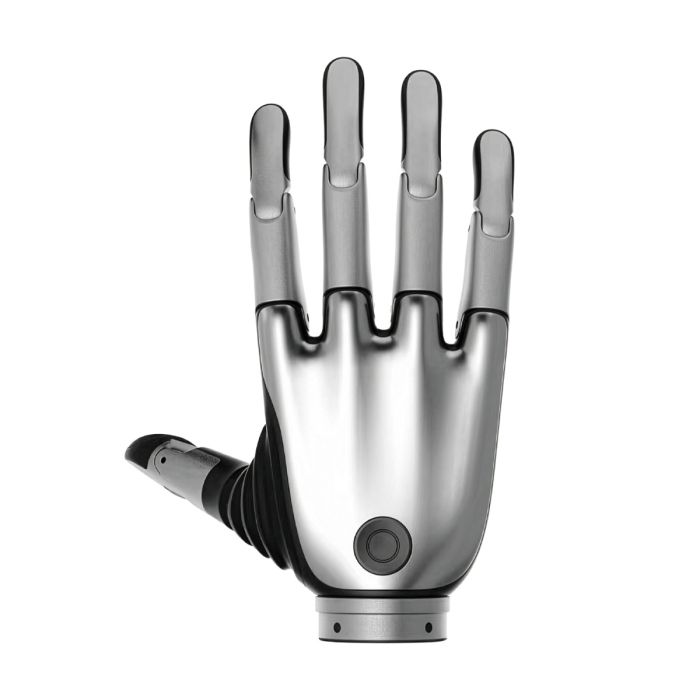
In stock
- BRAND:
- BRAINCO
- MODEL:
- REVO 2 TOUCH
- PART #:
- XTR
- ORIGIN:
- China
- AVAILABILITY:
- SUBJECT TO AVAILABILITY
- SKU:
- BrainCo-Revo-2-Touch
Brainco Revo 2 Touch Biomimetic Dexterous Right Hand (XTR)
Every robot hand eventually faces the same moment: the fingers close, the camera loses its view, and the only useful information is what the hand itself can feel. The Brainco Revo 2 Touch Biomimetic Dexterous Right Hand (XTR) is the version of the Revo 2 family that puts a tactile module in its fingertips. It is a bionic dexterous hand for robot integration and research, and it is meant for teams who want the hand to report back, not merely to obey.
Robots Europa, based in Dublin, is the seller of the Revo 2 Touch and supplies it across the EU and the DACH region. Quotation, delivery, customs handling and after-sales support are all arranged by Robots Europa, so that laboratories and integrators deal with one point of contact from first enquiry to commissioning.
Background
Brainco and the Revo 2 family
Brainco was founded in 2015 and incubated by the Harvard Innovation Lab. The company is based in Somerville, Massachusetts. Its Revo 2 line is described as a bionic dexterous hand for robot integration and research, and it is offered in three versions: Basic (XRL/XRR), Pro (XEL/XER) and Touch (XTL/XTR). The final letter of each code marks the side, so XTR is the right-hand Touch model and XTL is its left-hand counterpart.
Offering left and right hands under separate codes matters in practice. Each hand is addressed on its own, and the default device ID of the right hand is 127. A team building a bimanual platform therefore plans for two hands, each with its own identity on the bus, rather than for a mirrored pair that behaves identically.
Where the Touch version sits
Within the family, the Touch version is the one that carries a multi-dimensional fingertip tactile module. The Basic version is listed without it, and the Pro version is listed with the same three communication interfaces as the Touch. The Touch hand is therefore positioned for work in which contact itself is the subject of study: how a grasp settles, how a controller reacts to what the fingertips report, and how a manipulation policy can use that signal.
The hand also carries the engineering basics a research platform needs. Control precision is 0.1°, pinch force is at least 15N, and the hand protects itself with current, stall, high-temperature and anti-collision protection. These are the properties that let a team leave a hand running through long experiments without constant supervision.
Technical Specifications
| Specification | Value |
|---|---|
| Product type | Bionic dexterous hand for robot integration and research |
| Version code | XTR (Touch, right hand); the left-hand model is XTL |
| Pinch force | ≥15N |
| Control precision | 0.1° |
| Tactile module | Multi-dimensional fingertip tactile module |
| Communication interfaces | RS-485, CAN FD, EtherCAT (interface located below the wrist) |
| Software | SDK supports Python and C; compatible with Linux, Windows and ROS systems |
| Protections | Current, stall, high-temperature and anti-collision protection |
| Default device ID (right hand) | 127 |
| Standard colours | Space Gray, Silver (bulk colour customisation supported) |
Specifications as published by the manufacturer; confirmed against the datasheet at quotation.
The manufacturer has not published the package contents, the ingress protection rating, the tactile sensor resolution or the cable length; they are confirmed at quotation.
What makes the Revo 2 Touch different from the Basic and Pro versions?
The clearest difference is the fingertip. The Touch version is listed with a multi-dimensional fingertip tactile module, whereas the Basic version has none. A hand without tactile feedback can be positioned precisely, but the controller must infer the state of the grasp from joint behaviour alone. A hand with fingertip sensing gives the controller a second, independent channel about what is happening at the contact point.
The communication options are the second difference. The second-generation advanced and tactile versions support RS-485, CAN FD and EtherCAT, so the Touch hand can join a control architecture ranging from a simple serial link to a real-time industrial network. Teams that do not need touch can look at the BrainCo Revo 2 Pro Dexterous Right Hand (XER) or the BrainCo Revo 2 Basic Right Dexterous Bionic Hand (XRR), which share the same family and the same right-hand orientation.
How does the Revo 2 Touch connect to a robot controller?
The interface sits below the wrist, which keeps the connection at the natural boundary between hand and arm. Three buses are supported: RS-485, CAN FD and EtherCAT. A laboratory with an existing serial or CAN-based setup can integrate the hand without changing its architecture, and a group moving towards EtherCAT can use the same hand there.
On the software side, the SDK supports Python and C and is compatible with Linux, Windows and ROS systems. For research groups this means the hand can be driven from the same tools used for the rest of the robot, whether that is a quick Python script on a workstation or a ROS-based stack on a humanoid platform. The right hand answers to the default device ID 127, which should be noted when two hands share a bus.
Who is the Revo 2 Touch for?
The first segment is research laboratories studying manipulation, where the relevant question is not only whether an object was grasped but how the contact developed. A tactile fingertip module gives such groups a data source that position feedback alone cannot provide.
The second segment is humanoid robot developers who need a right hand with a defined interface, a documented SDK and built-in protections. Current, stall, high-temperature and anti-collision protection reduce the risk of damaging the hand during early integration, when software is still being tuned.
The third segment is integrators who need to commit to a communication standard. With RS-485, CAN FD and EtherCAT available, the hand does not dictate the architecture. Buyers who need the left-hand side of a bimanual system should look at the Brainco Revo 2 Touch Biomimetic Dexterous Left Hand (XTL). Those who do not need tactile sensing can compare the Pro and Basic versions listed in the Hands category.
What is the Revo 2 Touch used for?
- Tactile manipulation research. Studying how contact signals from the fingertips relate to grasp success and failure.
- Humanoid robot integration. Fitting a dexterous right hand to a humanoid platform through a documented bus and SDK.
- Controller development. Testing grasp and release strategies against 0.1° control precision and a pinch force of at least 15N.
- Industrial R&D. Evaluating dexterous handling in a lab before committing to a production architecture on RS-485, CAN FD or EtherCAT.
- Software and ROS development. Writing and testing drivers, nodes and experiments in Python or C on Linux, Windows or ROS.
- Teaching and demonstration. Showing students and visitors how a tactile, biomimetic hand behaves, in Space Gray or Silver, with bulk colour customisation supported.
Pricing and Availability
Robots Europa does not publish a price for the Revo 2 Touch; the call to action is a quotation. Delivery, customs and support are arranged together with the quotation, so the commercial and logistical terms are settled in one step. Quotation requests can be submitted from the form available on this page.
Frequently Asked Questions
Is the XTR a left or a right hand?
XTR is the right-hand model of the Touch version. The left-hand model carries the code XTL.
Which communication interfaces does it support?
It supports RS-485, CAN FD and EtherCAT. The interface is located below the wrist.
Which software environments are supported?
The SDK supports Python and C and is compatible with Linux, Windows and ROS systems.
What protections does the hand have?
It has current protection, stall protection, high-temperature protection and anti-collision protection.
What is the default device ID?
For the right hand, the default device ID is 127. For the left hand it is 126.
Which colours are offered?
The standard colours are Space Gray and Silver. Bulk colour customisation is supported.
Where can I buy the Revo 2 Touch and what does it cost?
The hand is supplied by Robots Europa in Dublin to customers in the EU and the DACH region. The cost is given in a written quotation, which also covers delivery, customs and support.
Summary
A hand that can only move is half a solution; the Revo 2 Touch is built for the other half, the moment of contact. It combines a multi-dimensional fingertip tactile module with 0.1° control precision, a pinch force of at least 15N, three communication interfaces, a Python and C SDK and a set of built-in protections. Robots Europa supplies it to the EU and the DACH region and arranges delivery, customs and support with the quotation. For research groups and integrators who want to work with touch rather than around it, this page is the starting point.
Specifications
General
Physical
Mobility
Performance
Connectivity
Software
Hand
Shipping
What's included
Videos


