
BrainCo Revo 1 Intelligent Dexterous Bionic Hand
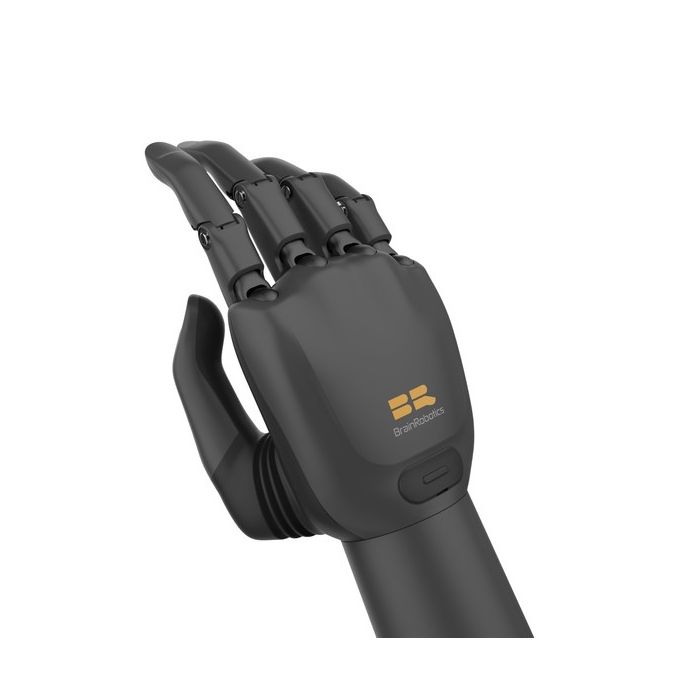
The BrainCo Revo 1 Intelligent Dexterous Bionic Hand is a robotic dexterous hand platform from BrainCo, a brain-computer-interface and human-machine-interface company that publicly lists “BrainCo Bionic Dexterous Hand Revo1” among its product lines on its official website. BrainCo positions itself as a company working across bionic hands, bionic knees, neurotechnology, and AI-oriented robotics solutions.
In stock
- BRAND:
- BRAINCO
- PART #:
- Intelligent Dexterous Bionic Hand
- ORIGIN:
- China
- Warranty:
- 12 MONTHS
- AVAILABILITY:
- SUBJECT TO AVAILABILITY
- SKU:
- BrainCo-Dexterous-Bionic-Hand
BrainCo Revo 1 Intelligent Dexterous Bionic Hand
Count the joints of the BrainCo Revo 1 Intelligent Dexterous Bionic Hand and the arithmetic is instructive: six active joints, yet ten degrees of freedom. The difference is made by passive joints, which let the fingers follow the shape of an object instead of being driven through every movement. That is the design philosophy in miniature: fewer actively controlled axes for the software to manage, and more mechanical adaptation where the hand meets the world.
Robots Europa, based in Dublin, supplies the BrainCo Revo 1 to customers across the EU and the DACH region. Robots Europa prepares the quotation, arranges delivery and customs, and supports European buyers after the sale.
Background
BrainCo and the idea of a biomimetic hand
BrainCo is a company working at the boundary between human intention and machine action, a field better known for brain-computer interfaces and human-machine interaction. A dexterous hand is a natural extension of that work. The Revo 1 is a biomimetic hand, meaning its finger layout follows human anatomy rather than the opposed-jaw geometry of an industrial gripper.
The Revo 1 is the first generation in a family. Later generations, such as the BrainCo Revo 2 Basic Right Dexterous Bionic Hand (XRR) and the BrainCo Revo 3-21 Touch Robot Hand, are listed as separate products and should be assessed on their own datasheets. Every figure in this article belongs to the Revo 1 alone.
Positioning: a programmable hand for integration
The Revo 1 is built to be commanded by software. It offers a C SDK and a Python SDK, so a team can work in the language of its existing control stack. Each hand carries a device ID, which is 1 by default and can be set anywhere from 1 to 254; this allows several hands to be addressed individually in one installation.
On power-up the hand runs a position calibration sweep by itself, and all fingers move while it does so. That is convenient for repeatable start-up, but it means the fingers must have clear space in front of them whenever the supply is switched on. The full range of Revo 1 variants is collected in the BrainCo Revo 1 category.
Technical Specifications
| Specification | Value |
|---|---|
| Active joints | 6 |
| Degrees of freedom | 10 |
| Thumb | 2 active degrees of freedom: abduction/adduction and flexion/extension |
| Each of the four fingers | 1 active degree of freedom (flexion/extension) and 1 passive degree of freedom (flexion/extension) |
| Maximum hand load | 30 kg |
| Five-finger grip force | 50 N |
| Supply voltage (Revo 1 Basic) | 9.5 ~ 28 V |
| Turbo mode | After a stall, pauses for the configured stall duration, then continues gripping at 500 ms intervals |
| Start-up behaviour | Automatic position calibration sweep after power-on |
| Default device ID | 1, adjustable within 1 - 254 |
| Software development kits | C SDK and Python SDK |
Specifications as published by the manufacturer; confirmed against the datasheet at quotation.
The manufacturer has not published the weight, the dimensions, the IP rating, the contents of the box or the operating noise; they are confirmed at quotation.
What makes the Revo 1 different from a conventional gripper?
A conventional gripper has one job: close on a part. It is efficient for a known object in a known pose, and it is a poor choice when objects vary. The Revo 1 starts from a different premise. Its thumb has two active degrees of freedom, so it can move across the palm as well as bend, and each of the four fingers adds a passive joint to its driven one. The grasp can therefore conform to the object rather than clamp it.
The control behaviour supports the same idea. In turbo mode, a finger that stalls against an object pauses for the configured stall duration and then continues gripping at 500 ms intervals. In practice the hand can keep tightening on an object in steps instead of stopping at the first point of resistance. Teams can tune that stall duration to the objects they handle.
The figures show the hand's intended scale: a maximum hand load of 30 kg and a five-finger grip force of 50 N. These are two separate figures and describe two different things, so the gripping capability of a particular grasp should be judged against the task, not by quoting one number.
Which Revo 1 variant should you choose?
The Revo 1 is sold in three named variants: Revo 1 Basic (MRL1/MRR1), Revo 1 Basic Touch (MTL1/MTR1) and Revo 1 Advanced (MEL2/MER2). Tactile sensing depends on the SKU, and the Basic and Advanced variants have model-specific interfaces and tactile options. The supply voltage of 9.5 ~ 28 V in the table above is the Basic variant's figure and should not be carried over to the others.
The practical advice is to decide first whether your application needs touch feedback. If it does, specify the tactile option when requesting a quotation, so that the correct SKU and its interface documentation are matched together.
Who is the Revo 1 for?
The first group is research laboratories studying manipulation. A hand with an SDK in C and Python, and a stable addressing scheme, can be integrated into an existing experiment without a custom driver layer. The second group is system integrators building demonstration cells or prototype robots, who need a hand that behaves predictably at start-up and can be commanded over a bus.
Development teams working on humanoid or upper-body platforms form a third group: they need a five-finger end-effector as a stand-in for a human hand. A fourth is groups working at the edge of assistive and medical robotics, where a biomimetic hand is a natural experimental tool; the wider field is covered in the Medical Robots category. Buyers who need a later generation should look at the Revo 2 and Revo 3 pages, for instance the Brainco Revo 2 Touch Biomimetic Dexterous Right Hand (XTR), and compare datasheets.
What is the Revo 1 used for?
- Dexterous manipulation research. Studying how a thumb and four fingers combine to hold objects of different shapes.
- Robot arm end-effector. Fitting a five-finger hand to an arm in place of a two-jaw gripper.
- Humanoid and upper-body platforms. Giving a humanoid prototype a hand with human-like proportions.
- Software and SDK development. Writing and testing grasp routines through the C SDK or the Python SDK.
- Tactile-feedback experiments. Exploring contact sensing on variants that carry tactile options.
- Teaching and demonstration. Showing students and visitors how a biomimetic hand follows commands.
Pricing and Availability
The BrainCo Revo 1 is supplied on quotation. Tell Robots Europa which variant and which hand side you need, and a quotation follows. Delivery, customs and support are arranged together with the quotation, so a European buyer deals with one supplier from enquiry to commissioning. Quotation details are available on this page.
Frequently Asked Questions
How many degrees of freedom does the Revo 1 have?
The Revo 1 has 6 active joints and 10 degrees of freedom. The thumb has two active degrees of freedom, and each of the four fingers has one active and one passive degree of freedom.
What load can the hand carry?
The maximum hand load is 30 kg and the five-finger grip force is 50 N. The two figures describe different measures and should be read separately.
What does the hand do when it is switched on?
It runs a position calibration sweep automatically, and all fingers move during it. Keep the area in front of the hand clear when applying power.
How do I address several hands?
The default device ID is 1, and it can be changed within the range 1 - 254. Each hand on a shared installation can therefore be given its own ID.
Which software can I use to control it?
The Revo 1 works with a C SDK and a Python SDK. The variants have model-specific interfaces, so name your SKU when you ask for documentation.
Are the weight, dimensions and IP rating available?
These three are open points listed beneath the specification table. Raise them with your quotation request and Robots Europa will answer them for your variant.
Where can I buy the Revo 1 and what does it cost?
The Revo 1 is available from Robots Europa in Dublin, which supplies the EU and the DACH region. The cost depends on the variant and the hand side, so request a quotation and it will be prepared for you.
Summary
The Revo 1 answers the question of six active joints and ten degrees of freedom with a hand that adapts through its passive joints instead of demanding more control from the software. Its two-way thumb, turbo mode, self-calibrating start-up, addressable ID and C and Python SDKs make it a practical platform for research and integration. The variant and the tactile option are chosen together with the quotation, and for a buyer in Europe this page is the starting point.


