
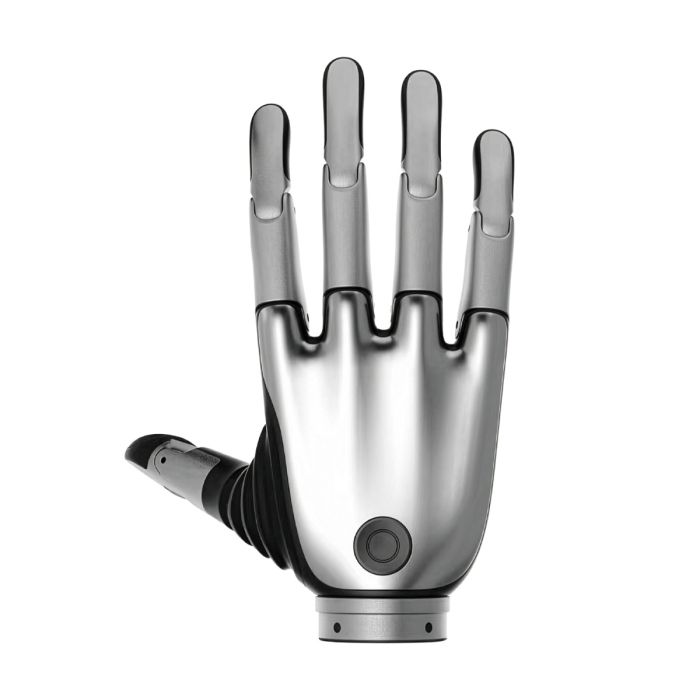
BrainCo Revo 2 Basic Right Dexterous Bionic Hand (XRR)
In stock
- BRAND:
- BRAINCO
- MODEL:
- REVO 2 BASIC
- PART #:
- XRL/XRR
- ORIGIN:
- China
- Warranty:
- 12 MONTHS
- AVAILABILITY:
- SUBJECT TO AVAILABILITY
- SKU:
- BrainCo-Revo-2-Basic
BrainCo Revo 2 Basic Right Dexterous Bionic Hand (XRR)
Almost everything a robot is asked to manipulate — a latch, a tool handle, a cable, a piece of packaging — was shaped for five fingers and an opposable thumb, not for a parallel jaw. The BrainCo Revo 2 Basic Right Dexterous Bionic Hand (XRR) approaches manipulation from that direction: rather than redesigning the task around the gripper, it gives the robot the form the task was designed for. Per the published description, it is a bionic dexterous hand for robot integration and research, supplied here in its right-hand configuration under the version code XRR.
Robots Europa, based in Dublin, supplies the BrainCo Revo 2 Basic Right Dexterous Bionic Hand (XRR) across the EU and the DACH region. Quotations, delivery arrangements, customs handling and after-sales support for European laboratories, universities and integrators are all managed by Robots Europa, so that a research group in Munich or an integrator in Rotterdam deals with a single European counterpart from enquiry to commissioning.
Background
BrainCo and the path to dexterous robotics
BrainCo is best known as a company working at the intersection of neurotechnology and assistive devices, a field in which hand design is not an academic exercise but a daily, human requirement. Companies that come to robotics from prosthetics tend to carry particular habits with them: an insistence on a hand that looks and moves naturally, attention to how a hand is worn and serviced over time, and a bias towards designs that can be produced consistently rather than assembled once for a demonstration. The Revo line of dexterous hands sits in that tradition, applying hand-building experience to the needs of robot integrators and research teams rather than individual users.
Where the Basic sits in the Revo 2 family
The sources name three configurations of the Revo 2: Basic, Pro and Touch, each available in left- and right-hand builds. Per the published material, the Basic carries the version codes XRL for the left hand and XRR for the right hand — the product on this page is the XRR, the right-hand Basic. The Basic is therefore the entry point into the family: the configuration for teams that want the Revo 2 platform's dexterous form on a robot without the additions that distinguish the Pro and Touch trims. The published specification lists 11 degrees of freedom, of which 6 are active, a figure reported for the Revo 2 and to be confirmed against the datasheet at quotation.
Technical Specifications
| Specification | Value |
|---|---|
| Product type | Bionic dexterous hand for robot integration and research (as published) |
| Version / version code | Basic, right hand — XRR (left hand: XRL) |
| Degrees of freedom | 11 (6 active), per the published specification |
| Communication interface connector (Basic) | BM05B-PASS-TFT(LF)(SN), located under the wrist |
| Default device ID | 127 (right hand); 126 for the left hand |
| IP rating | Not published by the manufacturer |
| Dimensions with wrist | Not published by the manufacturer |
| Flexion/extension lifespan | Not published by the manufacturer |
| Battery | Not published by the manufacturer |
Specifications as published; all figures are confirmed against the manufacturer's current datasheet at quotation.
How does the Revo 2 Basic physically and logically join a robot?
Integration questions usually come down to two things: where does the cable go, and how does the device announce itself on the bus. For the Revo 2 Basic, the published documentation answers both. The communication interface sits under the wrist, with the connector model reported as BM05B-PASS-TFT(LF)(SN) — a detail that matters early, because the mating connector and cable routing through the forearm are decided at the mechanical design stage, long before any software is written. Logically, the published material states that the Revo 2 ships with a default device ID of 127 for the right hand and 126 for the left. That convention is quietly useful on a bimanual platform: a left and a right hand can share a bus out of the box without an ID collision, and a commissioning engineer knows which address to poll first. As with all single-source details, both the connector designation and the ID convention should be confirmed against the datasheet supplied with the quotation.
What should buyers know about the unpublished specifications?
An honest product page names what the manufacturer has not said, because that is exactly where integration risk hides. For the Revo 2 Basic, four specifications are not published in the sources available to us: the IP rating, the overall dimensions with the wrist, the flexion/extension lifespan of the fingers, and any battery specification. None of these should be guessed. A team planning deployment in a dusty or damp environment needs the ingress protection figure; a team designing a forearm shell needs the dimensioned drawing with the wrist; a team planning endurance trials needs the cycle-life figure; and a team assuming the hand draws power from the host platform should verify the supply arrangement rather than infer one. All four points are confirmed against the manufacturer's documentation at quotation, and Robots Europa will obtain written answers before an order is placed where a project depends on them.
Who is the Revo 2 Basic Right Hand (XRR) for?
The XRR suits research groups and integrators who need a dexterous, human-form right hand as a platform for manipulation work — grasping studies, teleoperation rigs, humanoid development — and who do not need the additional capabilities of the higher trims. Bimanual projects will pair it with the BrainCo Revo 2 Basic Left Dexterous Bionic Hand (XRL), whose default device ID of 126 is reported to coexist with the right hand's 127 on the same installation. Teams whose requirements go beyond the entry configuration should consider the BrainCo Revo 2 Pro Dexterous Right Hand (XER), while projects centred on contact-rich manipulation and tactile research are better served looking at the Brainco Revo 2 Touch Biomimetic Dexterous Right Hand (XTR). The full family, in both left- and right-hand builds, is listed in the BrainCo Revo 2 category, and comparing the trims side by side before requesting a quotation is the sensible first step for any buyer who has not yet fixed the configuration.
What is the Revo 2 Basic Right Hand (XRR) used for?
- Humanoid robot integration — fitting a human-form right hand to a humanoid platform so it can use objects and interfaces designed for people.
- Manipulation and grasping research — serving as the physical testbed for grasp planning, in-hand manipulation and dexterity studies in academic and corporate labs.
- Teleoperation and data collection — acting as the remote end of a teleoperated rig, including the capture of demonstration data for learning-based manipulation.
- Robot arm end-of-arm tooling — replacing a conventional gripper on a collaborative or industrial arm where tasks demand finger-level dexterity.
- Human-robot interaction studies — providing a natural, bionic hand form for experiments where the robot's appearance and gestures matter to participants.
- Education and prototyping — giving engineering programmes and R&D teams an entry-level dexterous hand on which to build and evaluate manipulation software.
Pricing and Availability
Robots Europa supplies the BrainCo Revo 2 Basic Right Dexterous Bionic Hand (XRR) on a quotation basis: pricing depends on configuration, quantity and the support required, so a formal quotation is the correct starting point rather than a list figure. Delivery to your site, customs clearance within the EU and the DACH region, and ongoing technical support are all arranged together with the quotation. To begin, submit a quotation request through the enquiry options available on this page.
Frequently Asked Questions
Is the XRR a left or right hand?
The XRR is the right-hand build of the Revo 2 Basic. The matching left hand carries the version code XRL and is listed separately.
How many degrees of freedom does the Revo 2 have?
The published specification lists 11 degrees of freedom, of which 6 are active. This figure is reported from a single published source and is confirmed against the datasheet at quotation.
Where is the communication interface located?
According to the published documentation, the interface is located under the wrist, and the connector model is reported as BM05B-PASS-TFT(LF)(SN) for the Basic version.
What is the default device ID of the right hand?
Per the published material, the Revo 2 ships with a default ID of 127 for the right hand and 126 for the left, which allows a left-right pair to share a bus without reconfiguration.
Does the Revo 2 Basic have an IP rating?
The manufacturer has not published an IP rating for this hand. If ingress protection is critical to your deployment, Robots Europa will confirm the figure with the manufacturer at quotation.
What are the dimensions and the finger lifespan?
Neither the overall dimensions with the wrist nor the flexion/extension lifespan has been published in the sources available to us; both are confirmed against the manufacturer's documentation at quotation rather than estimated here.
Where can I buy the BrainCo Revo 2 Basic Right Hand (XRR) and what does it cost?
It is available from Robots Europa, which supplies the EU and the DACH region from Dublin. Pricing is provided by individual quotation, which you can request directly on this page.
Summary
The case for a dexterous hand is ultimately the case for meeting the world on its own terms: tasks built for human fingers are easiest for a hand built like one. The BrainCo Revo 2 Basic Right Dexterous Bionic Hand (XRR) offers that form in the Revo 2 family's entry configuration, with a published 11 degrees of freedom (6 active), a documented under-wrist connector and a sensible default-ID convention for bimanual work — and with its unpublished specifications named openly rather than guessed. For European buyers weighing the Basic against its Pro and Touch siblings, or simply ready to request a quotation from Robots Europa, this page is the starting point.


