
Deep Robotics LYNX M20 Omni Terrain Industrial Wheeled Quadruped Robot Dog
In stock
- BRAND:
- DEEP ROBOTICS
- MODEL:
- LYNX M20
- ORIGIN:
- China
- AVAILABILITY:
- ALLOW 2-4 WEEKS FOR DELIVERY
- SKU:
- Deep-Robotics-LYNX-M20
Deep Robotics LYNX M20 Omni Terrain Industrial Wheeled Quadruped Robot Dog
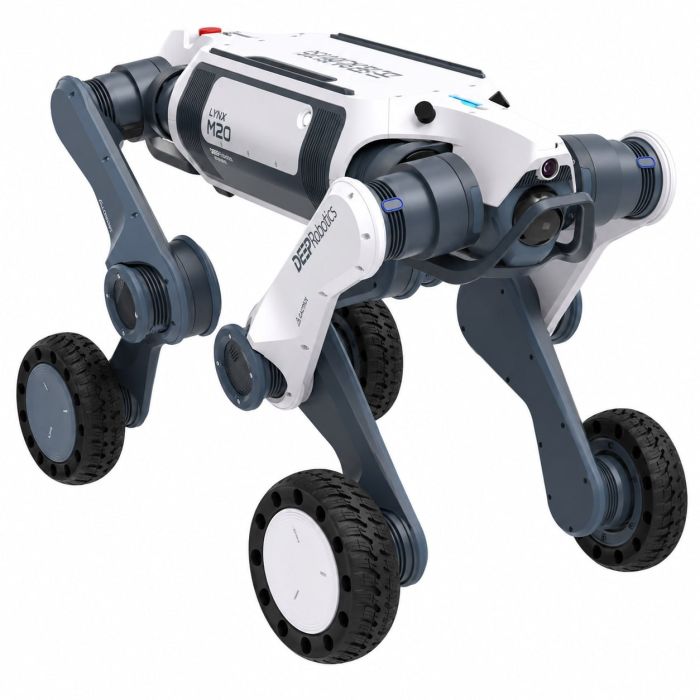
Industrial inspection has an awkward truth at its centre. The places that most need regular checking are often the places least willing to admit a person, a trolley or a conventional robot. A drainage tunnel half-filled with run-off, a frost-bound compound at first light, a plant floor where a gas alarm has just sounded: each one calls for a machine that covers ground quickly, copes with whatever lies in its path and keeps its sensors working throughout. The Deep Robotics LYNX M20 Omni Terrain Industrial Wheeled Quadruped Robot Dog is DEEP Robotics' answer to that brief. It is a quadruped that combines wheels and legs, carrying dual LiDAR, wide-angle cameras and industrial computing into terrain that would halt a wheeled rover and slow a walking robot.
Robots Europa, based in Dublin, supplies the LYNX M20 to organisations across the European Union and the DACH region. We prepare each quotation around the intended application, arrange delivery to your site and remain your point of contact for technical support once the robot is in service.
Background
DEEP Robotics and the LYNX line
DEEP Robotics is a developer of legged robots for industry, and its range spans walking quadrupeds for inspection work as well as the wheeled-legged LYNX family. The LYNX M20 series is the world's first wheeled-legged robot built specifically for challenging terrains and hazardous environments during industrial operation. The series currently comprises three versions: the LYNX M20 described on this page, the Deep Robotics LYNX M20 Pro Omni Terrain EDU Wheeled Quadruped Robot Dog and the Deep Robotics LYNX M20S Omni Terrain Industrial Wheeled Quadruped Robot Dog. All figures on this page belong to the LYNX M20 alone.
Wheel-leg mobility and leg-mode switching
The defining idea of the LYNX M20 is that it does not have to choose between rolling and walking. On firm, even ground it can travel on its wheels, which is where wheeled platforms are at their most efficient; when the route turns into steps, debris or a steep incline, its articulated legs take over. DEEP Robotics builds the robot with hyper-flexible joints and seamless leg-mode switching, for example between a front-elbow and a rear-knee configuration, so that the posture of the body can be adapted to the obstacle rather than the obstacle dictating the route. The mid-size form is a deliberate compromise: it balances narrow-space mobility, with 50cm clearance, against payload and endurance, so that the robot can pass through tunnels and pipelines while still carrying useful equipment for a full inspection round.
Technical Specifications
| Specification | Value |
|---|---|
| Standing size | 820 × 430 × 570 mm |
| Weight (with battery) | 33 kg |
| Payload capacity | 15 kg |
| Maximum load capacity | 50 kg |
| Unloaded endurance and range | 3 h / 15 km |
| Loaded endurance and range (15 kg) | 2.5 h / 12 km |
| Charging time (single battery) | 1.5 h |
| Maximum speed (lab-tested) | 5 m/s |
| Safe operational speed | 2 m/s |
| Maximum continuous stair height | 25 cm |
| Maximum single-step height | 80 cm |
| Maximum slope | 45° |
| Narrow-space clearance | 50cm |
| Computing power | Dual octa-core 64-bit industrial processors (16 GB + 128 GB) × 2 |
| LiDAR | Dual 96-line units (360° × 90°, ~860,000 pts/s) |
| Cameras | Dual wide-angle cameras |
| Ingress protection | IP66 |
| Operating temperature | -20 °C to +55 °C |
| Electrical ports | 72 V power input, Gigabit Ethernet |
| Functional features | Omnidirectional obstacle avoidance, point-cloud surround view, front/rear bidirectional lighting, RF image transmission, OTA upgrades |
| Options | Self-charging, modular expansion |
Specifications are as published by the manufacturer and are confirmed against the datasheet at quotation. DEEP Robotics has not published the battery capacity, the battery chemistry, the wheel size, the included accessories, details of the control software, the payload mounting interface or the wireless connectivity standards; these are confirmed at quotation.
How does a wheeled-legged robot differ from a conventional robot dog?
A conventional quadruped walks everywhere. That gives it remarkable agility on broken ground, but every metre of a long, flat corridor costs it the same effort as a metre of rubble. A wheeled rover has the opposite profile: economical on smooth surfaces, helpless at the first flight of steps. The LYNX M20 is designed to sit between the two. On a paved yard or a factory aisle it can make use of its wheels; at a staircase it climbs continuous steps of up to 25 cm, and it can surmount a single step of up to 80 cm or a slope of up to 45°.
The difference also shows in how the robot is meant to move through its environment. Dual 96-line LiDAR units provide a 360° × 90° field of view, feeding omnidirectional obstacle avoidance and a point-cloud surround view, while dual wide-angle cameras and RF image transmission give the operator a live picture. Front and rear lighting means the robot is equally usable travelling in either direction, which matters in a tunnel where turning round is not always possible. Two industrial processor modules handle perception and control on board.
What do the endurance and load figures mean for a working shift?
DEEP Robotics gives two endurance figures, and the distinction is worth noting when planning a deployment. Without a load, the LYNX M20 runs for 3 h and covers 15 km; carrying 15 kg, it runs for 2.5 h over 12 km. Charging a single battery takes 1.5 h. For an inspection team, that profile suggests a robot that can complete a substantial round, return for charging and go out again within the same shift, with the optional self-charging capability reducing the need for an operator to intervene between runs.
Speed should be read in the same practical light. The lab-tested maximum of 5 m/s shows what the drivetrain can do, whereas the safe operational speed of 2 m/s is the figure that belongs in a site risk assessment. The payload capacity of 15 kg and the maximum load capacity of 50 kg are listed separately by the manufacturer; how a particular sensor package or tool fits within them is worked out with you during the quotation.
Who is the Deep Robotics LYNX M20 for?
The LYNX M20 is aimed at organisations whose sites combine distance with difficulty. Operators of utility tunnels, pipelines, power and process plants will recognise the problem it addresses: long routes interrupted by stairs, gratings and confined passages, in conditions that range from frost to summer heat. Its IP66 rating and an operating range of -20 °C to +55 °C suit outdoor and semi-enclosed installations across Europe throughout the year.
Public-safety and industrial emergency teams form a second group. A robot that can be sent ahead into a hazardous area, lighting its own path and transmitting images back, reduces the exposure of personnel during the first assessment; buyers in this field may wish to browse our Emergency Response range alongside it. System integrators and research groups make up a third segment: the Gigabit Ethernet port, the 72 V power input, modular expansion and OTA upgrades give them a platform to build on. Those comparing the M20 with the Pro and M20S versions, or with other machines of this class in our Wheeled Quadrupeds category, are welcome to ask us for a side-by-side comparison for their application.
What is the Deep Robotics LYNX M20 used for?
- Routine industrial inspection: patrolling plant rooms, yards and stairways with LiDAR and cameras on a repeatable route.
- Tunnel and pipeline work: traversing narrow passages where its 50cm clearance and leg-mode switching keep it moving.
- Hazardous-environment entry: going first into areas where conditions are unknown or unsafe for staff.
- Emergency response support: providing lit, live imagery to incident teams from places they cannot yet reach.
- Payload transport on difficult ground: carrying instruments or tools across stairs and slopes between manual labour and heavy machinery.
- Mapping and site survey: building point-cloud views of complex structures with its dual 96-line LiDAR.
Pricing and Availability
Robots Europa supplies the LYNX M20 on quotation, so that the configuration, options such as self-charging and any modular expansion match the work you have in mind. Delivery, customs and support are arranged together with your quotation. Some of the functions listed by the manufacturer are enabled through future OTA updates, and we set out which apply when we prepare your offer. To begin, use the quotation request available on this page.
Frequently Asked Questions
Can one person transport the LYNX M20?
Yes. DEEP Robotics states that the robot is portable by a single operator, and its published weight with battery is 33 kg.
Is the LYNX M20 suitable for outdoor use in European weather?
The robot carries an IP66 ingress protection rating and operates between -20 °C and +55 °C, which covers rain, dust and winter conditions on most sites.
How long does the robot run on one battery?
It runs for 3 h over 15 km without a load and for 2.5 h over 12 km carrying 15 kg. A single battery charges in 1.5 h.
Can the LYNX M20 climb stairs?
Yes. It handles continuous stairs of up to 25 cm per step, single steps of up to 80 cm and slopes of up to 45°.
Can the robot charge itself?
Self-charging is available as an option for the LYNX M20. Please mention it in your quotation request so that it is included in the configuration.
Can I integrate my own sensors or software?
The LYNX M20 offers modular expansion, a Gigabit Ethernet port and a 72 V power input. The mounting interface and software details are discussed with you when we prepare the quotation.
Where can I buy the Deep Robotics LYNX M20 and what does it cost?
Robots Europa supplies the LYNX M20 across the EU and the DACH region. The cost depends on configuration, options and delivery, so we provide it in a written quotation that you can request on this page.
Summary
The sites that most need watching are the ones that resist being reached, and the LYNX M20 is built around that problem. It rolls where the ground allows and walks where it does not, switching leg modes to pass through narrow spaces, climb stairs and cross steep slopes. Dual 96-line LiDAR, wide-angle cameras and twin industrial processors give it the perception to work in tunnels, plants and incident zones, while IP66 protection and a wide temperature range keep it in service through the European year. For organisations in the EU and the DACH region planning to put a wheeled-legged robot where people would rather not go first, this page is the starting point.
Specifications
General
Physical
Performance
Computing
Sensors
Connectivity
Battery + Power
What's included
Downloads
Related Products
Out of stock


