
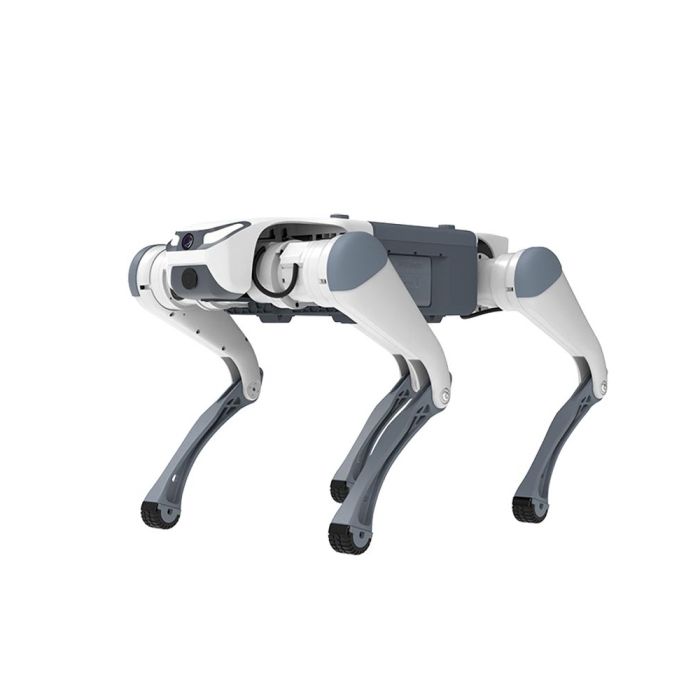
Deep Robotics Lite3 Academic & Research Quadruped Robot Dog
In stock
- BRAND:
- DEEP ROBOTICS
- PART #:
- Lite3
- ORIGIN:
- China
- AVAILABILITY:
- ALLOW 2-4 WEEKS FOR DELIVERY
- SKU:
- Deep-Robotics-Lite3
Deep Robotics Lite3 Academic & Research Quadruped Robot Dog
Four builds of the same robot share a length of 610 mm and a width of 370 mm, yet they do not stand at the same height. Every millimetre that the Deep Robotics Lite3 Academic & Research Quadruped Robot Dog gains between its Basic and LiDAR configurations is hardware that a research group has asked for: more interfaces, more sensing, more autonomy. Every gram of that hardware is also weighed against what the legs can still carry. This trade-off, rather than any single headline figure, is the most useful lens through which to choose a Lite3 for a laboratory, and it is the thread that runs through this page.
Robots Europa, based in Dublin, supplies the Lite3 in all four versions to universities, research institutes and technology companies across the European Union and the DACH region. Robots Europa prepares each quotation for the configuration a team specifies, arranges delivery to the institution and remains the point of contact for technical support once the robot is in service.
Background
DEEP Robotics and the Lite series
DEEP Robotics develops legged robots across a range that runs from compact research platforms to full-size industrial quadrupeds intended for inspection work. The Lite3 belongs to the smaller end of that range, the Lite Series, which is aimed at teaching, experimentation and secondary development rather than at heavy industrial duty. Quadrupeds of this class have become a common sight in robotics departments because they let students and researchers work on locomotion, balance and perception with a physical machine, rather than relying on simulation alone or building a legged robot from first principles.
Within the series, the Lite3 is offered as a family of versions rather than a single fixed product. The Basic, Venture, Pro and LiDAR builds share the same body footprint, and they differ in standing height, weight, payload, interfaces and perception features. For a buyer, this means the decision is less about whether the Lite3 suits a programme and more about which configuration matches the programme's research questions.
Torque density and an open software stack
The mechanical case for the Lite3 rests on its joints. DEEP Robotics states a 50% boost in joint torque, and with it the Lite3 achieves outstanding torque density, rapid response bandwidth and high reverse transmission efficiency. For legged robots these qualities matter in practical terms: a joint that responds quickly and transmits force efficiently in both directions gives control algorithms more room to recover from a slip, absorb an impact or execute a dynamic gait.
The software case is equally direct. Users can switch between ROS1 and ROS2 via built-in scripts to suit their research requirements. A laboratory with an established ROS1 codebase can therefore continue its existing work, while a group moving to ROS2 can do so on the same hardware, without maintaining two separate robots for two generations of middleware.
Technical Specifications
| Specification | Basic | Venture | Pro | LiDAR |
|---|---|---|---|---|
| Standing dimensions (L × W × H) | 610 × 370 × 406 mm | 610 × 370 × 445 mm | 610 × 370 × 450 mm | 610 × 370 × 496 mm |
| Weight | 12 kg | 12.2 kg | 12.9 kg | 13.5 kg |
| Payload capacity | 5 kg | 4.5 kg | 4 kg | 2.5 kg |
| Maximum slope | 40° | — | — | — |
| Obstacle clearance | 18 cm | — | — | — |
| Continuous operation | 1.5 – 2 hours | — | — | — |
| Maximum range | 5 km | — | — | 2.7 km |
| Interfaces | — | Ethernet × 2; External Power Input (24V/12V/5V) | — | USB 3.0, HDMI, Ethernet; External Power Input (24V/12V/5V); Power Connector |
| Perception features | — | — | — | Front/rear obstacle stop; Visual following; Forward obstacle avoidance; Autonomous navigation |
| ROS support | Switch between ROS1 and ROS2 via built-in scripts | Switch between ROS1 and ROS2 via built-in scripts | Switch between ROS1 and ROS2 via built-in scripts | Switch between ROS1 and ROS2 via built-in scripts |
Specifications are as published by the manufacturer and are confirmed against the datasheet at quotation.
The manufacturer has not published the top speed, battery capacity, degrees of freedom, IP rating, operating temperature, charging time or contents of the box, and gives slope, obstacle clearance and running-time figures for the Basic version only; all of these are confirmed at quotation.
How do the Basic, Venture, Pro and LiDAR versions differ?
The four versions are best understood as steps along a single axis. The Basic is the lightest at 12 kg and the lowest at 406 mm, and it carries the highest payload of the family at 5 kg. It is also the version for which DEEP Robotics publishes its terrain and endurance figures: a maximum slope of 40°, obstacle clearance of 18 cm, continuous operation of 1.5 – 2 hours and a maximum range of 5 km.
The Venture adds 0.2 kg and stands at 445 mm. Its interfaces are two Ethernet ports and an external power input at 24V, 12V and 5V, which is the kind of provision a developer needs to mount and power additional computing or sensors on the back of the robot. The Pro stands at 450 mm and weighs 12.9 kg, with a payload of 4 kg.
The LiDAR version is the tallest at 496 mm and the heaviest at 13.5 kg. It is the build with the richest interface set, comprising USB 3.0, HDMI, Ethernet, an external power input at 24V, 12V and 5V, and a power connector, and it is the version that lists perception features: front and rear obstacle stop, visual following, forward obstacle avoidance and autonomous navigation. Its maximum range is 2.7 km.
Why does the payload fall as the Lite3 gains capability?
The payload figures tell a consistent story. As each version takes on more built-in hardware, the mass of the robot rises and the allowance for additional equipment falls: 5 kg on the Basic, 4.5 kg on the Venture, 4 kg on the Pro and 2.5 kg on the LiDAR. The legs do not simply carry more because the robot does more; part of their capacity is already committed to the equipment fitted at the factory.
For a research team this has a clear consequence. A group planning to mount its own sensor package, manipulator or compute module should weigh that equipment before choosing a version. If the team's own hardware will do the perceiving, a lighter build leaves more margin. If the factory perception stack is the point of the purchase, the LiDAR version provides it ready to use, at the cost of a smaller allowance for anything else on top.
Who is the Deep Robotics Lite3 for?
The Lite3 suits university departments teaching robotics, control engineering or embodied AI, where students benefit from experimenting with real legged hardware. For teaching and locomotion research that values payload margin and documented terrain figures, the Deep Robotics Lite3 Basic Quadruped Robot Dog is the natural starting point.
Developers and research engineers who intend to integrate their own computing and sensors will find the dual Ethernet ports and multi-voltage power input of the Deep Robotics Lite3 Venture Quadruped Robot Dog a practical foundation. Teams who want a step further up the range, with a 4 kg payload, can review the Deep Robotics Lite3 Pro Quadruped Robot Dog.
Groups working on mapping, obstacle avoidance and autonomous navigation are best served by the Deep Robotics Lite3 LIDAR Quadruped Robot Dog, the version that carries the perception features. Across all segments, the ROS1 and ROS2 switching makes the Lite3 suitable for laboratories with mixed software histories.
What is the Deep Robotics Lite3 used for?
- Locomotion research — developing and testing gaits on joints built for torque density and fast response.
- Reinforcement learning — transferring control policies from simulation to a physical legged platform.
- Robotics teaching — giving students hands-on experience of balance, kinematics and control.
- Autonomous navigation — researching path planning and obstacle avoidance, notably on the LiDAR version.
- Sensor integration — mounting and powering custom payloads through the available interfaces.
- ROS development — building and migrating software between ROS1 and ROS2 on one robot.
Pricing and Availability
The Lite3 is offered on a quotation basis, so that each institution receives an offer for the exact version and configuration it needs. Delivery, customs and support are arranged together with the quotation by Robots Europa. Grant-funded projects and procurement departments can request the documentation they need for internal approval as part of the same process. A quotation for any of the four versions is available on this page.
Frequently Asked Questions
How many versions of the Lite3 are there?
Four versions are offered: Basic, Venture, Pro and LiDAR. They share a 610 × 370 mm footprint and differ in height, weight, payload and equipment.
Which version carries the most payload?
The Basic version has the highest payload capacity at 5 kg. The LiDAR version, with its built-in perception hardware, carries 2.5 kg.
Does the Lite3 support ROS2?
Yes. Users can switch between ROS1 and ROS2 via built-in scripts to suit their research requirements.
Which version offers autonomous navigation?
The LiDAR version lists autonomous navigation together with forward obstacle avoidance, visual following and front/rear obstacle stop.
How long does the Lite3 Basic run on a charge?
The Basic version offers continuous operation of 1.5 – 2 hours.
Can I mount my own sensors on the Lite3?
Yes. The Venture provides two Ethernet ports and an external power input at 24V, 12V and 5V, and the LiDAR version adds USB 3.0, HDMI and a power connector.
Where can I buy the Deep Robotics Lite3 and what does it cost?
Robots Europa supplies the Lite3 across the EU and the DACH region. The cost depends on the version and configuration, and Robots Europa provides it in a formal quotation requested from this page.
Summary
The Lite3 is a single robot body expressed in four ways, and the choice between them is a choice about where the legs' capacity should go. The Basic keeps that capacity free for a team's own equipment and carries the fullest set of terrain and endurance figures; the Venture and Pro add height and integration provision; the LiDAR commits more of the robot to factory perception and autonomous navigation. Common to all of them are joints designed for torque density and responsiveness, and a software stack that moves between ROS1 and ROS2. For a laboratory weighing which build fits its research, and for a quotation from Robots Europa, this page is the starting point.
Specifications
General
What's included
Downloads
Related Products
Out of stock


