
Deep Robotics LYNX M20 Pro Omni Terrain EDU Wheeled Quadruped Robot Dog
In stock
- BRAND:
- DEEP ROBOTICS
- PART #:
- LYNX M20 Pro
- ORIGIN:
- China
- AVAILABILITY:
- ALLOW 2-4 WEEKS FOR DELIVERY
- SKU:
- Deep-Robotics-LYNX-M20-Pro
Deep Robotics LYNX M20 Pro Omni Terrain EDU Wheeled Quadruped Robot Dog
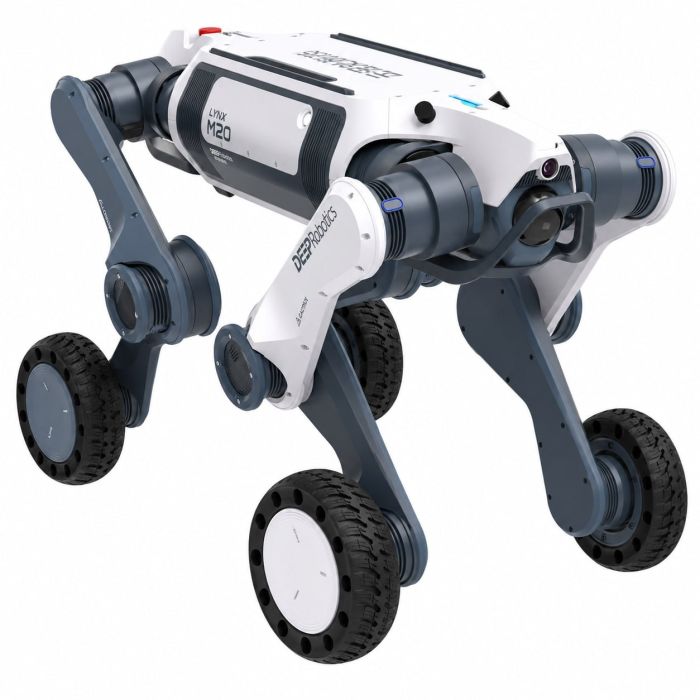
Every field robot is a compromise between the gaps it can squeeze through and the weather it can survive. Cable galleries, pipe racks and plant-room doorways reward a compact body, while rain, spray and dust punish anything that is not properly sealed. The Deep Robotics LYNX M20 Pro Omni Terrain EDU Wheeled Quadruped Robot Dog is designed to answer both sides of that trade-off: the LYNX M20 series is built around a mid-size form that passes through a 50cm clearance, and the Pro carries an IP66 protection rating. With wheels at the end of articulated legs, it belongs to a class of machine that can roll where the ground is kind and step where it is not. That makes it a demanding and instructive platform for anyone teaching, researching or trialling mobile robotics outside the laboratory.
Robots Europa, based in Dublin, supplies the LYNX M20 Pro EDU to universities, research institutes and industrial teams across the European Union and the DACH region. We prepare each quotation for the configuration you require, arrange delivery to your site and remain your point of contact for technical support once the robot is in service.
Background
Deep Robotics and the LYNX family
DEEP ROBOTICS is a Chinese developer of quadruped robots whose range spans fully legged machines such as the Deep Robotics X30 Industrial Quadruped Robot Dog and a growing family of wheeled-legged designs under the LYNX name. The LYNX M20 series sits within that family as a platform aimed squarely at industrial operation. It is the world's first wheeled-legged robot built specifically for challenging terrains and hazardous environments during industrial operation, and its mid-size body balances narrow-space mobility with payload and endurance. The series comprises three versions: the LYNX M20, the LYNX M20 Pro and the LYNX M20S. This page concerns the LYNX M20 Pro in its EDU designation.
Wheels on legs: why the hybrid matters
Conventional wheeled robots are efficient on flat floors but struggle with kerbs, steps and loose ground, while purely legged robots handle obstacles well at the cost of efficiency on long, even stretches. A wheeled-legged quadruped combines the two approaches: drive wheels carry the machine across smooth surfaces, and the legs adjust posture and lift the body over features a wheel alone cannot climb. For an educational or research user, that combination is valuable in its own right, because it exposes students and engineers to locomotion control, terrain perception and mode switching in a single machine. For an industrial user, it means one robot can cover routes that would otherwise require both a rover and a legged platform. The M20 series applies this concept in a compact format, so that the same robot that crosses a yard can also enter the confined spaces found in plant and infrastructure sites.
Technical Specifications
| Specification | Value |
|---|---|
| Narrow-space clearance (LYNX M20 series) | 50cm |
| Charging time (single battery) | 1.5 h |
| Wide-angle cameras | × 2 |
| Protection rating | IP66 |
Specifications are as published by the manufacturer and are confirmed against the datasheet at quotation.
The manufacturer has not published the battery capacity, the wheel diameter, the details of wireless connectivity, whether a remote controller is supplied, the full package contents, the noise level or any independent certifications; Robots Europa confirms these points with you at quotation.
What does IP66 protection mean for an M20 Pro in the field?
An IP66 rating describes a high level of protection against the ingress of dust and against powerful jets of water. For a mobile robot, that matters far more than it might for a static device. A quadruped working outdoors will be caught in rain, splashed by puddles, coated in dust on construction sites and, in many industrial settings, cleaned down after use. A platform without meaningful sealing has to be sheltered, scheduled around the weather or retired early; a platform with IP66 protection can be planned around the task rather than the forecast.
For teaching and research, the rating has a quieter benefit. Field trials are where control algorithms and perception pipelines meet real conditions, and they are also where unprotected hardware is most often damaged. Being able to take the LYNX M20 Pro outside, run experiments on wet grass or gravel and bring it back without anxiety makes outdoor work part of the normal programme rather than a special occasion. Combined with the series' 50cm clearance, the M20 Pro can move between open ground and tight interior spaces on a single route, which is precisely the kind of mixed environment that tests a robot's autonomy most thoroughly.
How do charging time and onboard cameras shape everyday operation?
A charging time of 1.5 h for a single battery gives operators a clear planning figure for turnaround between sessions. In a teaching setting, that supports a rhythm of practical work, recharge and further practical work within the same day; in an inspection or research setting, it helps a team decide how many batteries to hold and how to stagger missions across a shift.
The two wide-angle cameras on the M20 Pro provide the visual coverage that operators and software rely on. Wide-angle optics give a broad view of the surroundings, which is useful for remote supervision, for recording inspection imagery and for computer-vision work in research projects. Together, these features describe a robot designed to be used repeatedly and observed closely, which suits both a laboratory schedule and an operational deployment.
Who is the LYNX M20 Pro EDU for?
The EDU designation points first to universities, technical colleges and research institutes that want a wheeled-legged platform for courses and projects in locomotion, perception and autonomous navigation. Robotics groups developing their own behaviours will find a hybrid chassis a richer test bed than a simple rover, and the IP66 rating allows their experiments to move outdoors without changing platform.
The second group is industrial innovation teams: operators of utilities, plant and infrastructure who want to evaluate a wheeled-legged robot for inspection or patrol before committing to a fleet. For such buyers, the M20 Pro offers the series' compact form and sealed construction in a configuration that can be studied in depth.
Buyers whose needs are purely operational may also wish to compare the Deep Robotics LYNX M20 Omni Terrain Industrial Wheeled Quadruped Robot Dog and the Deep Robotics LYNX M20S Omni Terrain Industrial Wheeled Quadruped Robot Dog, the other versions in the series. Where a smaller wheeled-legged machine would suit the task, the Deep Robotics LYNX S10 Pro Wheeled Quadruped Robot Dog is also worth considering. Robots Europa will set the versions side by side against your requirements so that you choose the right machine rather than the largest one.
What is the LYNX M20 Pro EDU used for?
- Robotics teaching: practical courses in locomotion, sensing and control on a single hybrid platform.
- Academic research: experiments in navigation, terrain perception and mode switching between rolling and stepping.
- Inspection trials: evaluating wheeled-legged inspection on plant and infrastructure routes before wider deployment.
- Confined-space access: working through narrow passages that the series' 50cm clearance allows.
- Outdoor field testing: running trials in rain, dust and mud, supported by the IP66 rating.
- Visual data collection: capturing imagery with the two wide-angle cameras for supervision and vision research.
Pricing and Availability
Robots Europa supplies the LYNX M20 Pro EDU on a quotation basis, so that the configuration, accessories and documentation match your project. Delivery, customs and support are arranged together with the quotation. To begin, tell us about your intended use and site, and the quotation form is available on this page.
Frequently Asked Questions
Can the LYNX M20 Pro EDU work outdoors?
Yes. The LYNX M20 Pro carries an IP66 protection rating, which covers dust and powerful water jets. That allows it to operate in rain and dusty conditions typical of outdoor sites.
How long does a battery take to charge?
The charging time for a single battery is 1.5 h, which makes it practical to plan several sessions within one working day.
How many cameras does the M20 Pro have?
The M20 Pro has two wide-angle cameras, providing broad visual coverage for operators and vision software.
Can it move through narrow spaces?
The LYNX M20 series has a mid-size form designed for narrow-space mobility with a 50cm clearance. This lets it pass through confined passages found in industrial and infrastructure settings.
Is the LYNX M20 Pro a wheeled or a legged robot?
It is both: a wheeled-legged quadruped that rolls on its wheels across even ground and uses its legs to adjust posture and negotiate obstacles.
Which versions does the LYNX M20 series include?
The series comprises the LYNX M20, the LYNX M20 Pro and the LYNX M20S. Robots Europa can help you compare them against your application.
Where can I buy the LYNX M20 Pro EDU and what does it cost?
You can buy the LYNX M20 Pro EDU from Robots Europa, which supplies customers across the EU and the DACH region. The cost depends on configuration and delivery requirements, so please request a quotation through this page.
Summary
The LYNX M20 Pro EDU resolves the familiar conflict between reach and resilience: a compact series design that passes through a 50cm clearance, and a Pro build sealed to IP66 for outdoor work. Its wheeled-legged concept places rolling efficiency and stepping ability in one machine, its two wide-angle cameras give operators and researchers a clear view of the world it moves through, and a 1.5 h single-battery charge keeps sessions within a practical schedule. For a university, research group or industrial team in Europe looking to take robotics beyond the laboratory floor, Robots Europa provides the quotation, delivery and support, and this page is the starting point.
Specifications
General
Physical
Performance
Computing
Sensors
Connectivity
Software
Battery + Power
Shipping
What's included
Downloads
Related Products
Out of stock


