
MagicLab MagicDog-W Wheeled Quadruped Robot Dog
In stock
- BRAND:
- MAGICLAB
- MODEL:
- MAGICDOG-W
- ORIGIN:
- China
- Warranty:
- 12 MONTHS
- AVAILABILITY:
- SUBJECT TO AVAILABILITY
- SKU:
- MagicLab-MagicDog-W
MagicLab MagicDog-W Wheeled Quadruped Robot Dog
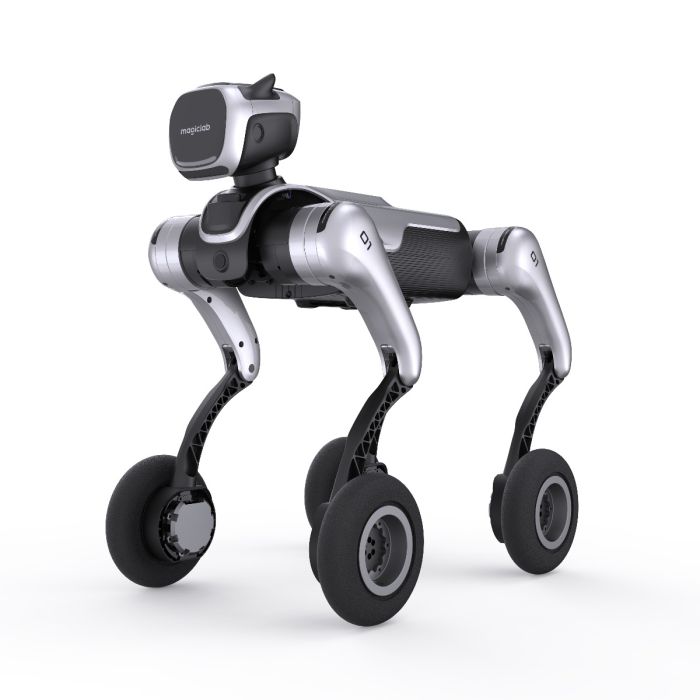
Legs are slow on smooth floors and wheels are helpless at a kerb; most mobile robots are built around one compromise or the other. The MagicLab MagicDog-W Wheeled Quadruped Robot Dog declines to choose. Each of its four legs ends in a pneumatic tyre, so the same machine can roll briskly along a corridor, then lift, step and balance where the ground stops cooperating. For a laboratory, a lecture theatre or an inspection team, it is a single platform for two styles of movement and for the research questions that arise wherever they meet.
Robots Europa, based in Dublin, supplies the MagicDog-W to universities, research institutes, integrators and businesses throughout the European Union and the DACH region. Robots Europa prepares each quotation, arranges delivery to the customer's site and remains the point of contact for technical questions once the robot is in service.
Background
MagicLab and its robot family
MagicLab develops general-purpose robots in two families: the MagicBot humanoids, which run from the compact Z1 to the full-size X1, and the MagicDog quadrupeds. The MagicDog-W belongs to the second family and adds wheels to the four-legged formula. Buyers working with MagicLab therefore deal with one manufacturer whose legged and humanoid platforms share a common design outlook, which can simplify planning where a programme expects to use more than one type of robot over time.
Wheel-legged locomotion
A wheel-legged robot keeps the articulated legs of a conventional quadruped but places a driven wheel where the foot would be. On level ground the robot rolls, which is generally more efficient and quicker than walking; on steps, slopes or debris it can use the legs to adjust posture, absorb disturbances and keep the body stable. The MagicDog-W pairs this layout with a sensor suite built for perception and mapping, and with a backplate designed to take expansion docks, so that the locomotion platform can be turned into a measuring, filming or mapping tool as the project requires.
Technical Specifications
| Specification | Value |
|---|---|
| Standing dimensions | 670*350*650mm |
| Prone dimensions | 720*500*290mm |
| Total weight | 22.5 kg (with battery) |
| Payload | Maximum 10 kg |
| Motion speed | 0-3 m/s |
| Maximum slope angle | ≤ 40° |
| Material | Aluminium alloy + high-strength engineering plastic |
| Tyre type and size | 7-inch pneumatic tyre |
| Motor number | 16+1 (head motor) |
| Maximum joint torque | 37.5 N·m |
| Onboard computing power | 6TOPS |
| Sensors | 2D LiDAR + dual camera + depth camera + 4K HD camera + fisheye camera + ultrasonic sensors |
| Communication | WiFi 5, 4G module, BT 5.0 |
| Battery | Capacity: 8200 mAh, rated voltage: 29.6 V |
| Battery life | 2-4 h |
| Operating temperature range | -5° ~ 40° |
| Facial expression display | 24 |
| Expansion | Versatile backplate compatible with expansion docks for peripherals such as LiDAR and gimbals |
Specifications are as published by the manufacturer and are confirmed against the datasheet at quotation.
The manufacturer has not published the IP rating, the charging time, whether the battery can be swapped, the maximum runtime per charge under load or the noise level; Robots Europa confirms these points at quotation.
What makes a wheeled quadruped different from a walking robot dog?
A walking quadruped moves every metre by placing feet, which gives it excellent footing on broken ground but makes long, flat distances comparatively laborious. The MagicDog-W rolls on 7-inch pneumatic tyres and reaches a motion speed of 0-3 m/s, so travel between points of interest in a building, campus or facility becomes a matter of driving rather than stepping. The pneumatic tyres also add a degree of cushioning that rigid wheels lack.
The legs remain fully in play. With 16 motors in the body plus one in the head, and a maximum joint torque of 37.5 N·m, the robot can reposition its body, lower itself into its prone posture of 720*500*290mm and climb gradients of up to 40°. In practice this means one machine can cover distance efficiently and still cope with the ramps, thresholds and uneven patches that would halt a purely wheeled rover. For researchers, the combination is a subject of study in its own right: deciding when to roll, when to step and how to blend the two is an open problem in control and motion planning.
What can the MagicDog-W sense and carry?
The perception package is unusually broad for a robot of this size. A 2D LiDAR supports mapping and localisation; a dual camera and a depth camera provide stereo vision and distance data for obstacle handling; a 4K HD camera records detailed imagery; a fisheye camera widens the field of view; and ultrasonic sensors cover close-range detection. All of this is processed onboard by 6TOPS of computing power, while WiFi 5, a 4G module and BT 5.0 connect the robot to local networks, remote operators and nearby devices.
As a carrier, the MagicDog-W accepts a payload of up to 10 kg. Its backplate is compatible with expansion docks for mounting peripherals such as an additional LiDAR or a gimbal, which lets an integrator fit the sensor or camera a task demands. The body is built from aluminium alloy and high-strength engineering plastic, and the robot weighs 22.5 kg including its 8200 mAh, 29.6 V battery, which gives 2-4 h of battery life. The operating temperature range is -5° ~ 40°, suitable for many indoor settings and for outdoor work in moderate conditions. A head display with 24 facial expressions gives the robot a recognisable character when it works among people.
Who is the MagicDog-W for?
University departments and research institutes working on locomotion, perception or autonomous navigation will find a platform that combines two locomotion modes with a substantial sensor set and onboard computing, removing much of the hardware groundwork before experiments can begin. Engineering faculties and technical colleges can use it to teach robotics as an integrated discipline, where mechanics, sensing and software meet in one machine.
System integrators and innovation teams in industry are a second segment: the payload capacity, the expansion backplate and the 4G connectivity make the robot a candidate base for inspection, monitoring or data-collection prototypes. Museums, science centres, trade-fair stands and corporate showrooms form a third, drawn by a robot that moves fluidly and greets visitors with an expressive face.
The MagicDog-W is offered as a standard version and as a MagicDog-W Pro, and Robots Europa advises buyers on which of the two fits their project. Those comparing MagicLab's quadruped range more broadly may also consider the MagicLab MagicDog Quadruped Robot and the MagicLab MagicDog Y1 Quadruped Robot Dog, and Robots Europa can advise on which platform best matches a given brief.
What is the MagicDog-W used for?
- Locomotion research: studying how a robot switches between rolling and stepping across changing terrain.
- Mapping and navigation: developing localisation and path-planning methods with LiDAR, depth and stereo data.
- Robotics education: giving students a complete mobile platform for courses in control, perception and programming.
- Inspection prototypes: carrying cameras or sensors through facilities to trial remote monitoring workflows.
- Payload integration: mounting gimbals, extra LiDAR units or custom tools on the expansion backplate.
- Exhibitions and visitor engagement: drawing and entertaining audiences with agile movement and expressive facial displays.
Pricing and Availability
Robots Europa supplies the MagicDog-W on a quotation basis, so that the configuration, version and any accessories can be matched to the intended use before an order is placed. Delivery, customs and support are arranged together with the quotation. Questions about the Pro version or integration needs can be raised at the same time. To begin, simply use the quotation request available on this page.
Frequently Asked Questions
How fast can the MagicDog-W travel?
The MagicDog-W has a motion speed of 0-3 m/s. Its wheels allow it to cover flat ground efficiently, while the legs handle obstacles and slopes.
How much can the robot carry?
It carries a payload of up to 10 kg. The backplate accepts expansion docks for peripherals such as LiDAR units and gimbals.
How long does the battery last?
The 8200 mAh, 29.6 V battery gives 2-4 h of battery life.
Can the MagicDog-W climb slopes?
Yes, it handles slopes of up to 40°. The articulated legs help it keep a stable posture on gradients and uneven ground.
Which sensors does the robot use?
The MagicDog-W combines a 2D LiDAR, a dual camera, a depth camera, a 4K HD camera, a fisheye camera and ultrasonic sensors. Their data are processed onboard by 6TOPS of computing power.
Is there more than one version?
Yes, there is a standard version and a MagicDog-W Pro. Robots Europa helps buyers choose between them.
Where can I buy the MagicDog-W and what does it cost?
The MagicDog-W is available from Robots Europa, which supplies customers across the EU and the DACH region. The cost depends on version and configuration and is provided in a personal quotation requested through this page.
Summary
The MagicDog-W resolves the old trade-off between wheels and legs by refusing to give either up. It rolls on pneumatic tyres where the ground allows and uses its articulated legs where it does not, while a broad sensor suite, onboard computing and an expansion backplate turn that mobility into a working tool for research, teaching, inspection trials and public engagement. Robots Europa supplies it across Europe with quotation, delivery and support handled from Dublin. For any organisation that needs a robot able to cover distance and difficult ground alike, this page is the starting point.


