
Unitree D1-T Teleoperation Robot Arm
In stock
- BRAND:
- UNITREE ROBOTICS
- MODEL:
- GO2 SERVO ROBOTIC ARM
- ORIGIN:
- China
- AVAILABILITY:
- SUBJECT TO AVAILABILITY
- SKU:
- Unitree-D1-T
Unitree D1-T Teleoperation Robot Arm
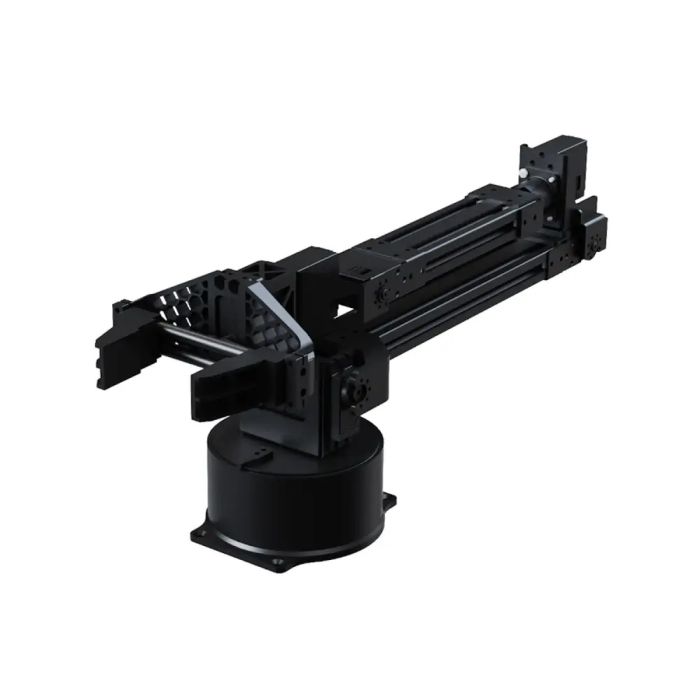
Most manipulation research does not begin on a factory floor. It begins on a desk, between a laptop and a power supply, with an arm light enough to lift with one hand and an open question about how a robot ought to learn to grasp, carry and place. The Unitree D1-T Teleoperation Robot Arm is designed for that desk rather than for a guarded production cell. It is an aluminium-alloy arm of about 2.37kg with six joints and a gripper, and it is supplied within Unitree's AI teleoperation kits. In those kits, human movement becomes the raw material from which robot behaviour is built.
Robots Europa, based in Dublin, supplies the Unitree D1-T Teleoperation Robot Arm to universities, research institutes, integrators and companies across the European Union and the DACH region. Robots Europa prepares the quotation for the kit edition you require, arranges delivery to your site and remains your point of contact for technical support after the arm has arrived.
Background
Unitree Robotics and the company behind the D1
Unitree Robotics is the brand of Yushu Technology Co., Ltd., a manufacturer best known in Europe for its quadruped robots and, more recently, its humanoid platforms. Its arms sit alongside these mobile robots rather than apart from them. The D1 arm family was conceived as a manipulator that can work on its own on a bench, or be mounted on a mobile base when a project calls for both movement and handling. The D1-T is the teleoperation-oriented member of that family, and it carries the model designation D1 on its specification sheet.
Positioning: embodied intelligence and data acquisition
Unitree positions the arm as a leading choice for embodied intelligent assistants, with an emphasis on data acquisition and continuous learning. That positioning matters when reading the rest of this page. The D1-T is not offered as a replacement for a heavy industrial manipulator. It is offered as an instrument for people developing the software that will eventually make manipulators more capable. Teleoperation is the method: a person guides the motion, the system records what happens, and those recordings feed the learning models now central to robotics research. A compact arm that can be set up on an ordinary workbench lowers the threshold for running that process in a laboratory or a lecture room.
Technical Specifications
| Specification | Value |
|---|---|
| Model | D1 |
| Weight | About 2.37kg |
| Arm length | 670mm |
| Reach | 550mm (gripper not included), 670mm (gripper included) |
| Payload | 500g |
| Degrees of freedom | Six joints and a gripper |
| Material | Aluminium alloy |
| Motor type | Bus Servo |
| Control modes | Position control, velocity control, force control |
| Control interfaces | Low-level and high-level interfaces for direct servo motor control and advanced functions |
| Power supply | 24V 2.5A (MAX 5A) |
| Power | 60W |
| Interface | DC5.5-2.1 (Power Supply) + RJ45 (Communication) + Type-C (Serial Port Debugging) |
| External hardware | Connects to external devices such as cameras and mobile robot chassis |
| Kit editions | Dual-Arm AI Teleoperation Kit (Standard Edition); Quad-Arm AI Teleoperation Kit (Full Edition) |
Specifications as published by the manufacturer; they are confirmed against the datasheet at quotation.
The manufacturer has not published the repeatability, the joint travel ranges, the joint speed, the operating temperature, an ingress protection rating, the box contents of a single arm or the details of software SDK support, so these points are confirmed at quotation.
What makes the D1-T different from an industrial robot arm?
An industrial arm is judged on how reliably it repeats the same motion thousands of times inside a fenced cell. The D1-T is judged on something else: how easily a team can set it up, command it at different levels and gather useful data from it. Several published characteristics point in that direction.
The first is scale. At about 2.37kg and with an arm length of 670mm, the D1-T is built to share a desk with the researchers using it. The second is its control model. It offers position control, velocity control and force control, and it exposes both low-level and high-level interfaces. Students can therefore begin with high-level commands, while experienced developers address the servo motors directly. Force control is particularly relevant where a task involves contact, such as pressing, inserting or handling objects that should not be gripped too firmly.
The third is its connectivity. The arm takes power through a DC5.5-2.1 connector, communicates over RJ45 and provides a Type-C port for serial debugging. These are familiar interfaces that suit a laboratory network and a development laptop. It can also be connected to external devices such as cameras and mobile robot chassis, which allows perception and mobility to be added around the arm rather than bought as a closed system.
The trade-off is clear from the published figures. A payload of 500g and a 60W power rating place the D1-T among light-duty, research-grade manipulators. It suits grasping and placing everyday objects, not lifting heavy parts on a production line.
What is the difference between the Dual-Arm and Quad-Arm kits?
The D1-T is offered in two editions: the Dual-Arm AI Teleoperation Kit (Standard Edition) and the Quad-Arm AI Teleoperation Kit (Full Edition). The edition names make the principal difference plain, namely the number of arms supplied, while the specifications in the table above describe the arm itself. In teleoperation setups of this kind, arms are typically used in pairs, with one moved by the operator and one carrying out the motion. A larger kit therefore usually reflects interest in two-handed tasks or in running more than one station.
Who is the Unitree D1-T Teleoperation Robot Arm for?
The most obvious buyers are research groups working on embodied AI and robot learning. For them, the arm is a means of collecting demonstrations, testing policies and comparing control approaches without committing to an industrial installation. University departments in robotics, mechatronics and computer science form a second group. Here, the combination of position, velocity and force control gives a single platform on which a full course in manipulation can be taught, from simple trajectories to contact-aware behaviour.
A third group consists of integrators and developers who are building mobile manipulation prototypes. Because the arm connects to cameras and mobile robot chassis, it can become the handling element of a larger system. Teams in that position may also wish to browse the wider Unitree Arms range, as well as the Quadruped Accessories category, where components for Unitree's mobile platforms are listed. Organisations planning to move parts heavier than the published payload, or needing a sealed arm for harsh environments, are better served by a heavier-duty manipulator, since the D1-T is a light-duty research arm.
What is the Unitree D1-T Teleoperation Robot Arm used for?
- Teleoperated data collection – recording human-guided grasping and placing as training data for learning models.
- Imitation learning research – testing how well a policy reproduces demonstrated manipulation on real hardware.
- Teaching robot control – letting students compare position, velocity and force control on the same arm.
- Vision-guided grasping – pairing the arm with an external camera to locate and pick objects.
- Mobile manipulation prototypes – mounting the arm on a mobile robot chassis so that a robot can both travel and handle.
- Light pick-and-place trials – evaluating handling concepts with small objects before scaling up.
Pricing and Availability
Robots Europa supplies the Unitree D1-T Teleoperation Robot Arm by quotation, so that the kit edition, accessories and project requirements can be matched precisely. Delivery, customs and technical support are arranged together with the quotation. To begin, tell us which edition interests you and how you intend to use it, using the quotation request available on this page.
Frequently Asked Questions
How much does the Unitree D1-T weigh?
The arm weighs about 2.37kg and is made of aluminium alloy. That weight makes it practical to set up on a standard laboratory bench.
What is the payload and reach of the D1-T?
The payload is 500g. The reach is 550mm without the gripper and 670mm with the gripper included.
How many degrees of freedom does the arm have?
The D1-T has six joints and a gripper. This allows it to position and orient objects freely within its working space.
Which control modes does the D1-T support?
It supports position control, velocity control and force control. Both low-level and high-level interfaces are provided, so the servo motors can be addressed directly or through higher-level functions.
What power and connections does it need?
The arm uses a 24V 2.5A (MAX 5A) supply and is rated at 60W. Its connections are DC5.5-2.1 for power, RJ45 for communication and Type-C for serial port debugging.
Can the D1-T be combined with cameras or a mobile robot?
Yes, the arm can be connected to external devices such as cameras and mobile robot chassis. This makes it a practical handling element for vision-guided and mobile manipulation projects.
Where can I buy the Unitree D1-T Teleoperation Robot Arm and what does it cost?
You can buy it from Robots Europa, which supplies customers across the EU and the DACH region. The cost depends on the kit edition and the accessories you choose, so Robots Europa prepares an individual quotation.
Summary
The Unitree D1-T Teleoperation Robot Arm brings manipulation research back to the scale of a desk. It combines an aluminium-alloy build of about 2.37kg, six joints with a gripper, three control modes and familiar interfaces in a form that a laboratory can set up quickly and a lecture room can share. It is not meant to compete with industrial arms on load. Its value lies in turning human guidance into data and in giving developers access at every level of control. Whether you are equipping a research group with a Dual-Arm kit or planning a larger setup with the Quad-Arm edition, this page is the starting point.
Specifications
General
Physical
Shipping
What's included
Related Products
Out of stock


