
Unitree G1 Competition Humanoid Robot
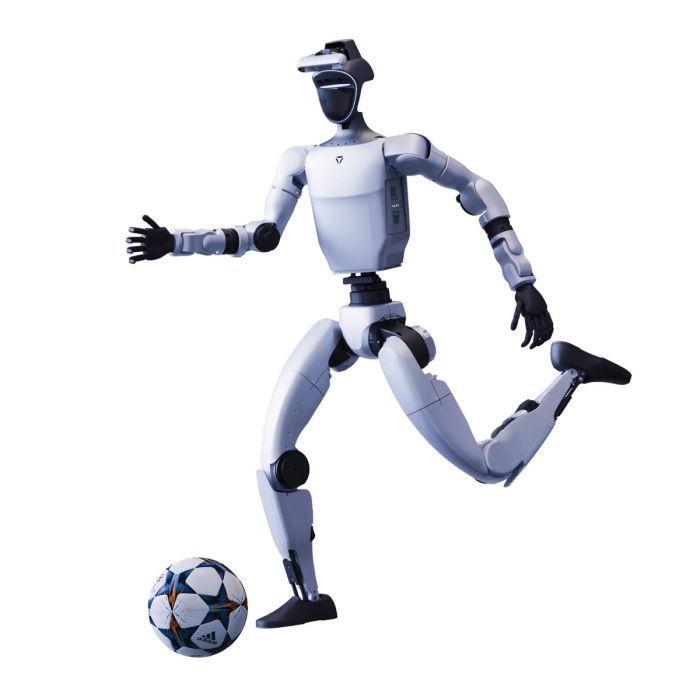
In stock
- BRAND:
- UNITREE ROBOTICS
- PART #:
- G1-Comp
- ORIGIN:
- China
- AVAILABILITY:
- SUBJECT TO AVAILABILITY
- SKU:
- Unitree-G1-Comp
Unitree G1 Competition Humanoid Robot
On a robot football pitch, code that won a simulated match on Tuesday has to survive a real ball, a real opponent and a real referee by Saturday. The Unitree G1 Competition Humanoid Robot is the member of Unitree's G1 family built around that crossing from simulation to stadium. Unitree describes it as a football icon designed for competitions, and the design follows that brief: a compact bipedal body, onboard AI computing, depth and LiDAR sensing, and a built-in YOLO11 detector that gives developers a rich interface to stadium information. For a team, that means less time building infrastructure and more time refining how the robot reads the game.
Robots Europa, based in Dublin, supplies the Unitree G1 Competition Humanoid Robot to universities, robotics clubs, research institutes and companies across the European Union and the DACH region. Robots Europa prepares each quotation for the configuration requested, arranges delivery to the customer's site and remains the point of contact for technical questions and support once the robot is in service.
Background
Unitree Robotics: from quadrupeds to humanoids
Unitree was established in 2016 and has advanced to mass production of robot dogs and androids. That lineage matters to a competition buyer. Legged locomotion, joint actuation and balance control are problems Unitree has solved repeatedly across its quadruped range, and the G1 family carries that experience into a two-legged form. A manufacturer producing at volume also tends to build an ecosystem around its platforms, including development tools, simulation support and a community of users, which is precisely what a team preparing for tournaments relies upon between matches.
The G1 family and its competition variant
The sources name three versions in the family: the G1, the G1 EDU and the G1-Comp. The G1-Comp is the variant that Unitree positions explicitly for competitive football. Its distinguishing software feature is the visual recognition API, which ships with the YOLO11 real-time target detection algorithm and exposes stadium information to the developer. Ball, goal and opponent detection are tasks every football team must otherwise implement and tune itself; having a current-generation detector in place from the outset changes where a team can spend its engineering effort. The figures below apply to the G1-Comp only; the sources do not publish comparable figures for the other two versions here, and Robots Europa can clarify the differences when preparing a quotation.
Technical Specifications
| Specification | Value |
|---|---|
| Positioning | Football icon designed for competitions |
| Dimensions standing (H x W x T) | 1320x450x200mm |
| Dimensions folded (H x W x T) | 690x450x300mm |
| Weight (with battery) | About 35kg+ |
| Total degrees of freedom (joint freedom) | 25-45 |
| Head degrees of freedom | 2 |
| Single leg degrees of freedom | 6 |
| Maximum knee joint torque | 120N·m |
| Arm maximum load | About 3Kg |
| Development computing unit | Orin NX, 100TOPS AI computing power |
| Sensing | Depth camera, 3D LiDAR |
| Connectivity | WiFi 6, Bluetooth 5.2 |
| Battery | Smart Battery (Quick Release) 9000mAh |
| Charger | 54V 5A |
| Battery life | About 2h |
| Secondary development | Yes |
| Simulation environment | Isaac gym, Mujoco |
| Visual recognition API | Built-in YOLO11 real-time target detection algorithm |
| ROS support | Compatible with ROS Ecosystem |
| Shell | Aluminium alloy and high-strength engineering plastics |
Specifications are as published by the manufacturer and are confirmed against the datasheet at quotation.
Unitree has not published the maximum walking speed, the IP rating, the camera model, the contents of the box or the operating temperature range; Robots Europa confirms these with the quotation.
What does the G1-Comp bring to a football match?
Football asks a humanoid to do several difficult things at once: stay upright while changing direction, find a moving ball, judge the position of goals and opponents, and strike with enough force to matter. The G1-Comp addresses each of these from a different part of its specification.
Locomotion starts with the legs. Each leg has 6 degrees of freedom, and the knee joint delivers a maximum torque of 120N·m, which is the joint that absorbs landings, drives acceleration and loads the kick. A standing height of 1320mm with a body thickness of 200mm keeps the robot compact, a sensible proportion for a machine expected to turn quickly and recover from contact.
Perception combines a depth camera with a 3D LiDAR. The depth camera gives the detector its view of ball and players, while the LiDAR adds geometric awareness of the surroundings. The head has 2 degrees of freedom, so the robot can direct its gaze across the pitch without turning its whole body, which is valuable when the ball leaves the field of view during play.
The software layer ties it together. The built-in YOLO11 detector runs in real time on the Orin NX computing unit, which provides 100TOPS of AI computing power. Running detection on board, rather than on an external machine, keeps latency within the robot itself, and WiFi 6 and Bluetooth 5.2 remain available for team communication and supervision. The shell, made of aluminium alloy and high-strength engineering plastics, is chosen for durability, an important consideration in a sport where falls are part of every match.
How do teams develop software for the G1-Comp?
A competition season is won as much in simulation as on the pitch. The G1-Comp supports secondary development and is compatible with the ROS ecosystem, so teams can work with familiar robotics middleware, existing packages and their own codebases. Isaac gym and Mujoco are both supported as simulation environments; teams can therefore train locomotion and behaviour policies in a physics simulator before transferring them to the hardware, a workflow that reduces wear on the robot and allows far more iterations than real-world testing alone.
The quick-release smart battery supports this rhythm in practice. With a battery life of about 2h and a battery that can be swapped rapidly, a training session or a tournament day need not stop for long charging pauses, provided spare batteries are planned into the order. The folded dimensions of 690x450x300mm also make the robot considerably easier to transport between laboratory, training hall and venue.
Who is the Unitree G1 Competition Humanoid Robot for?
The clearest audience is university and school teams entering humanoid football leagues and robotics tournaments. For them, the combination of onboard detection, simulation support and ROS compatibility shortens the path from a new robot to a team that can take the field.
Research groups working on legged locomotion, reinforcement learning and sim-to-real transfer form a second segment. Football is a demanding benchmark for dynamic balance and fast perception, and a platform designed for it serves well as a testbed for methods that extend far beyond sport.
Educators running robotics and AI programmes are a third group. A football task gives students an immediate, measurable goal, and the open development environment lets them work at every level, from high-level strategy to perception pipelines.
Finally, organisers of exhibitions, science festivals and corporate showcases may value a humanoid built to perform in front of an audience. Buyers whose work is not centred on competition can ask Robots Europa about the G1 and G1 EDU versions within the same family, so that the chosen configuration matches the intended use.
What is the Unitree G1 Competition Humanoid Robot used for?
- Competitive robot football: fielding humanoid players in leagues and tournaments built around ball detection and dynamic movement.
- Sim-to-real research: training policies in Isaac gym or Mujoco and validating them on physical hardware.
- Real-time perception studies: building on the YOLO11 detector and the depth camera and 3D LiDAR data.
- Robotics education: giving students a tangible platform for control, vision and AI coursework.
- Multi-robot strategy: developing team play and coordination over the robot's wireless connectivity.
- Public demonstrations: showcasing humanoid capabilities at exhibitions, open days and outreach events.
Pricing and Availability
The Unitree G1 Competition Humanoid Robot is supplied by quotation, because the final configuration, any spare batteries and the development support required differ from one team to the next. Delivery, customs and support are arranged together with the quotation, so the robot arrives ready for the team that will use it. To receive a tailored offer from Robots Europa, please use the quotation request available on this page.
Frequently Asked Questions
What computing hardware does the G1-Comp use?
The G1-Comp uses an Orin NX development computing unit, which provides 100TOPS of AI computing power. This runs the built-in YOLO11 detector on board the robot.
How long does the battery last during play?
Battery life is about 2h from the 9000mAh quick-release smart battery, and the charger is rated at 54V 5A. Because the battery is quick-release, it can be exchanged rapidly between sessions when spares are available.
Can we develop our own software for the robot?
Yes. The G1-Comp supports secondary development, is compatible with the ROS ecosystem and supports Isaac gym and Mujoco for simulation.
How large and heavy is the G1-Comp?
Standing, it measures 1320x450x200mm, and it folds to 690x450x300mm for transport. Its weight with the battery is about 35kg+.
Which sensors does the robot carry?
The G1-Comp is equipped with a depth camera and a 3D LiDAR. The camera model is not published and is confirmed by Robots Europa at quotation.
How robust is the body for competition use?
The shell is covered with aluminium alloy and high-strength engineering plastics for strength and durability. The knee joint, which bears the greatest load in running and kicking, delivers a maximum torque of 120N·m.
Where can I buy the Unitree G1 Competition Humanoid Robot and what does it cost?
You can buy it from Robots Europa, which supplies customers across the EU and the DACH region from Dublin. The cost depends on the configuration and options selected, and Robots Europa provides it in a written quotation.
Summary
The gap between a simulated match and a real one is where most humanoid football projects stall, and the Unitree G1 Competition Humanoid Robot is designed to narrow it. Strong knee joints and six-degree-of-freedom legs handle the physical side; a depth camera, 3D LiDAR and an onboard YOLO11 detector handle the perceptual side; and Isaac gym, Mujoco and ROS compatibility let teams carry their work from the simulator onto the pitch with little friction. Supplied, delivered and supported by Robots Europa across the EU and the DACH region, it offers a coherent platform for teams, laboratories and educators alike. For any group ready to move its football code from simulation to the stadium, this page is the starting point.
Specifications
General
What's included
Related Products
Out of stock


