
Unitree H1-2 Dexterous Hand
In stock
- BRAND:
- UNITREE ROBOTICS
- PART #:
- H1-2 dexterous hand (develop by Unitree)
- ORIGIN:
- China
- AVAILABILITY:
- SUBJECT TO AVAILABILITY
- SKU:
- Unitree-H1-2-Dexterous-Hand
Unitree H1-2 Dexterous Hand
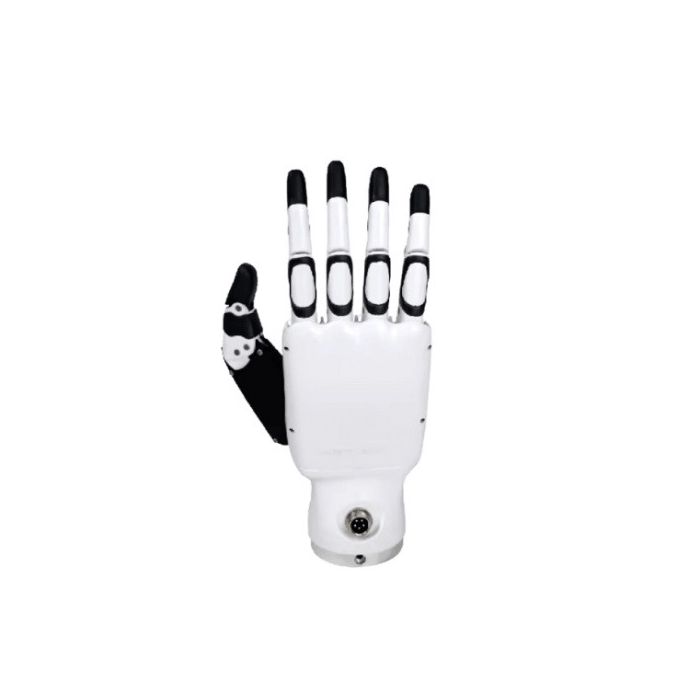
A full-size humanoid that walks across a laboratory floor is impressive for about a minute. After that, everyone in the room asks the same question: what can it actually do with what it finds there? The answer sits at the end of each arm. The Unitree H1-2 Dexterous Hand is the part of the H1-2 platform that turns locomotion into work. It is a multi-jointed hand with haptic array sensors in every finger, so the robot can not only close around an object but also register where and how that object is touching it. For teams that have already solved the problem of getting a humanoid from A to B, this is where the next set of problems begins.
Robots Europa, based in Dublin, supplies the Unitree H1-2 Dexterous Hand to research institutions, universities, industrial laboratories and system integrators throughout the EU and the DACH region. Robots Europa prepares each quotation for the specific robot configuration, arranges delivery and customs, and provides support after the hand has been fitted to your H1-2.
Background
Unitree Robotics and its move from legs to hands
Unitree Robotics made its name with agile, comparatively accessible legged robots, first quadrupeds and then bipedal humanoids. That lineage shows in the company's approach: capable hardware intended for researchers and developers who want a working platform rather than a closed demonstration piece. The H1 humanoid established Unitree's presence in the full-size category, and the H1-2 continues that line as a human-scale platform standing about 178CM tall. As the humanoid field has matured, attention has shifted from balance and gait towards manipulation, and the dexterous hand is Unitree's response to that shift for this platform.
Touch as the key technology
Most of what makes a hand useful is invisible from the outside. Cameras can tell a robot where an object is, but only contact sensing can tell it whether a grasp is secure, whether something is slipping, or whether it is pressing too hard on a delicate part. This hand places haptic array sensors on each finger, with more than 20 sensor contacts per finger, giving the controller a spatial picture of contact rather than a single on-or-off signal. Combined with at least ten degrees of freedom and finger joints rated at more than 0.7 Nm of maximum output torque, it is designed for manipulation research in which force and touch matter as much as position. The H1-2 can be fitted with two optional hand modules, one for each arm, so bimanual tasks are within reach.
Technical Specifications
| Specification | Value |
|---|---|
| Degrees of freedom | ≥10 |
| Hand modules per robot | 2 (optional) |
| Finger sensing | Haptic array sensors for each finger |
| Sensor contacts per finger | >20 |
| Maximum output torque of each finger joint | >0.7 Nm |
| Hand options on the H1-2 | Dex5-1 or other ambidextrous hands |
| Host robot height (H1-2) | About 178CM |
Specifications as published by the manufacturer; confirmed against the datasheet at quotation.
Unitree has not published the hand's weight, dimensions, operating voltage, communication interface, payload per hand, fingertip force or positioning accuracy, nor the contents of the box; these are confirmed at quotation.
What makes a tactile hand different from a simple gripper?
A two-jaw gripper is an excellent tool when the object, its position and its orientation are known in advance. It opens, it closes and it holds. A humanoid, however, is usually deployed precisely because the environment was built for people: handles, switches, tools and containers of every shape. In that setting a gripper forces you to redesign the world around the robot, whereas a multi-fingered hand lets the robot adapt to the world as it is.
The degrees of freedom are what allow that adaptation. With at least ten independently controllable motions, the fingers can wrap around irregular shapes, pinch small items or present a flat palm. Tactile sensing is what makes the adaptation reliable. Because each finger carries a haptic array with more than 20 contacts, the controller learns where the pressure lies across the finger surface, which is the information needed to detect slip, adjust grip mid-task or feed training data into a learning-based manipulation policy. The torque figure for each finger joint indicates the hand is meant for genuine object handling rather than gesture alone.
Should I equip one hand or two?
The H1-2 accepts two optional hand modules, and the decision between one and two is mainly a question of what you intend to study or automate. A single hand is often sufficient for early work on grasp planning, tactile perception or teleoperation pipelines, and it keeps the integration effort focused. Two hands open up bimanual manipulation: holding a part with one hand while working on it with the other, passing objects between hands, or opening containers. Because the H1-2 is offered with the Dex5-1 or other ambidextrous hands, the configuration is something to discuss with Robots Europa before ordering, so that the hand fitted matches both your robot and your research plan.
Who is the Unitree H1-2 Dexterous Hand for?
The first group is research laboratories working on humanoid manipulation, tactile perception and embodied artificial intelligence. For them, sensorised fingers on a full-size bipedal platform provide a realistic testbed for algorithms that must eventually work in human spaces. Universities form a second group: teaching and doctoral programmes that need hardware students can use to study grasping, control and human–robot interaction on a platform of human scale.
System integrators and industrial innovation teams are the third group. They evaluate whether humanoids can take on tasks in logistics, assembly or inspection, and the hand is what determines whether such a pilot gets past walking demonstrations. Teams that need a specific side or a particular tactile hand for an H1 or H1-2 may also consider the Unitree Dex5-1P Tactile Hand For H1-H1-2 (Left) (DEX5-HANDL). Organisations working with the smaller G1 humanoid rather than the H1-2 will be better served by the Unitree G1 Dex3-1 Force-Controlled 3-Finger Tactile Dexterous Hand, and those looking at Unitree's higher-DOF biomimetic designs can compare the Unitree Dex5-S Pro 22-DOF Tactile Dexterous Hand. The full range is collected in the Hands category, with further add-ons under Humanoid Accessories.
What is the Unitree H1-2 Dexterous Hand used for?
- Tactile manipulation research – studying how contact information from each finger improves grasp stability and slip detection.
- Embodied AI and learning – collecting touch-rich demonstration data to train manipulation policies on a human-scale robot.
- Teleoperation – mapping a human operator's hand movements onto a multi-jointed robotic hand for remote tasks and data capture.
- Bimanual task studies – fitting two hand modules to explore coordinated two-handed work such as handovers and assembly.
- Industrial pilot projects – evaluating whether a humanoid can handle tools, parts and containers designed for human hands.
- Teaching and demonstration – giving students and visitors a tangible platform for grasping, control and human–robot interaction.
Pricing and Availability
Robots Europa sells the Unitree H1-2 Dexterous Hand on a quotation basis, because the right offer depends on your robot, the number of hand modules and the hand option chosen. Delivery, customs and support are arranged together with the quotation, so you receive one clear proposal for the whole configuration. To start the process for your laboratory or project, the quotation request is available on this page.
Frequently Asked Questions
How many degrees of freedom does the hand have?
The hand has at least ten degrees of freedom, which allows the fingers to form a wide range of grasps.
Does each finger have tactile sensing?
Yes. Each finger carries haptic array sensors with more than 20 sensor contacts per finger.
How strong are the finger joints?
The maximum output torque of each finger joint is more than 0.7 Nm.
Can the H1-2 use two hands at once?
Yes. The robot can be equipped with two optional hand modules, one on each arm.
Which hands can be fitted to the H1-2?
The H1-2 is offered with the Dex5-1 or other ambidextrous hands. Robots Europa will advise on the right option for your robot.
Can the hand be used for teleoperation?
Multi-jointed hands of this class are commonly used in teleoperation set-ups, where an operator's hand movements are mapped onto the robot's fingers. The tactile sensors in each finger add contact information that can be fed back to the operator or recorded for training.
Where can I buy the Unitree H1-2 Dexterous Hand and what does it cost?
You can buy it from Robots Europa, which supplies customers across the EU and the DACH region. The cost depends on your configuration and is set out in a personal quotation, which you can request on this page.
Summary
A humanoid that can walk but not handle anything remains a demonstration; one that can feel what it holds becomes a research and pilot platform. The Unitree H1-2 Dexterous Hand closes that gap for the H1-2, combining at least ten degrees of freedom with haptic array sensors in every finger and the option of fitting a hand to each arm. Its value lies less in any single figure than in the contact information it gives to whoever is writing the control software. Robots Europa will match the right hand option to your robot and arrange delivery and support across Europe. If your humanoid is ready to move from walking to working, this page is the starting point.
Specifications
General
What's included
Related Products
Out of stock


