
RobotEra L7 Bipedal Humanoid Robot w
In stock
- BRAND:
- ROBOTERA
- PART #:
- L7
- ORIGIN:
- China
- Warranty:
- 12 MONTHS
- AVAILABILITY:
- SUBJECT TO AVAILABILITY
- SKU:
- RobotEra-L7
RobotEra L7 Bipedal Humanoid Robot w
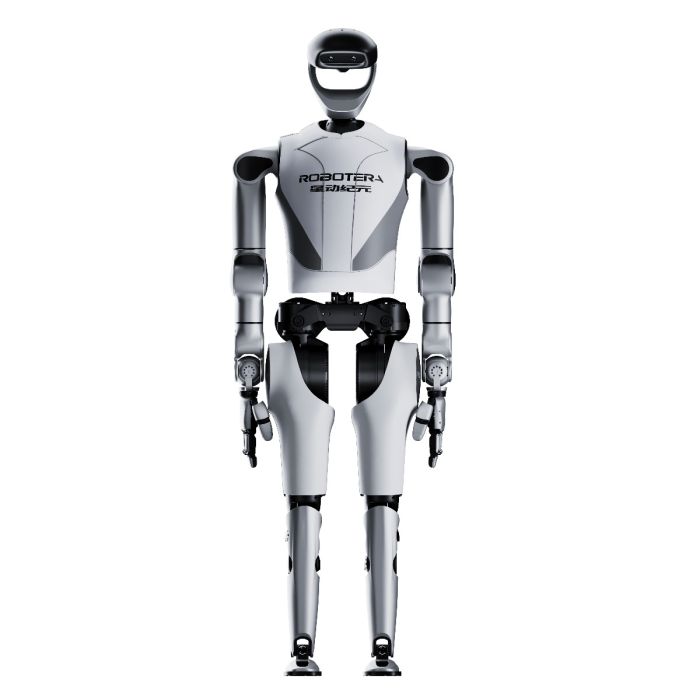
Most humanoid robots are built to impress or built to work, and the two goals tend to pull a design in opposite directions. Athletic machines need lightweight limbs and violent bursts of power, while useful machines need patient, precise hands and a stable working posture. The RobotEra L7 Bipedal Humanoid Robot w declines to choose. The same frame that runs and performs rotating jumps is expected, minutes later, to sort parcels, scan barcodes and drive a screw gun. That double brief, athlete and technician in one adult-sized body, is the thread that runs through every specification below.
Robots Europa, based in Dublin, supplies the RobotEra L7 to organisations across the European Union and the DACH region. Robots Europa prepares each quotation, coordinates delivery to your site and remains your point of contact for technical support once the robot is in service. Whether you are a research group, a systems integrator or an operator planning a public installation, Robots Europa can advise on the configuration that fits your project.
Background
ROBOTERA and its humanoid family
ROBOTERA develops a range of humanoid platforms rather than a single flagship. Its portfolio spans wheeled service robots, upper-body wheeled humanoids, full-size bipeds and stand-alone dexterous hands, which means the L7 sits within an ecosystem of shared engineering ideas rather than as an isolated experiment. Among the humanoids in the range, the L7 is the full-size bipedal model positioned for multi-scenario deployment: the robot intended to walk into environments designed for people and operate there without a dedicated robot cell.
Quasi-direct drive at the core
The defining technology in the L7 is its joint system. ROBOTERA uses self-developed semi-direct drive joints, which it also describes as a quasi-direct drive system, built into a modular skeletal structure. By removing conventional gear reducers, the design reduces power loss, makes the structure more compact and improves force feedback accuracy, so the robot can adjust to impacts in real time. Each joint reaches 400N·m peak torque and 25rad/s peak speed. Built-in heat dissipation for the high-power joints, together with a frame of aerospace-grade aluminium alloy and carbon fibre, supports the sustained effort that both athletic motion and repetitive industrial work demand.
Technical Specifications
| Specification | Value |
|---|---|
| Product type | Full-size high-performance bipedal humanoid robot for multi-scenario deployment |
| Height | 171 cm |
| Total weight | 65kg (excl. dexterous hands) |
| Dual-arm max payload | 20kg |
| Full-body degrees of freedom | 55 |
| Upper limb configuration | 7DOF humanoid robotic arms + 3DOF waist |
| Operation space | 2.1m diameter |
| Hand degrees of freedom | 12 independently actuated |
| Hand response rate | 10 Hz |
| Locomotion | Walking, running (4m/s), 360° rotating jumps |
| Joint peak torque | 400N·m |
| Joint peak speed | 25rad/s |
| Joint drive | Self-developed semi-direct (quasi-direct) drive joints, modular skeletal structure |
| Perception system | Binocular vision + 3D LiDAR + microphone array |
| Interfaces | 1×HDMI, 1×Ethernet, 2×USB, 1×emergency stop, external power interface |
| Communication and control | Ethernet/USB communication, full-body teleoperation, 2.4G wireless control |
| Power | High-performance lithium battery with BMS |
| Frame material | Aerospace-grade aluminium alloy + carbon fibre |
| Configurations | Full-body; upper-body only (interchangeable) |
Specifications are as published by the manufacturer and are confirmed against the datasheet at quotation.
ROBOTERA has not published the battery capacity, the charging time, the IP rating, the operating system, the onboard compute, any dimensions other than height or the contents of the box; Robots Europa confirms these at quotation.
What makes the RobotEra L7 different from a wheeled humanoid?
Wheeled humanoids place an upper body on a mobile base. They are stable and efficient on flat floors, but they meet their limits at steps, thresholds and uneven ground. The L7 takes the harder route of bipedal locomotion, and it does so with real athletic range: its legs support walking, running at 4m/s and 360° rotating jumps. That capability is not merely for show. A robot able to absorb and recover from dynamic movement is better equipped to cope with the bumps, shifts in load and unexpected contact that come with working among people.
The quasi-direct drive joints are what make this credible. Without gear reducers between motor and limb, force feedback is more accurate and the robot can react to impacts as they happen. The perception system supports the same goal: binocular vision, 3D LiDAR and a microphone array combine to give 360° perception, supporting obstacle avoidance in complex environments such as warehouses holding irregular goods. In short, the L7 is built to move through spaces that were never adapted for robots.
Full-body or upper-body: which configuration do you need?
The L7 can be configured as a full-body or an upper-body system, and the two configurations are interchangeable. ROBOTERA recommends the full-body version for commercial services built around dynamic displays, such as 360° spinning jumps and street dance performances, where the legs are the point of the exercise.
Where the work is concentrated in the arms and hands, the upper limb configuration carries the load. Each 7DOF humanoid arm works with a 3DOF waist to create an operating space 2.1m in diameter, and the dexterous hands bring 12 independently actuated degrees of freedom with a 10 Hz response rate. Every finger is controlled independently, so the hand can move from gripping mechanical parts to handling soft packages and pressing the button on a screw gun, adjusting its posture ten times per second as it switches between screwing, scanning and labelling. If your application keeps the robot at a single station, Robots Europa can discuss with you whether the upper-body configuration is the better starting point.
Who is the RobotEra L7 for?
Logistics and warehouse operators are a natural fit. Sorting, barcode scanning and handling irregular goods are named tasks for the L7, and its perception system recognises QR codes even when they are tilted or wrinkled, which is a frequent problem with real parcels rather than laboratory samples.
Industrial teams exploring humanoid automation on existing lines form a second group. Screw fastening and labelling with standard hand tools allow the L7 to be trialled at workstations designed for human operators, while the 20kg dual-arm payload covers a meaningful range of components and packages.
Research institutions and robotics developers gain a full-size platform with 55 full-body degrees of freedom, open interfaces through HDMI, Ethernet and USB, and support for full-body teleoperation, a useful basis for work on locomotion, manipulation and human-robot interaction.
Finally, exhibition, retail and entertainment operators who need a robot that draws a crowd should choose the full-body configuration, which ROBOTERA positions specifically for dynamic performances. Buyers comparing the L7 with other full-size walking robots will find further options in our Bipedal Humanoids category.
What is the RobotEra L7 used for?
- Parcel sorting: handling soft packages and irregular goods in logistics environments.
- Barcode and QR code scanning: reading codes on items even when the labels are tilted or wrinkled.
- Screw fastening: operating a screw gun with independently controlled fingers at human workstations.
- Labelling: switching quickly between scanning, labelling and fastening within a single task sequence.
- Dynamic performances: spin jumps and street dance routines for commercial displays and events.
- Teleoperation and research: full-body teleoperated control for developing and studying humanoid behaviour.
Pricing and Availability
The RobotEra L7 is supplied on quotation, because the right offer depends on the configuration, the hands, the accessories and the support your project requires. Delivery, customs and support are arranged with the quotation, so you receive one clear proposal from Robots Europa covering the entire supply. To begin, send us a short description of your application and your preferred configuration, and a quotation request for the RobotEra L7 is available on this page.
Frequently Asked Questions
How tall is the RobotEra L7 and how much does it weigh?
The L7 stands 171 cm tall. Its total weight is 65kg, excluding the dexterous hands.
How fast can the RobotEra L7 run?
The L7 runs at up to 4m/s. Its legs also support walking and 360° rotating jumps.
What sensors does the L7 use to perceive its surroundings?
It combines binocular vision, 3D LiDAR and a microphone array for 360° perception. This supports obstacle avoidance in complex environments and the recognition of tilted or wrinkled QR codes.
Can the L7 be controlled remotely?
Yes. The L7 supports full-body teleoperation and 2.4G wireless control, in addition to communication over Ethernet and USB.
Is the L7 available without legs?
The L7 has interchangeable full-body and upper-body configurations. Robots Europa will help you decide which one suits your application when preparing your quotation.
Which interfaces and power system does the L7 have?
The L7 provides 1×HDMI, 1×Ethernet, 2×USB, an emergency stop and an external power interface. It runs on a high-performance lithium battery managed by a BMS.
Where can I buy the RobotEra L7 Bipedal Humanoid Robot w and what does it cost?
You can buy the RobotEra L7 from Robots Europa, which supplies customers across the EU and the DACH region from Dublin. The cost depends on configuration and scope, so please request a quotation on this page.
Summary
The RobotEra L7 resolves the usual conflict between athletic and practical humanoids by giving one full-size body both roles. Quasi-direct drive joints with 400N·m peak torque provide the power to run and jump, while arms with a 2.1m operating space and dexterous hands with independently controlled fingers deliver the patience to sort, scan, label and fasten. Multi-sensor perception and open interfaces connect the two halves of that brief to the real environments where the robot will work. For organisations ready to evaluate a humanoid that can both perform and work, supplied and supported by Robots Europa across Europe, this page is the starting point.
Specifications
General
Physical
Mobility
Performance
What's included
Downloads
Related Products
Out of stock


