
Agilex AUTO KIT (AUTO KIT)
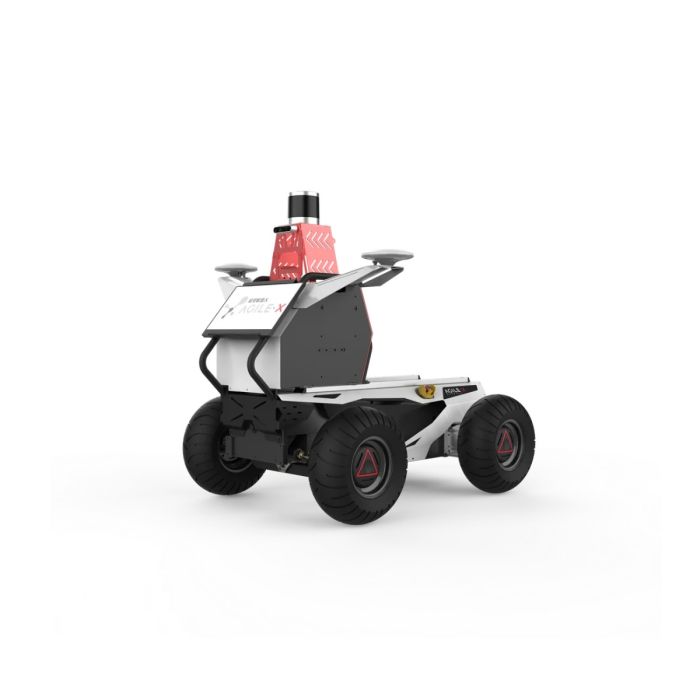
In stock
- BRAND:
- AGILEX
- PART #:
- AUTO KIT
- ORIGIN:
- China
- AVAILABILITY:
- SUBJECT TO AVAILABILITY
- SKU:
- AgileX-AUTO-KIT
Agilex AUTO KIT (AUTO KIT)
A mobile robot chassis will follow a joystick for as long as someone holds it, but the moment the operator lets go, it simply stops. Teaching it to look, decide and steer for itself is the hard part of autonomous driving, and it is exactly the gap the Agilex AUTO KIT (AUTO KIT) is built to close. Rather than leaving a teaching team to source a computer, a LiDAR, a screen and a CAN interface separately and then reconcile drivers for a semester, the kit arrives as one open-source package built on Autoware, ready to be bolted to a compatible AgileX rover and put to work in the lab.
Robots Europa, based in Dublin, sells and supplies the Agilex AUTO KIT (AUTO KIT) to universities, colleges, research groups and engineering teams across the EU and the DACH region. Robots Europa prepares each quotation, arranges delivery to your institution and remains your point of contact for technical questions once the kit is in use.
Background
AgileX and its mobile robot platforms
AgileX is known for wheeled and tracked mobile robot chassis that serve as the physical base for research and development projects, and for a family of kits that add specialised capabilities to those bases. You can browse the wider range in our AgileX category. The AUTO KIT belongs to this ecosystem: it is not a vehicle in itself but an autonomy package intended to sit on top of an existing AgileX robot. It is compatible with the Hunter 2.0, Bunker, Scout 2.0 and Ranger mini 2.0 mobile robots, which means an institution that already owns one of these platforms can extend it rather than replace it.
Autoware as the foundation
The kit is described by AgileX as the Open Source Autonomous Driving Development KIT, and it is based on the Autoware open source framework. Autoware is one of the most widely studied open software stacks for self-driving vehicles, structured around the same stages a production autonomous system relies on: perception, localisation, planning and control. Building the kit around an open framework matters for education in particular, because students work with source code they can read, modify and compare against published research rather than with a closed black box. AgileX positions the AUTO KIT as an economical, comprehensive solution tailored specifically for educational applications, and supports it with comprehensive tutorials and sample code covering everything from beginner to advanced levels.
Technical Specifications
| Specification | Value |
|---|---|
| Software framework | Autoware (open source) |
| Compatible robots | Hunter 2.0, Bunker, Scout 2.0, Ranger mini 2.0 |
| Onboard computer | ASUS VC66 (i7- 9700) |
| Computer cores | 8 cores |
| Computer memory type | DDR4 RAM 2400MHz |
| Computer power adapter | 24v to 19V (10a) |
| LiDAR | Robotsense RO-LiDAR-16, 16 channel |
| LiDAR range | 150m(80m@10% NIST) |
| LiDAR range accuracy (typical) | Up to ±2cm |
| LiDAR rotation speed | 300/600/1200rpm (5/10/20Hz) |
| LiDAR dimensions | φ109mm * H80.7 mm |
| LiDAR operating voltage | 9V - 32V |
| Display | 11.6 inch monitor, 480g/8mm, 1920 X 1080 resolution, USB Type-C direct connection |
| Robot interface | USB-to-CAN module |
| Mounting | Standardised mounting with aluminium T-slot rail compatibility |
| GPS module | Not included in the standard package |
Specifications are as published by the manufacturer and are confirmed against the datasheet at quotation.
AgileX has not published the total weight, the overall dimensions, the power consumption, the IP rating or the operating temperature range of the kit; these are confirmed at quotation.
What does the AUTO KIT add to an AgileX robot?
On its own, a Scout 2.0 or a Hunter 2.0 is a capable chassis waiting for instructions. The AUTO KIT supplies the parts that turn those instructions into decisions made on board. The computer runs the Autoware stack; the Robotsense RO-LiDAR-16 builds a three-dimensional picture of the surroundings, with a range of 150m(80m@10% NIST) and a typical range accuracy of up to ±2cm; the USB-to-CAN module lets the software command the chassis directly; and the 11.6 inch display gives students a view of what the system is doing without having to bring a laptop to the vehicle.
The kit is designed for autonomous obstacle avoidance: it senses obstacles and plans local paths around them. Using computer vision, it can detect certain objects such as letters, numbers and traffic lights, which makes it well suited to exercises that recreate simplified road scenarios in a laboratory or on a test track. The LiDAR rotation speed is selectable at 300/600/1200rpm (5/10/20Hz), so a course can show students the trade-off between scan rate and point density in practice rather than only in theory.
Physically, the underside of the kit provides a standardised mounting solution compatible with aluminium T-slot rails, so it can be fixed securely to a compatible rover. For a teaching team, that standardisation means less time spent fabricating brackets and more time spent on the software the course is actually about.
Can the AUTO KIT be extended beyond the standard package?
Yes, and this is one of the main reasons to choose an open kit over a closed demonstrator. AgileX states that users can build professional applications, customise performance, and add GPS, depth cameras or line-following modules. The GPS module is not included in the standard package, so projects that rely on outdoor global positioning should plan for it from the outset and raise it when requesting a quotation. Because the software is open source, the same extensibility applies to code: research groups can replace or extend individual Autoware modules, and the tutorials and sample code give newer students a structured path from first experiments to advanced work.
Who is the Agilex AUTO KIT (AUTO KIT) for?
The clearest audience is higher education. Universities and technical colleges teaching autonomous driving, mobile robotics or computer vision gain a complete, documented platform on which students can practise the whole pipeline from sensor data to motion. Because AgileX tailors the kit specifically to educational applications and pairs it with tutorials from beginner to advanced level, it suits both introductory modules and postgraduate projects.
Research laboratories form a second group. Teams investigating perception, path planning or localisation can use the kit as a reproducible baseline built on an open framework, then extend it with additional sensors as their work develops. Engineering departments and start-ups prototyping autonomous functions for outdoor or campus vehicles will find value in the same flexibility, particularly where they already operate a Hunter 2.0, Bunker, Scout 2.0 or Ranger mini 2.0.
The sources also name an Auto Kit Pro alongside this standard version. AgileX has not published a detailed comparison between the two, so if your project calls for capabilities beyond the standard package, such as integrated GPS, ask Robots Europa to set out the differences in your quotation before you decide. Institutions building a broader robotics laboratory can also explore the rest of the AgileX range.
What is the Agilex AUTO KIT (AUTO KIT) used for?
- Autonomous driving courses: teaching the perception, planning and control stages of a self-driving system on real hardware.
- Autoware research: testing and modifying open-source autonomy modules on a reproducible mobile platform.
- Obstacle avoidance experiments: studying how a vehicle senses obstacles and replans its local path in real time.
- Traffic scenario recognition: building exercises around the detection of letters, numbers and traffic lights with computer vision.
- LiDAR mapping projects: working with three-dimensional point clouds for mapping and localisation tasks.
- Student projects and competitions: giving final-year and postgraduate teams a ready autonomy stack to extend with GPS, depth cameras or line-following modules.
Pricing and Availability
Robots Europa supplies the Agilex AUTO KIT (AUTO KIT) on quotation, so that the configuration, the compatible chassis and any optional modules can be matched to your project. Delivery, customs and support are arranged together with your quotation. Tell us which AgileX robot you intend to use and whether you need a GPS module or other additions, and we will prepare an offer accordingly; the request form is available on this page.
Frequently Asked Questions
Which robots is the AUTO KIT compatible with?
The kit is compatible with the Hunter 2.0, Bunker, Scout 2.0 and Ranger mini 2.0 mobile robots. It attaches by means of a standardised mounting solution compatible with aluminium T-slot rails.
What software does the kit run?
The kit is based on the Autoware open source framework. AgileX provides tutorials and sample code from beginner to advanced levels.
Is a GPS module included?
No, the GPS module is not included in the standard package. It can be added as an extension, and Robots Europa can include it in your quotation.
Which LiDAR does the kit use?
The kit includes the Robotsense RO-LiDAR-16, a 16 channel LiDAR with a range of 150m(80m@10% NIST) and a rotation speed of 300/600/1200rpm (5/10/20Hz).
What can the kit detect?
Using computer vision, the kit can detect certain objects such as letters, numbers and traffic lights. It also senses obstacles and plans local paths around them.
Is the kit suitable for teaching?
Yes. AgileX describes it as an economical, comprehensive solution tailored specifically for educational applications.
Where can I buy the Agilex AUTO KIT (AUTO KIT) and what does it cost?
You can buy it from Robots Europa, which supplies customers across the EU and the DACH region. The cost depends on your configuration and any optional modules, so please request a quotation on this page.
Summary
The distance between a robot that moves and a robot that decides is where most autonomous driving projects lose their time. The Agilex AUTO KIT (AUTO KIT) shortens that distance by combining an onboard computer, a 16 channel LiDAR, a display and a USB-to-CAN interface in one package built on Autoware, ready to mount on a Hunter 2.0, Bunker, Scout 2.0 or Ranger mini 2.0. Its open software, structured tutorials and room for GPS, depth cameras and line-following modules make it a platform that grows with a course or a research programme rather than one that is outgrown after a term. For institutions across the EU and the DACH region ready to let their robots take the decisions, this page is the starting point.


