
Agilex SCOUT MINI R&D KIT (SCOUT MINI R&D KIT)
In stock
- BRAND:
- AGILEX
- PART #:
- SCOUT MINI R&D KIT
- ORIGIN:
- China
- AVAILABILITY:
- SUBJECT TO AVAILABILITY
- SKU:
- AgileX-SCOUT-MINI-R&D-KIT
Agilex SCOUT MINI R&D KIT (SCOUT MINI R&D KIT)
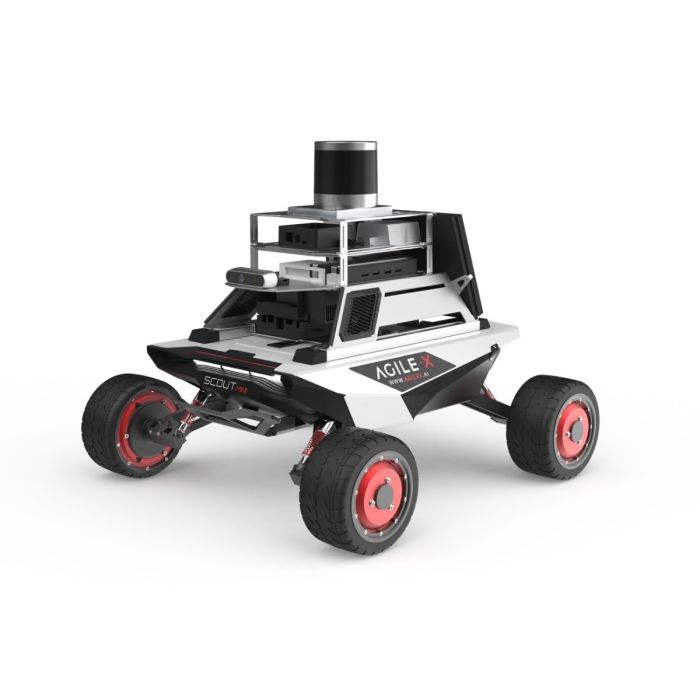
Most mobile robotics projects lose their first weeks before the robot has moved at all. The chassis arrives, and then comes the slow work of mounting sensors, locating drivers, preparing a computer and persuading every component to communicate with every other. The Agilex SCOUT MINI R&D KIT (SCOUT MINI R&D KIT) is designed to remove those weeks. It takes the SCOUT MINI mobile robot and supplies it with a camera, a 360° LiDAR and a pre-installed NVIDIA Jetson Nano computer, so that a laboratory's first afternoon with the robot can be spent building a map rather than studying a wiring diagram.
Robots Europa, based in Dublin, supplies the SCOUT MINI R&D KIT to universities, research institutes, schools and engineering teams across the European Union and the DACH region. Robots Europa prepares each quotation, arranges delivery to your institution and remains your point of contact for technical questions and support once the kit is in service.
Background
AgileX and the SCOUT MINI base
AgileX builds mobile robot platforms – wheeled and tracked chassis, development kits and manipulation systems – intended for research, teaching and applied development. The wider range is gathered in the AgileX category. The SCOUT MINI is the compact mobile robot within that family, and it is the foundation of this kit. Rather than designing a new vehicle for research users, AgileX has taken an existing, proven base and equipped it with the perception and computing hardware a research group would otherwise have to select, mount and configure itself.
From chassis to research platform
The distinction between a robot chassis and a research platform lies almost entirely in integration. A bare chassis moves; a research platform perceives, computes and can be programmed from the first day. The SCOUT MINI R&D KIT closes that gap with an onboard NVIDIA Jetson Nano, a camera and a 360° LiDAR, and with sensor drivers that are already installed. It is compatible with Gazebo, NoMachine and Viz: in general terms, a simulator in which algorithms can be developed before they run on hardware, remote desktop access to the onboard computer, and visualisation of sensor data and robot state. Integration spaces on the platform allow further sensors to be added as a project grows, so the kit can follow a research programme rather than constrain it.
Technical Specifications
| Specification | SCOUT MINI R&D KIT | SCOUT MINI R&D PRO |
|---|---|---|
| Base platform | SCOUT MINI mobile robot | SCOUT MINI mobile robot |
| Onboard computer | NVIDIA Jetson Nano, pre-installed | Nvidia AGX Xavier |
| CPU | – | 64-bit ARM v8.2 |
| GPU | – | Tensor Core Volta |
| Memory | – | 32 GB LPDDR4x |
| AI performance | – | Up to 32 TOPS |
| Operating power | – | As little as 10 W |
| Operating system | – | Pre-installed Linux and ROS Ubuntu 18.4 |
| Sensors | Camera and 360° LiDAR | 16-beam 3D 360° LiDAR (VLP -16), horizontal and vertical scanning |
| LiDAR maximum range | – | 150 meters |
| Sensor drivers | Pre-installed | – |
| Sensor expansion | Integration spaces for additional sensors | – |
| Compatible tools | Gazebo, NoMachine, Viz | – |
| Intended applications | Indoor SLAM, navigation and vision | High-performance applications |
Specifications are as published by the manufacturer and are confirmed against the datasheet at quotation.
The manufacturer has not published the dimensions, weight, maximum speed, payload, battery capacity, runtime, IP rating, operating temperature or the full contents of the box for this version; Robots Europa confirms these at quotation.
What does the SCOUT MINI R&D PRO add over the R&D KIT?
The two versions share the SCOUT MINI base but are aimed at different computational ambitions, and their figures belong strictly to their own version. The SCOUT MINI R&D KIT relies on the NVIDIA Jetson Nano, a computer well suited to indoor SLAM, navigation and vision work, and to teaching environments in which students need a capable but approachable system. Its sensor set of a camera and a 360° LiDAR covers the perception that these tasks typically require.
The SCOUT MINI R&D PRO moves to an Nvidia AGX Xavier, with a 64-bit ARM v8.2 CPU, a Tensor Core Volta GPU and 32 GB of LPDDR4x memory. It delivers up to 32 TOPS and can operate in as little as 10 W. The PRO also changes the perception hardware: a VLP -16, a 16-beam 3D 360° LiDAR scanning both horizontally and vertically, with a maximum range of 150 meters. It ships with pre-installed Linux and ROS Ubuntu 18.4. In short, the PRO is intended for work in which three-dimensional point clouds and heavier onboard inference are central, while the R&D KIT addresses the large body of indoor research and teaching in which those resources would remain largely unused.
How much integration work does the R&D KIT leave to the buyer?
Far less than a self-assembled platform. The camera and LiDAR are already part of the system, the sensor drivers are pre-installed and the Jetson Nano is in place, so the usual sequence of selecting brackets, routing cables and resolving driver conflicts is not part of the project. Compatibility with Gazebo means that algorithms can be developed and tested in simulation before they run on the physical robot, NoMachine provides remote access to the onboard computer, and Viz supports inspection of what the robot perceives.
What remains is the work that actually constitutes research: the mapping strategy, the navigation stack, the vision pipeline and the experiments themselves. Where a project later needs additional perception, the integration spaces allow further sensors to be mounted without redesigning the platform. For procurement teams, Robots Europa handles the remaining practical questions as part of the quotation.
Who is the SCOUT MINI R&D KIT for?
The first group is educators. Universities, technical colleges and training centres that teach mobile robotics need a platform on which students can reach meaningful results within a semester; a kit with pre-installed drivers and an onboard computer allows lessons to focus on SLAM, path planning and perception rather than on assembly.
The second group is academic researchers. Doctoral candidates and research groups working on indoor localisation, mapping, navigation or computer vision benefit from a consistent, reproducible hardware base, and the compatibility with simulation tools supports the common workflow of developing in simulation and validating on hardware.
The third group is development teams carrying out rapid prototyping. Start-ups and corporate innovation departments that need to demonstrate an autonomous indoor concept quickly can use the kit as a ready-made testbed and add their own sensors through the integration spaces.
Groups whose work centres on long-range three-dimensional perception or computationally demanding onboard inference should consider the SCOUT MINI R&D PRO, whose Xavier computer and 16-beam LiDAR are intended for high-performance applications. Teams whose projects call for a different chassis type altogether can compare the other platforms in the AgileX range with Robots Europa before deciding.
What is the SCOUT MINI R&D KIT used for?
- Indoor SLAM: building maps of laboratories, corridors and buildings while localising the robot within them.
- Autonomous navigation: developing and testing path planning and obstacle avoidance in indoor environments.
- Computer vision: using the onboard camera for detection, recognition and visual perception experiments.
- Robotics education: giving students hands-on experience with a complete, working mobile robot system.
- Academic research: providing a reproducible hardware base for publications, theses and comparative studies.
- Rapid prototyping: validating an autonomous indoor concept before investing in a dedicated platform.
Pricing and Availability
Robots Europa supplies the SCOUT MINI R&D KIT on the basis of an individual quotation, which allows the configuration and any additional sensors to be agreed before an order is placed. Delivery, customs and support are arranged together with the quotation. Institutions that need documentation for internal procurement or grant applications can request it at the same time. To begin, please use the quotation request available on this page.
Frequently Asked Questions
Which computer is installed in the SCOUT MINI R&D KIT?
The kit comes with a pre-installed NVIDIA Jetson Nano. The more powerful Nvidia AGX Xavier belongs to the SCOUT MINI R&D PRO.
Which sensors does the kit include?
The platform features a camera and a 360° LiDAR for exploration. The sensor drivers are pre-installed, so the sensors can be used from the outset.
Can additional sensors be fitted?
Yes. The platform provides integration spaces for additional sensors. Robots Europa can discuss the intended sensors as part of the quotation.
Which software tools is the kit compatible with?
The kit is compatible with Gazebo, NoMachine and Viz, which support simulation, remote access and visualisation respectively.
Is the SCOUT MINI R&D KIT suitable for outdoor use?
The kit is presented as ideal for indoor SLAM, navigation and vision applications. If you are planning an outdoor deployment, Robots Europa will advise you as part of the quotation.
How does the R&D KIT differ from the R&D PRO?
The R&D KIT uses a Jetson Nano with a camera and a 360° LiDAR for indoor research and teaching. The R&D PRO uses an Nvidia AGX Xavier and a VLP -16 16-beam 3D LiDAR for high-performance applications.
Where can I buy the SCOUT MINI R&D KIT and what does it cost?
Robots Europa supplies the kit across the EU and the DACH region. The cost is set out in an individual quotation, which you can request from this page.
Summary
The value of the SCOUT MINI R&D KIT lies in the weeks it gives back. Instead of a chassis that must first be turned into a robot, a research group or classroom receives the SCOUT MINI with a camera, a 360° LiDAR, a pre-installed Jetson Nano and ready drivers, together with compatibility with Gazebo, NoMachine and Viz and space for further sensors. That makes it a direct route into indoor SLAM, navigation and vision work, while the SCOUT MINI R&D PRO remains the option for projects that need three-dimensional long-range perception and greater onboard computing power. For institutions in the EU and the DACH region that would rather spend their time on experiments than on integration, this page is the starting point.


