
Agilex Piper Lightweight Robotic Arm
In stock
- BRAND:
- AGILEX
- PART #:
- PiPER
- ORIGIN:
- China
- AVAILABILITY:
- SUBJECT TO AVAILABILITY
- SKU:
- AgileX-PiPER
Agilex Piper Lightweight Robotic Arm
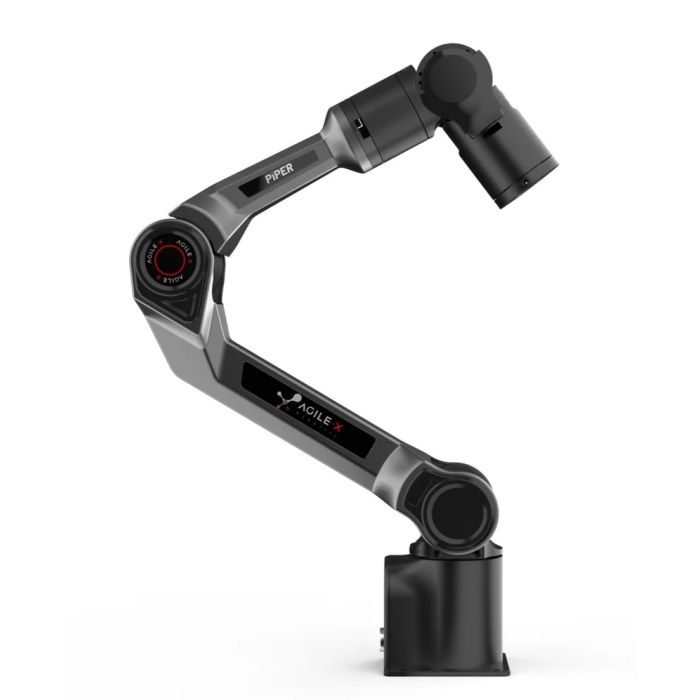
Most six-axis arms arrive crated, bolted to a pedestal and fenced off from the people who programme them. This one can be carried across the lab by one person and set on a bench beside the workstation that controls it. The Agilex Piper Lightweight Robotic Arm turns articulated manipulation from a facilities project into a desk-side tool. Researchers, teachers and integrators can move a joint by hand, record the path and replay it, or drive the arm from a Python script or a ROS node, without first building a cell around it.
Robots Europa supplies PiPER from Dublin to customers throughout the European Union and the DACH region. Robots Europa prepares each quotation, arranges delivery to your institution or company, and remains your point of contact for technical questions and support once the arm is in use.
Background
AgileX and its development platforms
AgileX Robotics is best known for mobile robot chassis and development kits aimed at research, education and prototyping. Its range listed under AgileX covers wheeled and tracked platforms as well as kits that pair mobile bases with manipulators. PiPER brings the same approach to the robotic arm: hardware that a development team can unpack, connect and begin programming against open interfaces, rather than a closed industrial system that needs a specialist to commission it.
Integrated joints and an integrated controller
PiPER is a lightweight robotic arm with six integrated joint motors for smooth, precise control. The controller is integrated into the arm as well, so there is no separate control cabinet to house and cable. Outside the arm, there is one power connection and one CAN connection. The structure combines an aluminium alloy body with a polymer shell, which keeps the arm light while giving it a rigid frame. This design places PiPER among the compact arms covered in our Cobots category. These arms are generally chosen when a laboratory, classroom or mobile platform needs manipulation but cannot accommodate a full-size industrial robot.
Technical Specifications
| Specification | Value |
|---|---|
| Degrees of freedom | 6 |
| Weight | 4.2kg |
| Payload | 1.5kg |
| Reach | 626 mm |
| Repeatability | ± 0.1 mm |
| Operating temperature | -20℃ to 50℃ |
| Input voltage | DC24V |
| Material | Aluminium alloy body, polymer shell |
| Controller | Integrated |
| Communication | CAN |
| External interface | Power*1, CAN*1 |
| Programming | Drag Teaching / Offline Trajectory / API / PC |
| Software support | Python API; ROS1 and ROS2 |
| User interface | Tablet-based interface for building and controlling applications |
| Base installation dimensions | 70mm*70mm*M5*4 |
Specifications are as published by the manufacturer and are confirmed against the datasheet at quotation.
The manufacturer has not published the IP rating, maximum joint speed, joint range of motion, power consumption, overall dimensions, box contents or whether a gripper is included; these details are confirmed at quotation.
How is PiPER programmed and integrated?
PiPER offers four programming routes, so the same arm can serve a first-year student and an experienced robotics engineer. With drag teaching, the user guides the arm through a movement by hand and the arm records it. This is the quickest way to demonstrate a task without writing any code. Offline trajectory programming lets a path be prepared in advance and then executed. API and PC control open the arm to custom software.
For developers, PiPER can be controlled through a Python API and supports both ROS1 and ROS2. Teams with an existing ROS codebase can therefore bring the arm into their current stack, while teams starting from scratch can write directly in Python. Communication runs over CAN, a robust bus that is common in mobile robotics and automotive electronics. For users who prefer not to start with code, a tablet-based interface is provided for building and controlling applications.
Integration is simple at the hardware level. The integrated controller means the arm needs only its DC24V supply and a CAN connection. The base is mounted using a 70mm*70mm*M5*4 pattern, which is straightforward to replicate on a bench plate, a trolley or the top deck of a mobile platform.
What does a lightweight arm change in practice?
At 4.2kg, PiPER is light enough to reposition between experiments, take into a lecture theatre or mount on a mobile robot without an elaborate support structure. Weight matters a great deal on a mobile base, where every kilogram of arm reduces the capacity left for batteries, sensors and the object being handled.
A light arm has to remain useful, and its figures show what PiPER offers. It supports a stable payload of 1.5kg, reaches 626 mm and has a repeatability of ± 0.1 mm. That combination suits pick-and-place of small parts, laboratory handling, demonstration tasks and the repeated trials that learning-based research depends on. The operating range of -20℃ to 50℃ extends its use beyond the climate-controlled laboratory to workshops, unheated buildings and outdoor test sites.
Who is the Agilex Piper Lightweight Robotic Arm for?
Universities and research institutes form the first group. Laboratories working on manipulation, embodied AI, imitation learning or human–robot interaction need an arm they can programme openly and run for long periods. PiPER's ROS1 and ROS2 support and its Python API allow it to fit into the toolchains these groups already use.
Educators are the second group. Schools, colleges and training centres teaching robotics can use drag teaching to introduce motion concepts before moving students on to code. The arm's low weight makes it practical to set up and pack away between sessions.
System integrators and engineering teams building prototypes form the third group. A compact arm with an integrated controller and a CAN interface can be mounted on mobile bases, test rigs and proof-of-concept cells while a project's requirements are still taking shape.
PiPER comes in three versions: Basic, Gripper and Pendant. If your application needs an end effector or a separate teaching device, describe it in your quotation request and Robots Europa will recommend the version that matches it.
What is PiPER used for?
- Robotics teaching — Students learn kinematics and programming on a real six-axis arm, starting with hand-guided motion.
- Manipulation research — Laboratories test grasping, planning and control algorithms through ROS1, ROS2 or Python.
- Embodied AI and data collection — Teams use drag teaching to record demonstrations that become training data for learning-based control.
- Mobile manipulation — The compact base pattern and low weight suit mounting on a mobile robot platform.
- Light pick-and-place — Small parts and samples within the arm's payload are moved between fixed positions on a bench.
- Prototyping and demonstration — Integrators show an automation concept to stakeholders before committing to industrial hardware.
Pricing and Availability
Robots Europa supplies PiPER on quotation, so that the version, configuration and any accessories can be matched to your project before you order. Delivery, customs and support are arranged with the quotation. When you contact us, please state which version you are considering and describe your intended application, so that we can match the configuration to your requirements. To begin, use the quotation request available on this page.
Frequently Asked Questions
Does PiPER support ROS2?
Yes. PiPER supports both ROS1 and ROS2, and it can also be controlled through a Python API.
How much can PiPER carry?
PiPER supports a stable payload of 1.5kg, and the arm itself weighs 4.2kg.
How is PiPER mounted?
The base installation dimensions are 70mm*70mm*M5*4. Robots Europa can advise on mounting the arm to a particular platform or fixture.
Can PiPER be programmed without writing code?
Yes. Drag teaching lets you guide the arm by hand to record a movement, and a tablet-based interface is provided for building and controlling applications.
Which versions of PiPER are available?
PiPER is offered in Basic, Gripper and Pendant versions. Tell Robots Europa about your application and we will recommend the version that fits it.
What power supply does PiPER need?
PiPER uses a DC24V input and has one power interface and one CAN interface.
Where can I buy the Agilex Piper Lightweight Robotic Arm and what does it cost?
Robots Europa supplies PiPER across the EU and the DACH region. Pricing is provided by quotation, so please submit a request on this page with your preferred version and application.
Summary
PiPER takes the six-axis arm out of the fenced industrial cell and puts it within reach of the people who programme it. It weighs 4.2kg, carries a stable 1.5kg, reaches 626 mm and repeats to ± 0.1 mm. Its controller is integrated and it connects over a single CAN link. Drag teaching, offline trajectories, a Python API and ROS1 and ROS2 support give students, researchers and integrators a choice of how to work with it. To match the right version to your project, with delivery and support from Robots Europa, this page is the starting point.


