
Agilex HUNTER SE (HUNTER SE)
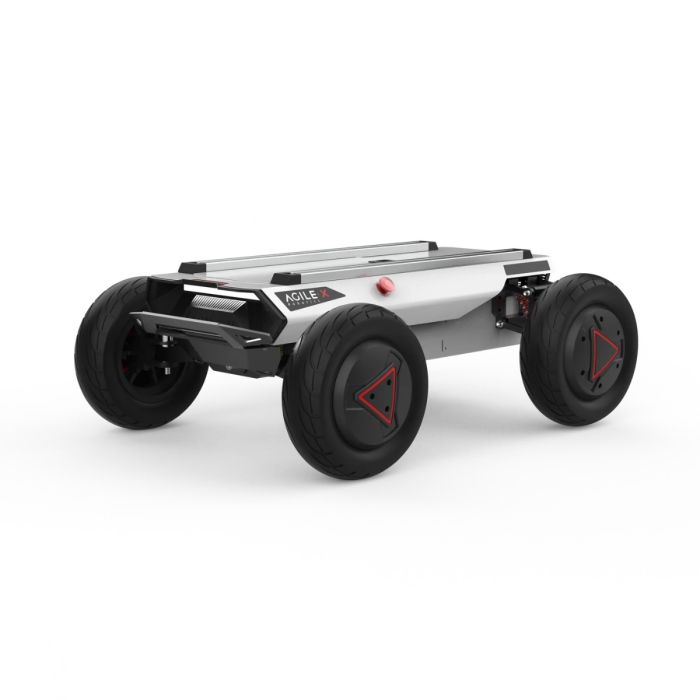
In stock
- BRAND:
- AGILEX
- PART #:
- HUNTER SE
- ORIGIN:
- China
- AVAILABILITY:
- SUBJECT TO AVAILABILITY
- SKU:
- AgileX-HUNTER-SE
Agilex HUNTER SE (HUNTER SE)
A robot that pivots on the spot is well suited to a warehouse aisle, but a street asks for something different: a vehicle that holds its line at pace, steers through a bend the way a car does, and behaves predictably enough for a planning algorithm to trust it. The Agilex HUNTER SE (HUNTER SE) is built around that second requirement. It is an Ackermann steering wheeled robot designed for the challenging road conditions and speed requirements of urban areas, giving development teams car-like driving capabilities for high speed autonomous applications without the cost and complexity of converting a full-size vehicle.
Robots Europa, based in Dublin, sells the HUNTER SE to universities, research institutes, integrators and companies across the EU and the DACH region. Robots Europa prepares each quotation, arranges delivery to the customer's site and remains the point of contact for technical support after the platform is in service.
Background
AgileX Robotics and the HUNTER series
Founded in 2016, AgileX Robotics is committed to advancing embodied intelligence innovation and accelerating the global commercialisation of robotics through its full-stack robotic technologies and open-source ecosystem. Its range covers wheeled and tracked mobile chassis, development kits and collaborative manipulation systems, all of which are intended to be extended by the customer rather than used as closed products. The HUNTER series is the part of that range that follows automotive geometry, and the HUNTER SE power system has upgraded the sleek design of the series with an all-steel body. You can browse the wider manufacturer range in our AgileX category.
Positioning: a road-going development base
The HUNTER SE features the latest wheeled motor structure technology, offering a speed of 4.8 m/s, driven by two 350 W brushless DC motors and powered by a 24V30Ah lithium battery. It is not designed for all-terrain work; instead, its swing arm suspension lets it pass common obstacles such as speed bumps, which is precisely what campus roads, business parks and urban test routes present. Its modular design allows easy reconfiguration and adaptability, so the same chassis can serve different functions over the life of a project, while aluminium T-slot rails provide secure mounting for external sensors or kits.
Technical Specifications
| Specification | Value |
|---|---|
| Product type | Ackermann steering wheeled robot |
| Speed | 4.8 m/s |
| Maximum load | 50 KG |
| Platform weight | 42Kg |
| Ground clearance | 120 mm |
| Minimum turning radius | 1.9m |
| Motors | 350W*2 (Brushless DC motor) |
| Battery | 24V30Ah Lithium Battery |
| Body | All-steel |
| Suspension | Swing arm |
| Mounting | Aluminium T-slot rails |
| Communication interface | CAN bus |
| CAN standard | CAN2.0B, baud rate 500K, MOTOROLA message format |
| CAN control | Linear velocity and steering angle |
| ROS compatibility | ROS1 / ROS2 |
| Software | Open-source SDK and software resources |
| Water resistance | Not waterproof |
Specifications are as published by the manufacturer and are confirmed against the datasheet at quotation.
The manufacturer has not published the dimensions, IP rating, runtime, climbing ability, charging time, box contents, certifications or onboard sensors of the HUNTER SE; these are confirmed at quotation.
Why choose Ackermann steering over a skid-steer chassis?
Skid-steer and differential-drive platforms turn by driving the wheels on each side at different speeds, which makes them agile in confined spaces but introduces wheel slip that a motion model must account for. Ackermann geometry, the arrangement used in most road cars, steers the wheels so that each follows its own arc through a turn. For teams developing autonomous driving software, this has a practical consequence: the kinematics of the robot resemble those of the vehicles the software is ultimately meant for, so path planners, trajectory controllers and localisation pipelines can be tested on a platform whose behaviour translates more directly to full-scale cars.
The trade-off is manoeuvrability. The HUNTER SE has a minimum turning radius of 1.9m, so it cannot rotate in place, and routes must be planned with that radius in mind. In return, its speed of 4.8 m/s and its swing arm suspension suit it to paved environments where a vehicle is expected to keep moving. Where a project calls for rough ground, gravel or slopes, the tracked platforms in the AgileX range are the more appropriate starting point, because the HUNTER SE is not designed for all-terrain use.
How does the HUNTER SE integrate with existing software?
Integration runs through the CAN bus. The CAN communication standard adopts CAN2.0B at a baud rate of 500K, with messages in MOTOROLA format, and the linear velocity and steering angle of the chassis can be controlled through the external CAN bus interface. That gives a clear, low-level boundary between the chassis and the customer's onboard computer: the computer decides how fast to go and where to steer, and the chassis executes those commands.
Above that layer, the platform is compatible with ROS1 and ROS2, and AgileX provides an open-source SDK and software resources for expanded capabilities. In practice, teams can bring existing ROS navigation stacks, simulation work and sensor drivers to the HUNTER SE rather than starting from scratch. The aluminium T-slot rails complete the picture on the mechanical side, allowing lidar, cameras, computing units or third-party kits to be fixed securely and rearranged as the sensor configuration evolves. Because no onboard sensors are listed in the published specification, buyers should plan the perception hardware as part of the project and confirm the exact supplied configuration with Robots Europa.
Who is the HUNTER SE for?
The first group is autonomous driving research: university laboratories and research institutes that need a vehicle with car-like kinematics to validate planning and control algorithms before moving to full-size cars. The HUNTER SE gives them a road-capable test vehicle that fits within a laboratory budget and can be operated on a campus.
The second group is product development teams working on last-mile delivery, unmanned logistics or site patrol. For them, the maximum load of 50 KG, the all-steel body and the modular design provide a base on which to build an early prototype, carry sensors and computing equipment, and iterate on the top structure without redesigning the drivetrain.
The third group is system integrators and engineering service providers who build bespoke mobile solutions for clients. The open CAN interface, ROS1 / ROS2 compatibility and open-source SDK let them treat the HUNTER SE as a dependable component within a larger system.
The platform is less suited to buyers whose work takes place on unpaved terrain or in wet conditions. The HUNTER SE is not waterproof and not designed for all-terrain driving; teams with those requirements should review the tracked chassis in the AgileX category, where Robots Europa can advise on the most suitable model.
What is the HUNTER SE used for?
- Autonomous driving research — testing planning, control and localisation algorithms on a platform with automotive steering geometry.
- Last-mile delivery prototyping — developing and demonstrating delivery robots on pavements, campus paths and private roads.
- Campus and site patrol — carrying cameras and sensors along fixed routes on paved industrial or institutional sites.
- Mapping and data collection — gathering lidar and camera datasets along road-like routes at driving speed.
- Sensor and perception testing — mounting new sensor configurations on the T-slot rails to evaluate them in motion.
- Robotics education — teaching mobile robot kinematics, ROS development and CAN-based vehicle control.
Pricing and Availability
Robots Europa supplies the HUNTER SE on a quotation basis, so that the offer reflects the configuration, accessories and support your project actually requires. Delivery, customs and technical support are arranged together with the quotation. Tell us about your application, your sensor plans and your delivery location, and we will confirm the specification against the current datasheet before you commit. To begin, use the quotation request available on this page.
Frequently Asked Questions
What load can the HUNTER SE carry?
The maximum load of the HUNTER SE is 50 KG. The platform itself weighs 42Kg.
Can the HUNTER SE be used off-road?
The HUNTER SE is not designed for all-terrain use. Its swing arm suspension allows it to pass common obstacles such as speed bumps, which suits paved roads and campus routes.
Is the HUNTER SE waterproof?
No, the HUNTER SE is not waterproof and should be kept out of wet conditions. An IP rating has not been published.
Does the HUNTER SE support ROS?
Yes, the platform is compatible with ROS1 and ROS2, and AgileX provides an open-source SDK and software resources.
How is the chassis controlled?
The linear velocity and steering angle are controlled through the external CAN bus interface, which uses the CAN2.0B standard at 500K with MOTOROLA message format.
Can I mount my own sensors?
Yes. Aluminium T-slot rails provide secure mounting for external sensors or kits, and the modular design allows the platform to be reconfigured for different functions.
Where can I buy the Agilex HUNTER SE (HUNTER SE) and what does it cost?
You can buy the HUNTER SE from Robots Europa, which supplies customers across the EU and the DACH region. The cost depends on configuration and delivery, so we provide it in a tailored quotation on request.
Summary
The HUNTER SE answers a specific question: how to give an autonomous system a body that drives like a car rather than turns like a tank. Ackermann steering, a speed of 4.8 m/s, an all-steel body and swing arm suspension make it a credible road-going test vehicle, while CAN bus control, ROS1 / ROS2 compatibility, the open-source SDK and T-slot rails make it an open foundation for your own sensors and software. It belongs on paved routes rather than rough ground, and it rewards teams who want their research to carry over to real vehicles. If your next project needs that kind of platform from Robots Europa, this page is the starting point.


