
Agilex PIKA (PIKA)
In stock
- BRAND:
- AGILEX
- PART #:
- PIKA
- ORIGIN:
- China
- AVAILABILITY:
- SUBJECT TO AVAILABILITY
- SKU:
- AgileX-PIKA
Agilex PIKA (PIKA)
Most robot-learning projects do not stall on the model. They stall on the demonstrations: hours of careful, repeatable human motion that has to be captured with enough fidelity for a machine to learn from it. A skilled operator can fold a cloth or insert a connector in seconds, yet turning that gesture into usable training data has traditionally meant motion-capture studios, awkward teleoperation rigs or long calibration sessions. The Agilex PIKA (PIKA) takes the opposite route. It puts the sensing into the hand, so that the person demonstrating a task carries the instrument that records it, and the same gripper design can later sit on a robot arm to reproduce what was shown.
Robots Europa, based in Dublin, sells and supplies the Agilex PIKA (PIKA) to universities, research institutes and industrial development teams across the European Union and the DACH region. Robots Europa prepares each quotation for the configuration you need, arranges delivery to your laboratory or site, and provides support once the system is in use.
Background
AgileX Robotics and its lineage
The PIKA is made by AgileX Robotics CO,.ltd., a Chinese manufacturer whose wider catalogue is available through our AgileX range, from tracked mobile platforms to manipulation kits for research. That background matters for a data-collection product: a company that builds the robots on which learned behaviours are eventually deployed has a direct interest in making the capture side compatible with standard robotics software. The PIKA reflects this, with support for ROS1 and ROS2 environments across the versions the sources describe.
Handheld capture for embodied learning
The PIKA belongs to a class of tools built around the idea of the universal manipulation interface, or UMI: a handheld gripper that mirrors the geometry of a robot end effector, so that a human demonstration and a robot execution share the same point of view. AgileX describes the Pika Pro as a compact, versatile data collection system for indoor and outdoor operation, capturing egocentric data and information from UMI-based handheld grippers. In practice this means the recorded images, depth and motion are seen from the perspective of the tool rather than from a fixed camera in the corner of the room, which is the perspective a learning policy will eventually have on the robot.
Technical Specifications
The sources describe two versions: the Pika Pro and the Pika (Package: Gripper, Sense & Station). Each figure below stays with the version for which it is published.
| Specification | Pika Pro | Pika (Package: Gripper, Sense & Station) |
|---|---|---|
| Pika Gripper spatial positioning accuracy | ±1.5 mm | — |
| Pika Gripper gripping force | up to 2 kg | max force 2 kg |
| Pika Gripper type and jaw range | — | two-finger, 0–95 mm range |
| Pika Gripper dimensions | — | 215 × 191 × 143 mm |
| Pika Gripper weight | — | 690 g |
| Pika Sense dimensions | — | 215 × 220 × 257 mm |
| Pika Sense weight | 460g | 550 g |
| Depth camera | — | FOV 87° × 58°, accuracy ±2% at 50 cm, 90 FPS |
| Wide-angle camera | — | diagonal FOV 200°, 90 FPS |
| IMU | — | 9-axis, 100 Hz |
| Pika Station battery life | — | up to 30 hours |
| Pika Station tripod | — | max height 2.1 m, adjustable tilt |
| Software support | ROS1, ROS2 and URDF | ROS1/ROS2 |
| Interface | Type-C | — |
Specifications as published by the manufacturer; confirmed against the datasheet at quotation.
The manufacturer has not published the dimensions or weight of the Pika Station, any specifications for the Pika EGO headset, the storage capacity of the Pika Package, the power requirements, the operating temperature range, the IP rating or the wireless connectivity; these are confirmed at quotation.
What does the Pika Pro add to the standard Pika package?
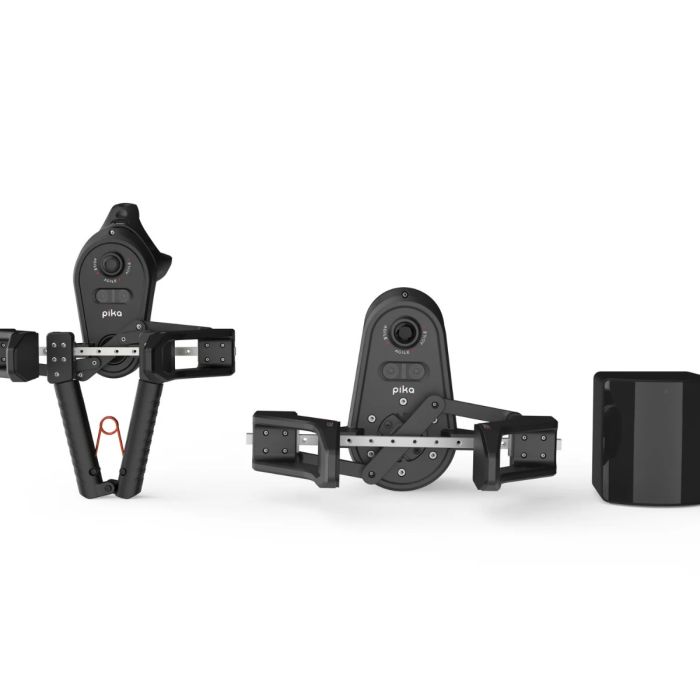
The standard Pika is built around three pieces of hardware. The Pika Gripper is a two-finger end effector with a 0–95 mm jaw range, carrying a depth camera, a wide-angle camera with a diagonal field of view of 200° and a 9-axis IMU. The Pika Sense is the handheld counterpart the operator uses during demonstrations, and the Pika Station supports the set-up on a tripod reaching 2.1 m with adjustable tilt, with battery life of up to 30 hours for long recording days.
The Pika Pro is described as a fuller data-collection system. Its Pika Gripper achieves ±1.5 mm spatial positioning accuracy with up to 2 kg of gripping force and delivers 6D spatial data, RGB imagery, depth and IMU outputs. The Pika Sense in the Pro is a lightweight, ergonomically designed hand-held unit of 460g. Two further elements appear in the Pro material: the Pika EGO, a first-person headset for synchronised egocentric data collection that outputs both depth and RGB streams, and the Pika Package, the computing and storage core of the system, which handles data processing, storage and scheduling.
The Pro is also positioned around workflow rather than hardware alone. It operates without calibration and is built to stay reliable with weak textures, in low light and amid distractions. An integrated system takes data from collection through management and annotation to training, with support for multi-device collaboration and task management. For a team that intends to run many capture sessions with several operators, those workflow features are often as decisive as any sensor figure.
How does the Agilex PIKA fit into a ROS-based workflow?
Both versions are compatible with ROS1 and ROS2 environments, which lets recorded topics feed directly into the tools most robotics laboratories already use for visualisation, logging and replay. The Pika Pro additionally supports URDF through a Type-C interface, so the gripper can be described in a robot model and deployed across different robotic platforms without a bespoke driver layer. For research groups this shortens the path from a recorded demonstration to a policy running on hardware; for industrial teams it means the capture tool does not lock them into a single arm supplier.
Who is Agilex PIKA (PIKA) for?
The first audience is academic: robotics and machine-learning groups working on imitation learning, embodied intelligence and dexterous manipulation, who need a repeatable way to build datasets without dedicated motion-capture facilities. The standard Pika package suits groups whose priority is the gripper, its cameras and its IMU, with a tripod-mounted station for structured sessions.
The second audience is industrial research and development: teams teaching robots assembly, handling or packing tasks from human examples, often in real workspaces rather than laboratories. Here the Pika Pro is the better fit, because its calibration-free operation, resilience in difficult lighting, egocentric headset and integrated data pipeline are aimed at frequent, multi-operator collection in changing environments.
A third audience is organisations building complete manipulation platforms, which can pair the PIKA with arms and mobile bases from the wider AgileX range. Robots Europa can advise on which version matches the scale and setting of your project.
What is Agilex PIKA (PIKA) used for?
- Imitation learning datasets — recording human demonstrations from the gripper's point of view to train manipulation policies.
- Embodied AI research — combining RGB, depth and inertial streams into multimodal training data for robots that act in the physical world.
- Robot end-effector execution — mounting the gripper on an arm to reproduce and evaluate tasks learned from demonstrations.
- Egocentric capture — using the Pika EGO headset of the Pro to record a first-person view in step with hand motion.
- Field data collection — gathering manipulation data indoors and outdoors, away from fixed capture studios.
- Dataset management and annotation — organising, labelling and preparing recordings for training within the Pro's integrated workflow.
Pricing and Availability
Robots Europa supplies the Agilex PIKA (PIKA) on quotation, so that the version, the components and any accompanying robot hardware reflect your project rather than a fixed bundle. Delivery, customs and support are arranged with the quotation. To receive a tailored offer for your laboratory or facility in the EU or the DACH region, use the quotation request available on this page.
Frequently Asked Questions
What is the difference between the Pika Pro and the standard Pika?
The standard Pika comprises the Gripper, Sense and Station. The Pika Pro is described as a complete data-collection system that adds the Pika EGO headset, the Pika Package computing and storage core, calibration-free operation and an integrated workflow from collection to training.
What data does the Pika Gripper record?
On the Pika Pro, the gripper delivers 6D spatial data, RGB imagery, depth and IMU outputs. The standard version carries a depth camera, a wide-angle camera and a 9-axis IMU running at 100 Hz.
How much can the gripper hold?
Both versions list a gripping force of up to 2 kg. The standard Pika Gripper is a two-finger design with a 0–95 mm jaw range.
Does the PIKA need calibration before each session?
The Pika Pro operates without calibration and is built to remain reliable with weak textures, in low light and amid distractions.
Is the PIKA compatible with ROS?
Yes. Both versions support ROS1 and ROS2, and the Pika Pro also supports URDF through a Type-C interface.
Can the PIKA be used outdoors?
The Pika Pro is described as engineered for both indoor and outdoor environments. No IP rating or operating temperature range has been published, so Robots Europa confirms suitability for your conditions at quotation.
Where can I buy the Agilex PIKA (PIKA) and what does it cost?
Robots Europa supplies the Agilex PIKA (PIKA) across the EU and the DACH region. Pricing depends on the version and configuration and is provided in a tailored quotation.
Summary
Teaching a robot by example only works when the example is captured well, and the Agilex PIKA (PIKA) moves that capture into the operator's hand. The standard Pika package combines a two-finger sensing gripper, a handheld Sense unit and a tripod station built for long sessions; the Pika Pro widens this into a full system with an egocentric headset, a computing and storage core, calibration-free operation and a pipeline from recording to training. Both speak ROS, and both are designed so that what a person demonstrates can be replayed by a robot from the same perspective. For laboratories and development teams that want their demonstrations to become data with less friction, this page is the starting point.


