
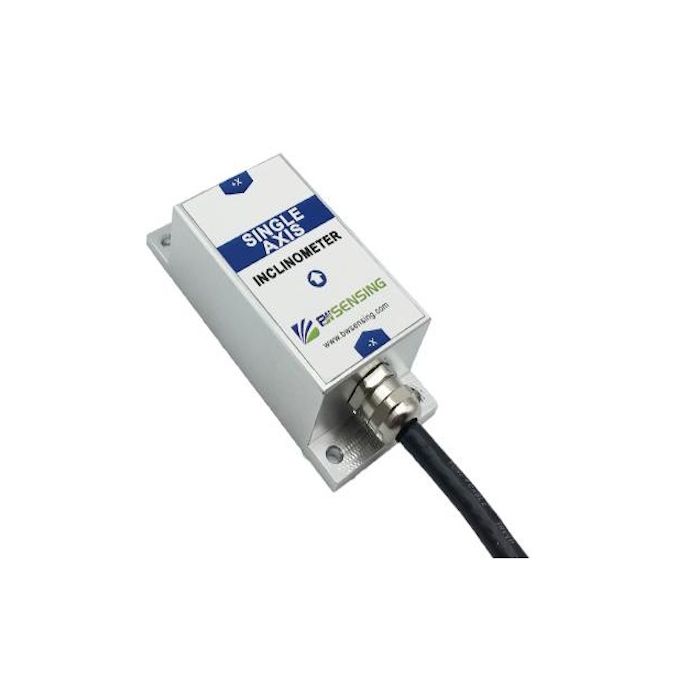
BWSENSING Inclinometer (BWK218)
In stock
- BRAND:
- BWSENSING
- PART #:
- BWK218
- ORIGIN:
- China
- AVAILABILITY:
- SUBJECT TO AVAILABILITY
- SKU:
- BWSENSING-BWK218
BWSENSING Inclinometer (BWK218)
Fieldbuses multiply and protocols change, yet in a great many plants the signal that reaches the controller most dependably is still a simple loop of current. The BWSENSING Inclinometer (BWK218) is built for that reality. It reads the tilt of whatever it is fixed to and expresses it as an analogue current that a PLC, a data logger or a panel indicator can accept without a driver, a protocol stack or a configuration session. For engineers who would rather spend commissioning time on the machine than on the sensor interface, that directness is the whole argument.
Robots Europa, based in Dublin, sells the BWK218 and supplies it to customers throughout the European Union and the DACH region. Robots Europa prepares quotations for single units and for project quantities, arranges delivery to your site and supports you with selection and integration questions, so that the output option and the mounting arrangement suit your application before the order is placed.
Background
Bewis Sensing Technology and the BWSENSING range
The BWK218 is designed by Bewis Sensing Technology LLC and sold under the BWSENSING brand. It belongs to a wider family of inclinometers that share a common idea, namely tilt measurement built on MEMS sensing, but which differ in the number of axes they measure and in the way they report the result. Some members of the family use digital interfaces such as Modbus or CAN, and some measure two axes. The BWK218 occupies the single-axis, current-output position within that family, which makes it the natural choice where the receiving equipment expects an analogue loop rather than a bus. You can browse the whole family in our BWSensing category.
MEMS sensing in a current-loop housing
At the heart of the BWK218 is an industrial-level MEMS accelerometer. An accelerometer of this kind senses the component of gravity acting along its measuring axis, and from that component the sensor derives an angle of inclination. Because the reference is gravity itself, the reading is an absolute tilt angle rather than a relative change, which is what levelling, alignment and structural monitoring tasks require. The BWK218 then converts that angle into a current signal, selectable as 4-20mA, 0-20mA or 0-24mA, and packages the electronics in an IP67 enclosure rated for a working temperature of -40℃~+85℃. Current signals of this type are widely used in industry because they tolerate electrical noise and long cable runs better than voltage signals, and because a live zero, as in the 4-20mA option, lets the receiving system distinguish a genuine reading from a broken wire.
Technical Specifications
| Specification | Value |
|---|---|
| Product type | Current output low cost single-axis inclinometer, industrial level MEMS accelerometer |
| Measuring range | ±180° |
| Highest accuracy | 0.2° |
| Resolution | 0.02° |
| Output | 4-20mA/0-20mA/0-24mA optional |
| Zero-point current output | 10 (0-20); 12 (4-20); 12 (0-24) |
| Power supply | 12-36V |
| Working temperature | -40℃~+85℃ |
| Protection level | IP67 |
| Impact resistance | 2000g, 0.5ms, 3 times/axis |
| EMC | According to GBT17626 |
| Dimensions | L90*W40.5*H26 (mm) |
| Weight | 230 (without package) |
Specifications as published by the manufacturer; confirmed against the datasheet at quotation.
The manufacturer has not published the cable length, the zero temperature drift, the non-linearity, the output noise density or the contents of the box; these are confirmed at quotation.
Why choose a current-output inclinometer rather than a digital one?
The choice between an analogue loop and a digital interface is rarely about the sensor alone; it is about the system that receives the signal. If your controller already has spare analogue input channels, a current-output sensor such as the BWK218 connects directly to them. There is no address to assign, no baud rate to match and no register map to interpret, and the angle can be scaled in the PLC with a straightforward linear conversion across the measuring range of ±180°.
A current loop is also forgiving in electrically noisy surroundings such as motor drives, converters and lifting equipment, where the BWK218 is intended to work. The wide power supply window of 12-36V allows it to share the supply rails commonly found in control cabinets and on mobile machinery, and the IP67 enclosure suits outdoor installations such as solar fields and towers.
A digital interface earns its place when many sensors share one cable, when diagnostic data must travel alongside the measurement, or when the controller has no analogue inputs left. In those cases a sibling model with Modbus or CAN output is the better fit, and we discuss those options below. Where a single angle has to reach an existing analogue input reliably, however, the BWK218 is the simpler route.
Which output option should I specify?
The BWK218 offers three current ranges, and the zero-point value differs between them. On the 4-20mA option the zero point sits at 12, at the centre of the span; on the 0-24mA option it is likewise 12; and on the 0-20mA option it is 10. In each case a level sensor therefore reads mid-scale, with tilt in one direction raising the current and tilt in the other lowering it.
For most new installations 4-20mA is the conventional choice, because the live zero allows a wiring fault to be detected as a current that falls outside the measuring span. The 0-20mA and 0-24mA options are useful where existing input cards or legacy indicators are configured for those ranges, which spares you the cost of replacing or reconfiguring the receiving hardware. Tell us which input card or controller the sensor will feed, and Robots Europa will confirm the matching option with the quotation.
Who is the BWSENSING Inclinometer (BWK218) for?
The BWK218 suits system integrators and OEM engineers who build machines and installations around PLCs with analogue inputs and who need one tilt angle measured robustly. Operators of photovoltaic plants and tracker manufacturers will find its outdoor-rated housing and wide temperature range relevant to automatic sun tracking. Asset owners who monitor towers and masts, as well as manufacturers of lifting equipment, special valves, oil drilling equipment and industrial converters, form further natural audiences, as do builders of medical instruments that need an inclination reference.
Some buyers will be better served by a sibling model. If your control system communicates over RS-485, the BWSENSING Cost-Effective Single-Axis Digital Output With Modbus Inclinometer (BWM417) keeps the single measuring axis while adding a Modbus interface. Vehicle and mobile-machine builders working on a CAN network should consider the BWSENSING Cost-Effective Single-Axis CAN Output Inclinometer (BWM415). Where both pitch and roll must be measured, a dual-axis model such as the BWSENSING Cost-Effective Dual-Axis Inclinometer (BWM427) is the more appropriate starting point. Further alternatives are listed in our Sensors category.
What is the BWSENSING Inclinometer (BWK218) used for?
- Industrial automatic levelling – feeding a platform or machine bed's tilt angle to the controller that brings it back to level.
- Photovoltaic automatic tracking – reporting the angle of a solar tracker so that the panels follow the sun accurately.
- Tower tilt monitoring – watching the inclination of masts and towers over time to detect structural movement.
- Lifting equipment inclination control – supplying the boom or platform angle to safety and control logic on cranes and lifts.
- Oil drilling equipment – measuring the attitude of drilling machinery in demanding field conditions.
- Medical instruments and special valves – providing an inclination reference for equipment positioning and for valve position indication.
Pricing and Availability
Robots Europa supplies the BWK218 on quotation, so that the output option, the quantity and any project-specific requirements are reflected in a single, accurate offer. Delivery, customs and support are arranged with the quotation. To receive an offer, please send us your required output range, the quantity and the delivery country; a quotation request form is available on this page.
Frequently Asked Questions
How many axes does the BWK218 measure?
The BWK218 is a single-axis inclinometer with a measuring range of ±180°. If you need two axes, a dual-axis model from the BWSENSING range is the better choice.
What accuracy and resolution does the BWK218 offer?
The highest accuracy is 0.2° and the resolution is 0.02°. The figures for your specific configuration are confirmed against the datasheet at quotation.
Which output signals are available?
The sensor can be ordered with a 4-20mA, 0-20mA or 0-24mA current output. The zero point is 12 on the 4-20mA and 0-24mA options and 10 on the 0-20mA option.
Can the BWK218 be installed outdoors?
The sensor carries an IP67 protection level and a working temperature of -40℃~+85℃, which makes it suitable for outdoor installations such as solar fields and towers. Cable entry and mounting should still be planned for the specific site.
What power supply does it need?
The BWK218 operates on a power supply of 12-36V. This range covers the supply voltages commonly used in control cabinets and on machinery.
How robust is the sensor against shock?
Impact resistance is specified as 2000g, 0.5ms, 3 times/axis, and electromagnetic compatibility is according to GBT17626. Details of further approvals can be clarified with the quotation.
Where can I buy the BWSENSING Inclinometer (BWK218) and what does it cost?
You can buy the BWK218 from Robots Europa, which supplies customers across the EU and the DACH region from Dublin. The price depends on the output option and the quantity and is set out in a quotation that you can request on this page.
Summary
Not every measurement task calls for a new protocol. The BWSENSING Inclinometer (BWK218) brings tilt sensing to the plain current loop that controllers have understood for decades: a MEMS-based single-axis sensor with a range of ±180°, a highest accuracy of 0.2°, a choice of three current outputs and an IP67 housing for harsh surroundings. For levelling, solar tracking, tower monitoring and lifting equipment it offers a direct path from angle to analogue input, while its Modbus, CAN and dual-axis siblings cover the cases where a bus or a second axis is required. If you want that path quoted, delivered and supported by Robots Europa, this page is the starting point.


