
BrainCo Revo 2 Basic Left Dexterous Bionic Hand (XRL)
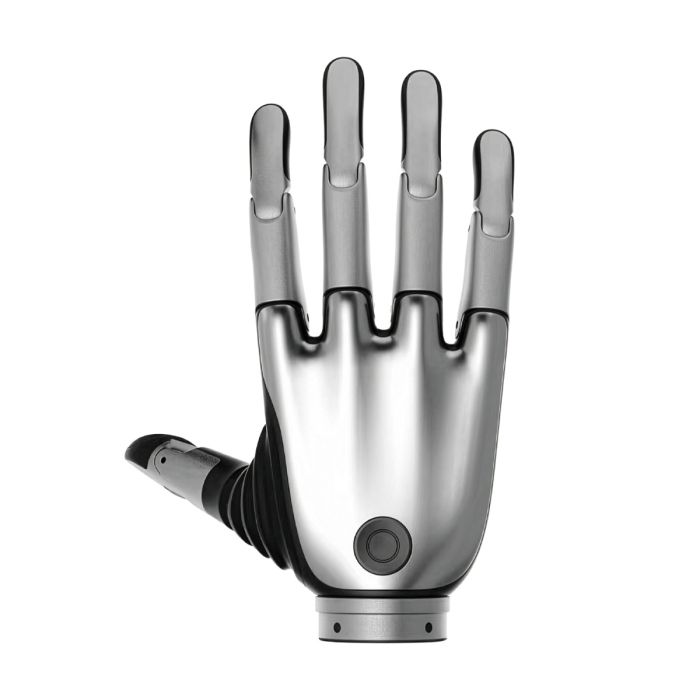
In stock
- BRAND:
- BRAINCO
- MODEL:
- REVO 2 BASIC
- PART #:
- XRL
- ORIGIN:
- China
- Warranty:
- 12 MONTHS
- AVAILABILITY:
- SUBJECT TO AVAILABILITY
- SKU:
- BrainCo-Revo-2-Basic-Left
BrainCo Revo 2 Basic Left Dexterous Bionic Hand (XRL)
Dexterous hands are increasingly marketed as sensor platforms first and mechanisms second, which quietly inverts what most integration projects actually need. Before a fingertip can report pressure, the hand must close repeatably, hold without stalling and answer a controller on a bus the robot already speaks. The BrainCo Revo 2 Basic Left Dexterous Bionic Hand (XRL) makes that older, less glamorous argument: it is, per the published description, a bionic dexterous hand for robot integration and research, offered in its Basic trim with the motion platform intact and the tactile layer deliberately left to the higher trims. For a laboratory or integrator whose perception stack lives in cameras rather than fingertips, that restraint is the point.
Robots Europa, based in Dublin, supplies the Revo 2 Basic Left across the European Union and the DACH region. Quotations, delivery, customs handling and after-sales support for this left-hand unit are arranged directly by Robots Europa, whether you are specifying a single hand for a research bench or a matched pair for a bimanual platform.
Background
From prosthetics to robot end effectors
BrainCo built its reputation in brain-computer interface technology and intelligent prosthetic hands — a field with unforgiving requirements, because a prosthesis must be light enough to wear all day, quiet enough for an office and reliable enough to be trusted with a cup of coffee. That engineering culture carries into the company's robotics line. A dexterous hand developed under prosthetic constraints tends to arrive with compact actuation, restrained operating noise and conservative thermal behaviour already designed in, rather than bolted on after a laboratory prototype proves fragile. The Revo 2 family is the second generation of that transfer from the human wrist to the robot wrist, following the Revo 1 platform into general robot integration.
Where the Basic trim sits in the Revo 2 family
The sources describe three trims of the Revo 2: Basic (version codes XRL/XRR), Pro (XEL/XER) and Touch (XTL/XTR). The XRL covered on this page is the left-hand Basic unit. Across the family the published mechanical story is shared — the sources report 6 active joints within an 11-degree-of-freedom structure — while the trims diverge in electrical envelope and feature set: the Basic is listed with a 12–28V supply where the Pro and Touch are listed at 12–64V, and the Basic draws reported lower static and no-load currents at 24V. The positioning is straightforward: the Basic is the motion-control foundation of the range, communicating over RS-485 or CAN FD, controllable in position, velocity and current with cascaded and compliance control, and protected by current, stall, high-temperature and anti-collision safeguards, all per the published specification.
Technical Specifications
| Specification | Value (Basic, XRL/XRR) |
|---|---|
| Version code | XRL/XRR |
| Degrees of freedom | 11(6 active) |
| Weight | 383 g |
| Height (palm base to middle fingertip) | 160 mm |
| Full fist grip force | ≥50N |
| Pinch force | ≥15N |
| Max payload | ≥20kg |
| Flexion/extension speed | ≤0.65s |
| Operating noise (at 50cm) | ≤50dB |
| Maximum opening and closing distance | 100mm(from thumb to index finger) |
| Repetitive control precision | 0.1° |
| Supply voltage | 12-28V |
| Static current | 65 mA @24V |
| No-load average current | 350mA @24V |
| Maximum current | 4.6 A @24V |
| Communication interface | RS-485 or CAN FD (485, CANfd) |
| Interface connector | BM05B-PASS-TFT(LF)(SN), under the wrist |
| Operating temperature | -10 - 40℃ / 90%RH |
| Default device ID | Left hand 126 (right hand 127) |
| Standard colours | Space Gray, Silver (bulk colour customisation supported) |
All figures are specifications as published from a single source; they should be confirmed against the manufacturer's datasheet at quotation. The manufacturer has not published the width, IP rating, materials, package contents, cable length or rated service life of this hand; these are confirmed at quotation rather than estimated here.
What does the Basic version leave out — and does it matter?
The honest answer is that the Basic leaves out what many projects never use. The trims above it in the range carry the Pro and Touch designations, and the Touch name signals a tactile, biomimetic emphasis; the Basic, by contrast, is specified around motion and control. Yet the published control architecture of the Basic is not a reduced one: position, velocity and current feedback control, cascaded control and compliance control are all listed, together with a reported 0.1° repetitive control precision — the same figure the source table prints for all three trims. Smart protection is likewise listed in full: current, stall, high-temperature and anti-collision protection. A team whose grasp planning is driven by vision, whose force estimates come from motor current rather than fingertip arrays, and whose budget must stretch to two hands rather than one, loses little by starting here. The genuine dividing line is electrical as much as sensory: the Basic's reported 12–28V supply window is narrower than the 12–64V listed for the Pro and Touch, so a platform standardised on a higher bus voltage should weigh the Revo 2 Pro Left (XEL) instead.
How does the XRL fit into an existing robot architecture?
Integration is where this hand makes its case. Per the published specification, the Basic communicates over RS-485 or CAN FD — two of the most widely deployed field buses in robotics — through a connector located under the wrist, model BM05B-PASS-TFT(LF)(SN). Addressing is already resolved for bimanual work: the left hand ships with a reported default device ID of 126 and the right with 127, so a matched pair can share a bus without reconfiguration on day one. On the software side, the SDK is reported to support Python and C and to be compatible with Linux, Windows and ROS, which covers the typical research stack from a quick scripted demonstration to a compiled real-time node. OTA online upgrades are reported to be supported, so firmware can evolve without opening the wrist. For a European laboratory, the practical consequence is that the XRL behaves like a well-mannered bus device rather than a proprietary island: it takes an ID, answers on a standard interface and exposes position, velocity and current control to whatever planner sits above it.
Who is the Revo 2 Basic Left (XRL) for?
The XRL suits three buyers in particular. The first is the humanoid or dual-arm integrator completing a platform: the left Basic pairs with the Revo 2 Basic Right (XRR) to form a bimanual set on a single bus with distinct default IDs. The second is the research group studying grasp synthesis, compliance or imitation learning, for whom the published control modes and the Python/C SDK on ROS are the working surface, and fingertip sensing is optional. The third is the product team prototyping a service or inspection robot that must be quiet in human spaces — the reported ≤50dB operating noise at 50cm matters there. Teams whose work is explicitly tactile — slip detection, in-hand manipulation guided by contact — should look to the Revo 2 Touch Left (XTL), while those needing the wider 12–64V supply window are better served by the Pro trim. The full family, left and right, is gathered in the BrainCo Revo 2 category, alongside our broader range of robot hands.
What is the Revo 2 Basic Left (XRL) used for?
- Bimanual humanoid integration — serving as the left hand of a matched pair on a shared RS-485 or CAN FD bus.
- Grasping and manipulation research — exercising position, velocity and current control modes from Python or C under ROS.
- Imitation learning and teleoperation studies — providing a repeatable five-finger end effector for data collection and replay.
- Compliance-control experimentation — using the reported cascaded and compliance control to study contact-rich tasks.
- Service-robot prototyping — fitting a quiet, human-proportioned hand to robots that work alongside people.
- Engineering education — giving students a documented, SDK-driven dexterous hand for coursework and theses.
Pricing and Availability
Robots Europa does not publish a list price for the Revo 2 Basic Left, because configuration — single hand or bimanual pair, standard or customised colour in bulk, and the accompanying trims — shapes each order. A quotation is prepared for your specific requirement, and delivery, customs clearance and support across the EU and the DACH region are arranged together with that quotation. Requesting a quotation for the BrainCo Revo 2 Basic Left Dexterous Bionic Hand (XRL) is available on this page.
Frequently Asked Questions
Is this the left or the right hand?
This page covers the left-hand Basic unit, version code XRL. The right-hand counterpart is the XRR, and the two are reported to ship with distinct default device IDs — 126 for the left, 127 for the right — so they can share one bus.
Which communication interfaces does the Basic version support?
Per the published specification, the Basic communicates over RS-485 or CAN FD, through a connector under the wrist, model BM05B-PASS-TFT(LF)(SN).
What software support is provided?
The SDK is reported to support Python and C and to be compatible with Linux, Windows and ROS. OTA online upgrades are also reported to be supported.
How does the Basic differ electrically from the Pro and Touch?
The source table lists the Basic at a 12–28V supply voltage against 12–64V for the Pro and Touch, with lower reported static and no-load currents at 24V for the Basic — figures to be confirmed against the datasheet at quotation.
What protections are built in?
The published specification lists current protection, stall protection, high-temperature protection and anti-collision protection.
What are the materials, IP rating and package contents?
The manufacturer has not published the materials, IP rating, width, package contents, cable length or service life; these details are confirmed at quotation.
Where can I buy the Revo 2 Basic Left (XRL) and what does it cost?
The hand is supplied by Robots Europa to customers across the EU and the DACH region. Pricing is provided by individual quotation, requested directly from this page, with delivery and support arranged alongside it.
Summary
The Revo 2 Basic Left makes a disciplined argument in a market that often leads with sensors: get the motion platform, the bus behaviour and the control modes right, and let tactile sensing be a choice rather than a tax. Per the published specification it brings a full 11-degree-of-freedom, six-active-joint hand, RS-485 and CAN FD communication, position, velocity and current control with compliance modes, and a Python/C SDK across Linux, Windows and ROS — with the Pro and Touch trims waiting when a project outgrows it. For European teams building a left hand, or a pair of hands, into their next platform, this page is the starting point.


