
BrainCo Revo 3-21 Basic Robot Hand
In stock
- BRAND:
- BRAINCO
- MODEL:
- REVO 3-21 BASIC
- ORIGIN:
- China
- Warranty:
- 12 MONTHS
- AVAILABILITY:
- SUBJECT TO AVAILABILITY
- SKU:
- BrainCo-Revo-3
BrainCo Revo 3-21 Basic Robot Hand
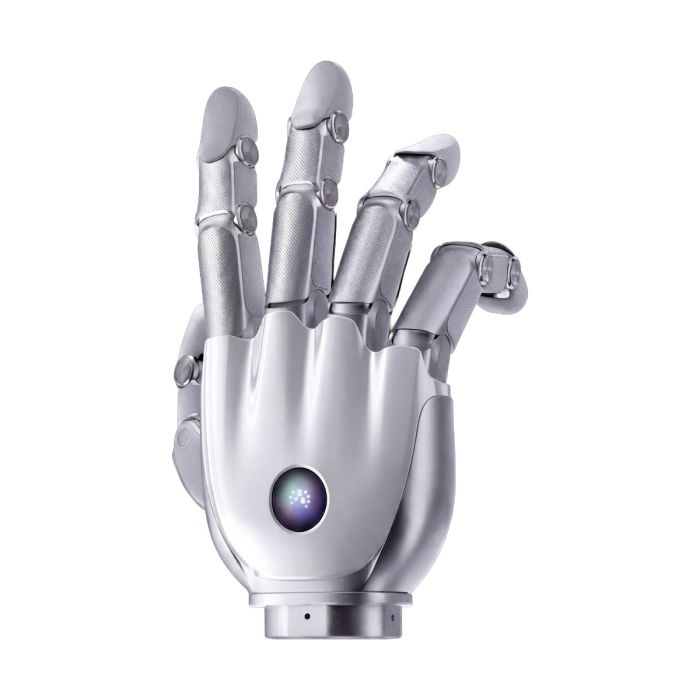
A robot hand can be built to move or built to feel, and the choice decides what the rest of the cell must do. The BrainCo Revo 3-21 Basic Robot Hand is the version that concentrates on movement: 21 independently driven degrees of freedom, direct-driven joints and no tactile sensing on board. For teams that already know how they intend to close the feedback loop, that focus is an advantage rather than an omission.
Robots Europa, based in Dublin, supplies the BrainCo Revo 3-21 Basic Robot Hand to customers across the EU and the DACH region. Robots Europa prepares the quotation, arranges delivery and customs, and provides support after the sale, so that integrators, research groups and industrial buyers deal with one contact from first enquiry to commissioning.
Background
BrainCo and the Revo family
BrainCo was founded in 2015. The company has built its name on technology at the boundary between people and machines, and the Revo range of dexterous hands carries that lineage into robotics. Earlier generations are still part of the catalogue: the BrainCo Revo 1 Intelligent Dexterous Bionic Hand and the Revo 2 hands, such as the BrainCo Revo 2 Basic Right Dexterous Bionic Hand (XRR), show how the platform has developed. Revo 3 is the generation in which every finger joint group receives its own actuator.
The Revo 3 line is organised into versions. The sources name Revo 3 U21, U21F, U21T and U21VT in the manufacturer's table, and the names Basic, Touch and Vision in the market. The page you are reading concerns the Basic version. Its siblings are collected in the BrainCo Revo 3 category.
Positioning and key technology
The Revo 3 is a biomimetic dexterous hand designed for industrial automation, scientific research and advanced robotics manipulation. Its 21 degrees of freedom are all fully active and independently driven: five in the thumb and four in each of the index, middle, ring and pinky fingers. Nothing is coupled through a shared tendon or a passive linkage, so each joint can be commanded on its own.
The joints are direct-driven and backdrivable. In practice this gives rapid response and high control density across all finger segments, and it lets the mechanism follow an external push instead of resisting it. For work in which a finger meets an unknown surface, that behaviour is often more useful than raw stiffness.
The hand is rated for over 1,000,000 joint flex cycles, which matters to anyone who plans to run it through repeated trials or a production shift. On the software side, cross-platform C/C++ and Python SDKs support Linux and Windows, so development can start on the machine a team already uses.
Technical Specifications
The manufacturer's table covers the Revo 3 U21, and its hand dimensions are the same for all four U21 models. Figures for the Basic version come from a reseller listing. Each column below shows the figures for that version only.
| Specification | Revo 3 U21 (manufacturer table) | Revo 3 Basic |
|---|---|---|
| Degrees of freedom | 21, fully active | 21, fully active |
| Hand dimensions | 216 × 108 × 50 mm | 215 × 105 × 50 mm |
| Supply voltage | 16–85 V | 12–80 V |
| Max current | 10 A (24 V) | Not stated |
| Max active grip force | ≥100 N | >70 N |
| Max fingertip pinch force | ≥25 N | Not stated |
| Total hand payload | 20 kg | Not stated |
| Four-finger payload | 5 kg | Not stated |
| Repeatability | 0.1° | Not stated |
| Joint open/close time | 0.33 s | Not stated |
| Max grasping diameter | 150 mm | Not stated |
| Communication interfaces | EtherCAT / CAN FD / RS-485 | Not stated |
| Communication frequency | 500 Hz | Not stated |
| Onboard sensors | IMU (mainboard), temperature (mainboard) | Not stated |
| Tactile sensors | Not stated | Not included |
| Control modes | Not stated | Position / MIT Force-Position / Admittance / Zero-Torque |
| Joint flex cycles | Over 1,000,000 |
Specifications as published by the manufacturer; confirmed against the datasheet at quotation. The manufacturer has not published the weight, the box contents, the IP rating, the operating temperature range or the power consumption; they are confirmed at quotation.
What makes the Revo 3 Basic different from a conventional gripper?
A two-jaw or three-jaw gripper offers one decision: how wide to open and how hard to close. The Revo 3 Basic offers 21. A thumb with five degrees of freedom can oppose each finger in turn, and each of the four fingers can curl, spread and adjust its own posture. A pinch, a wrap and a gentle release become different commands rather than different tools.
The control modes add to that range. Position control suits repeatable, scripted movements. MIT Force-Position blends a target with a compliance setting, admittance lets the hand give way under external load, and zero-torque leaves the joints free so that the fingers can be moved by hand. Because the joints are backdrivable, these modes act on a mechanism that can respond physically, not only numerically.
Connectivity points the same way. The manufacturer's table for the U21 lists EtherCAT, CAN FD and RS-485 at a communication frequency of 500 Hz, which places the hand in the same bus environment as the arms and controllers around it.
What does the Basic version leave out compared with the Touch versions?
The answer is tactile sensing. The Basic version is listed without tactile sensors, so the hand moves precisely but does not report contact across its fingertips. A project that must detect slip, measure contact distribution or react to light touch will need either external sensing or a sibling with the sensing built in.
The BrainCo Revo 3-21 Touch Robot Hand and the BrainCo Revo 3-21 V-Touch Robot Hand are the places to look for that capability. The Basic version, in return, is the straightforward choice where the motion itself is the subject of the work and the sensing is already provided elsewhere in the cell.
One further point concerns the figures. The Basic listing gives a lower active grasping force and a narrower supply voltage window than the manufacturer's U21 table. These are different versions with different figures, and they are kept in separate columns above.
Who is the BrainCo Revo 3-21 Basic Robot Hand for?
Research laboratories are the clearest audience. A university group working on in-hand manipulation, imitation learning or teleoperation needs individually addressable joints and an SDK it can script in Python or C/C++. The Basic version gives that, and a laboratory with its own sensing set-up gains nothing from paying for tactile hardware it will not use.
System integrators building demonstrators or pilot cells form a second segment. They value the Linux and Windows SDKs and the range of control modes of the platform. Developers of humanoid and bimanual systems, who need a hand that mounts on an arm and responds to a high-level policy, will find a natural fit.
Industrial teams with tasks that a gripper cannot do, such as handling small varied parts or operating a tool, may also start here. If the task depends on feeling contact, they should look instead at the Touch or V-Touch versions linked above.
What is the BrainCo Revo 3-21 Basic Robot Hand used for?
- Dexterous manipulation research. Studying grasp planning, in-hand repositioning and learned control with every joint under independent command.
- Humanoid and bimanual platforms. Giving a robot arm a human-scale hand that can take on tasks designed for people.
- Teleoperation and demonstration. Mapping an operator's hand motions onto the fingers, with zero-torque mode allowing a hand to be posed by hand.
- Flexible industrial handling. Picking varied small parts where one fixed gripper would need constant changeovers.
- Compliant interaction experiments. Using admittance and MIT Force-Position modes to test how a hand should yield to contact.
- Teaching and prototyping. Letting students and engineers develop control software on a real 21-degree-of-freedom hand through the Python and C/C++ SDKs.
Pricing and Availability
Robots Europa does not list a price for the BrainCo Revo 3-21 Basic Robot Hand; quotation is the way to proceed. State the version, the quantity and the control interface you intend to use, and Robots Europa will prepare an offer. Delivery, customs and support are arranged together with the quotation. The quotation request is available on this page.
Frequently Asked Questions
How many degrees of freedom does the hand have?
It has 21 fully active, independently driven degrees of freedom. The thumb has five, and each of the index, middle, ring and pinky fingers has four.
Does the Basic version have tactile sensors?
No. The Basic version is listed without tactile sensors. The Touch and V-Touch versions are the siblings to consider where contact sensing is required.
Which control modes are available?
The Basic version lists Position, MIT Force-Position, Admittance and Zero-Torque modes. Together they cover scripted motion, compliant contact and free posing of the fingers.
Which software can I use to program it?
Cross-platform C/C++ and Python SDKs are provided, compatible with Linux and Windows.
Are the joints backdrivable?
Yes. The joints are direct-driven and backdrivable, which gives rapid response and lets the fingers follow an external push.
How durable is the hand?
It is rated for over 1,000,000 joint flex cycles, which suits repeated trials and long working shifts.
Where can I buy the BrainCo Revo 3-21 Basic Robot Hand and what does it cost?
Robots Europa in Dublin supplies it across the EU and the DACH region. The cost is given in a quotation prepared for your configuration, which you can request on this page.
Summary
The BrainCo Revo 3-21 Basic Robot Hand is a hand built to move: 21 independently driven, backdrivable joints, four control modes and SDKs for Linux and Windows, with touch left to other versions or to the cell around it. For laboratories and integrators who know where their feedback comes from, that is a clear and honest proposition. Robots Europa supplies it with quotation, delivery and support arranged together, and this page is the starting point.


